"In the past four years, what we’ve been able to achieve is a unique ecosystem where we have soldiers, where we have startups, where we have volunteers and government agencies all fused together, working on products where you can develop a product from prototype to actual use on the battlefield in a matter of weeks," Ukrainian Ambassador to Australia Vasyl Myroshnychenko told a June 2026 panel at the ASPI Defence Conference. That sentence frames a central lesson from Ukraine now being debated for the Australian Defence Force (ADF): speed, scale and continuous adaptation can themselves be force multipliers.
Vasyl Myroshnychenko on Ukraine’s innovation loop
Myroshnychenko described what he called an “innovation loop from the battlefield information to manufacturing, R&D and then to basically providing it back to the battlefield.” He said long-range missiles could be produced in around 18 months, and warned that the critical advantage lay not in a single invention but in how quickly systems were adapted: “The key is ‘not how you innovate but how quickly you adapt to change, because three months later it becomes obsolete.’”
His account highlighted a dispersed ecosystem — soldiers, startups, volunteers, government agencies — that shortened the time from prototype to frontline use from months or years to weeks. For Australia, he argued, replicating that tempo would be difficult in peacetime but necessary given the international security pressures he described.
Semi-autonomous uncrewed systems as a path to combat mass
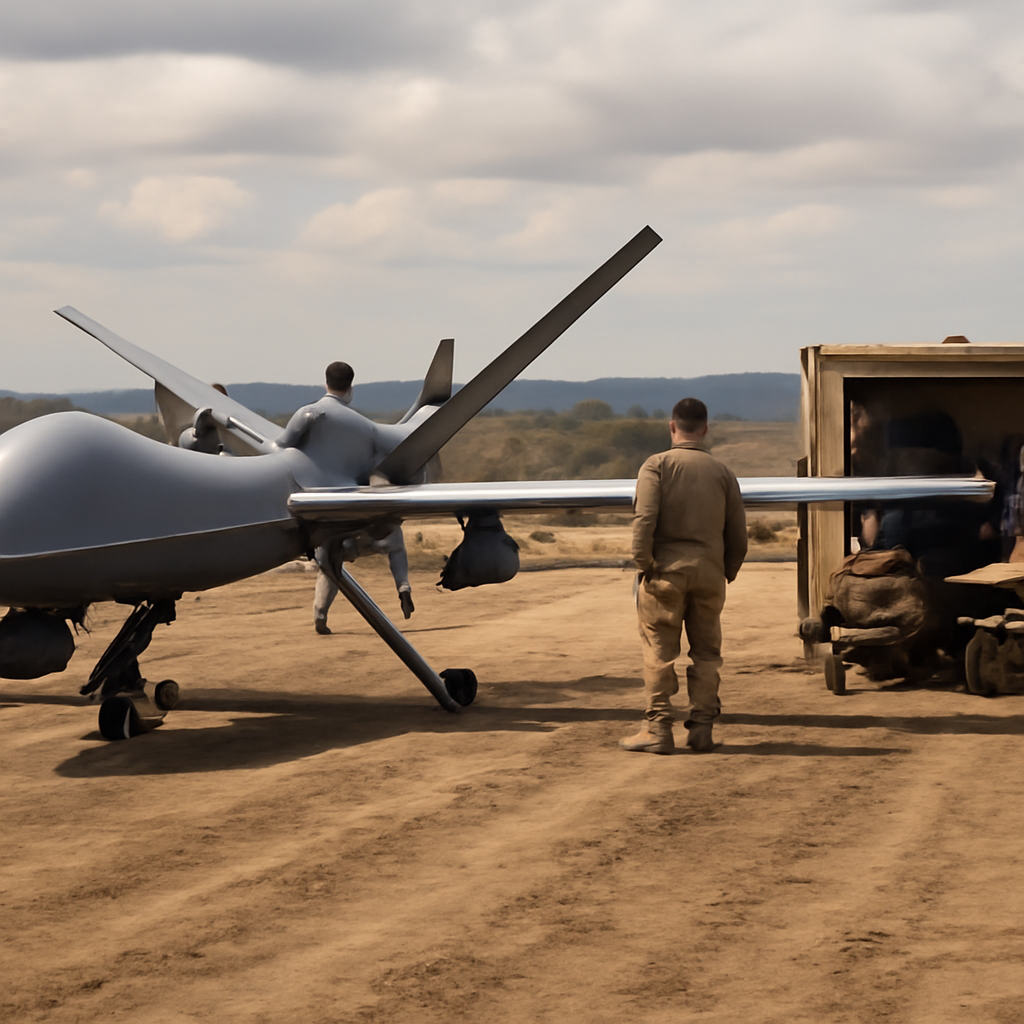
The panel explored how acquiring semi-autonomous uncrewed systems in volume could create operational mass across the Indo-Pacific. The argument is straightforward: modern defence procurement has emphasised small numbers of highly capable crewed platforms, but semi-autonomous systems can be acquired at lower per-unit cost, in larger numbers, and modernised continually to keep pace with rapid innovation cycles.
That approach promises “quantitative superiority and military effects in the right place and right time.” The panel connected this to operational realities: contested environments with degraded communications and denial of critical capabilities such as GPS mean autonomy — not remote, human-in-the-loop control — may be necessary for timely battlefield decisions.

Audit-ready is a season. It shouldn't be.
Evidence in spreadsheets, controls drifting between audits, frameworks multiplying on flat headcount. Nubivance runs continuous compliance on Rapid7 Cyber GRC - SOC 2, HIPAA, ISO 27001, PCI, CMMC.
End the scrambleShield AI, Mark Palmer, and devolving decisions to the front line
Mark Palmer, vice president at Shield AI Australia, drew directly on Shield AI’s experience in Ukraine to argue for moving decision-making forward. He said their work “allowed us to put some of the decision making into the front line.” The implication is that semi-autonomous systems must be designed to operate with less centralised human control — people “on the loop” rather than “in the loop” — so that autonomy can make mission decisions in fast-moving, contested environments.
Palmer also cautioned that autonomy itself must evolve. “If it’s autonomy that doesn’t evolve, doesn’t change, it can actually become a weakness,” he said. Continuous iteration — updating both tactics and software to meet enemy adaptations — was presented as central to maintaining effectiveness.
Air Vice‑Marshal Nicholas Hogan on industry scale and social licence
Air Vice‑Marshal Nicholas Hogan, head of air force capability, addressed the industrial and societal dimensions. He said industry needs time “to get industry right,” after which it can “pump out at mass and then decrease the per‑unit cost.” Equally, he framed cultural and political constraints as the other major barrier: “The barrier from our side of the house is looking at the way we culturally adapt, because data isn’t the problem. It’s the software, and the amount of autonomy that we allow us to take on with the social licence that may be granted to us by the Australian public.”
Hogan therefore placed responsibility not only on manufacturers and the ADF but on broader public acceptance of increased autonomy in military systems.
What this means for the ADF, Australian industry, and the Australian public
- The ADF: Must consider doctrinal and command changes to “devolve that decision‑making on how best to use autonomous systems down the chain of command,” while remaining compliant with obligations under international humanitarian law and political oversight requirements.
- Australian industry: Faces a twofold task — to adapt production models so units can be produced rapidly and at scale, and to embed continuous modernisation so autonomy and software keep pace with battlefield evolution.
- The Australian public: Is asked to weigh social licence for greater autonomy in military operations. Myroshnychenko argued the starting point is a frank national conversation about the prospect of future conflict and the need to adapt in peacetime.
The central tension running through the panel is clear: technology can deliver mass and tempo, but only if institutions, industry and society are prepared to alter procurement rhythms, command arrangements and public expectations. Ukraine’s experience, as described by Myroshnychenko and discussed by panelists, shows that speed, iteration and an ecosystem linking battlefield feedback to manufacturing can reshape warfare. The question for Australia is whether those adjustments will be embraced before circumstances — not least the strategic pressures mentioned on the panel — force them into place.
https://www.aspistrategist.org.au/learning-from-ukraine-semi-autonomy-can-deliver-combat-mass/