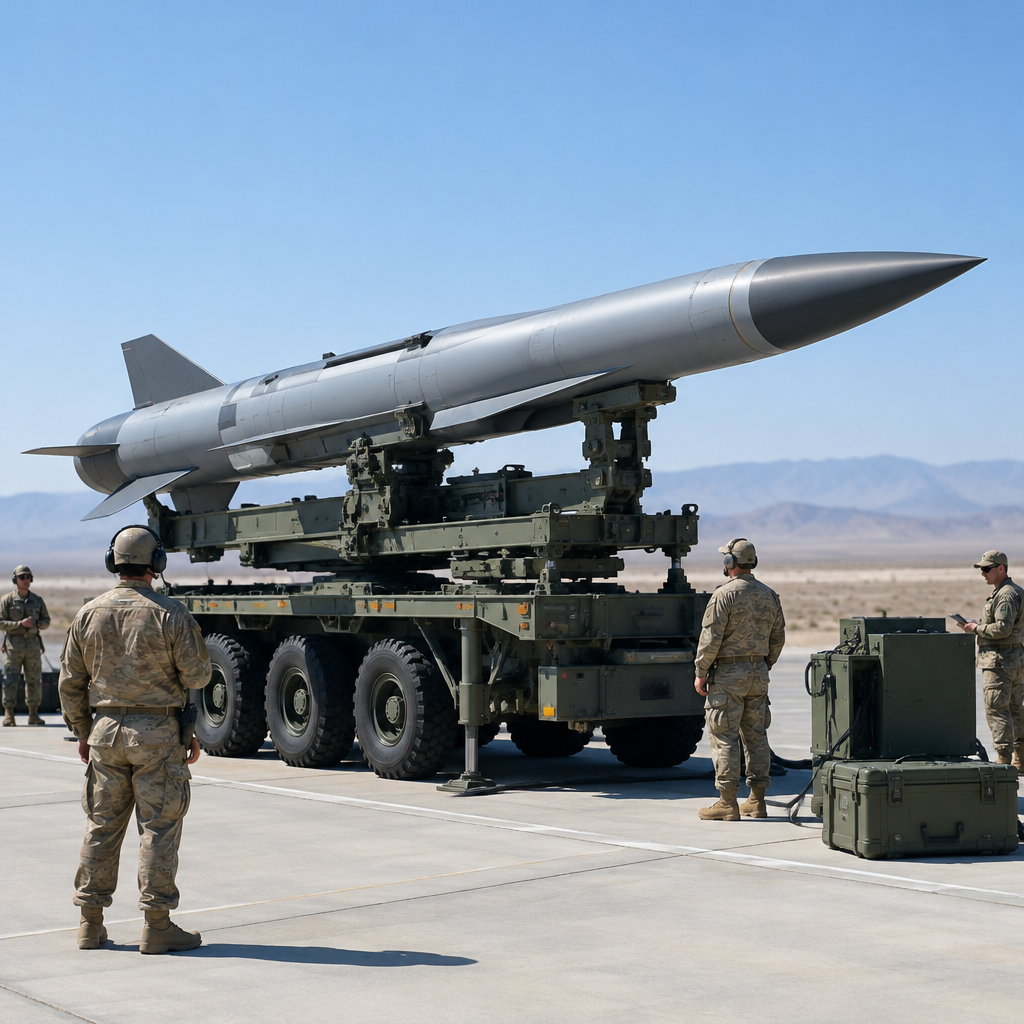
The Stockholm International Peace Research Institute’s 2026 yearbook estimates that China’s nuclear stockpile “reached about 620 warheads in January and will grow over the coming decade,” a figure the Bulletin of the Atomic Scientists has reached independently — and those numbers change the arithmetic for Canberra’s defence policy.
How a growing Chinese arsenal and the end of treaty limits reshape the region
The region’s strategic environment is shifting. The source notes new missiles “loaded into vast new silo fields in the north of the country,” and warns that the Indo‑Pacific is entering “a three‑way nuclear competition with no rulebook.” Compounding that, the source says New START “expired in February, leaving no constraints on warhead numbers for the first time in half a century.” Taken together, those facts convert nuclear capability growth into a structural problem for states that have relied principally on conventional deterrence.
Why deterrence by denial is incomplete for Australia
Canberra’s stated strategy of deterrence by denial aims to make a conventional campaign against Australia’s northern approaches costly. But the source argues that it “says nothing about what happens when the contest goes up the escalation ladder.” A nuclear‑armed adversary, the argument runs, can blunt conventional strength by threatening to escalate past it. In that logic, conventional strike options that can be neutralised by nuclear coercion “are not a deterrent.”

Audit-ready is a season. It shouldn't be.
Evidence in spreadsheets, controls drifting between audits, frameworks multiplying on flat headcount. Nubivance runs continuous compliance on Rapid7 Cyber GRC - SOC 2, HIPAA, ISO 27001, PCI, CMMC.
End the scrambleAUKUS, bomber rotations and the limits of ambiguity
The source urges Australia to move from a largely passive role — “accept the umbrella, host joint facilities, say little” — to one of explicit support for allied nuclear forces operating from Australian territory. Under AUKUS, the source records, “up to four US submarines and one British submarine will operate for extended periods from Western Australia.” It also notes that “US nuclear‑capable bombers already rotate through northern airfields under a reading of the Rarotonga Treaty that bars stationing but permits visits.” The recommendation is straightforward: visible support is a signal; ambiguity is a vacuum.
Pine Gap, Naval Communication Station Harold E Holt and hardening the backbone
The source identifies specific Australian facilities central to US nuclear command, control and communications: Pine Gap and Naval Communication Station Harold E Holt. It warns these facilities “could be attacked from submarines operating in Australia’s northern approaches,” and that “a conventional strike on them could blind or confuse allied nuclear decision‑making in the opening hours of a crisis.” The prescription is equally concrete: harden and defend the facilities where conventional investment and nuclear deterrence intersect.
What this means for Canberra, Washington, and Tokyo and Seoul
- Canberra: The source recommends a formal mechanism to coordinate deterrence strategies with allies, noting that Japan and South Korea already have comparable forums — the Extended Deterrence Dialogue and the Nuclear Consultative Group. It urges Australia to build a mechanism that “ideally, links these existing mechanisms and expands them into a wider Indo‑Pacific consultation,” giving Australia a seat at planning tables for nuclear escalation scenarios.
- Washington: The source frames US extended nuclear deterrence as Australia’s “best protection against nuclear escalation,” but stresses that extended deterrence “is not a static guarantee” — it must be “renewed, demonstrated and shared.” That implies a need for visible, operational ties and collective planning to sustain credibility.
- Tokyo and Seoul: The source records shifts in domestic and policy signalling. It says Japanese Prime Minister Sanae Takaichi “has declined to rule out revisiting the principle that bars nuclear weapons from Japanese territory,” and that “her defence minister has called for a debate without taboos.” In South Korea, a poll taken in August after “Washington abruptly scaled back joint military exercises found that 65 percent of respondents wanted their country to have its own nuclear weapons.” These developments underscore regional pressure on existing extended‑deterrence arrangements.
Critics, the source concedes, will warn that closer coupling to allied nuclear forces risks an arms race or damages non‑proliferation credentials. The counter in the source is blunt: “the arms race is already under way.” At the 2025 Shangri‑La Dialogue, Defence Minister Richard Marles described US extended nuclear deterrence as a “critical if under‑sung asset” against proliferation — and the author adds, “Under‑sung is precisely the problem.”
The practical policy choices the source offers are modest and specific: build a formal consultative mechanism, make geography count by openly supporting allied nuclear forces’ operations from Australian territory, and harden the command‑and‑control facilities that underpin the American umbrella. Those steps would not produce a bomb in Australia’s hands, the source emphasises, but they would move Canberra from passive reliance to active shaping of the regional deterrence architecture.