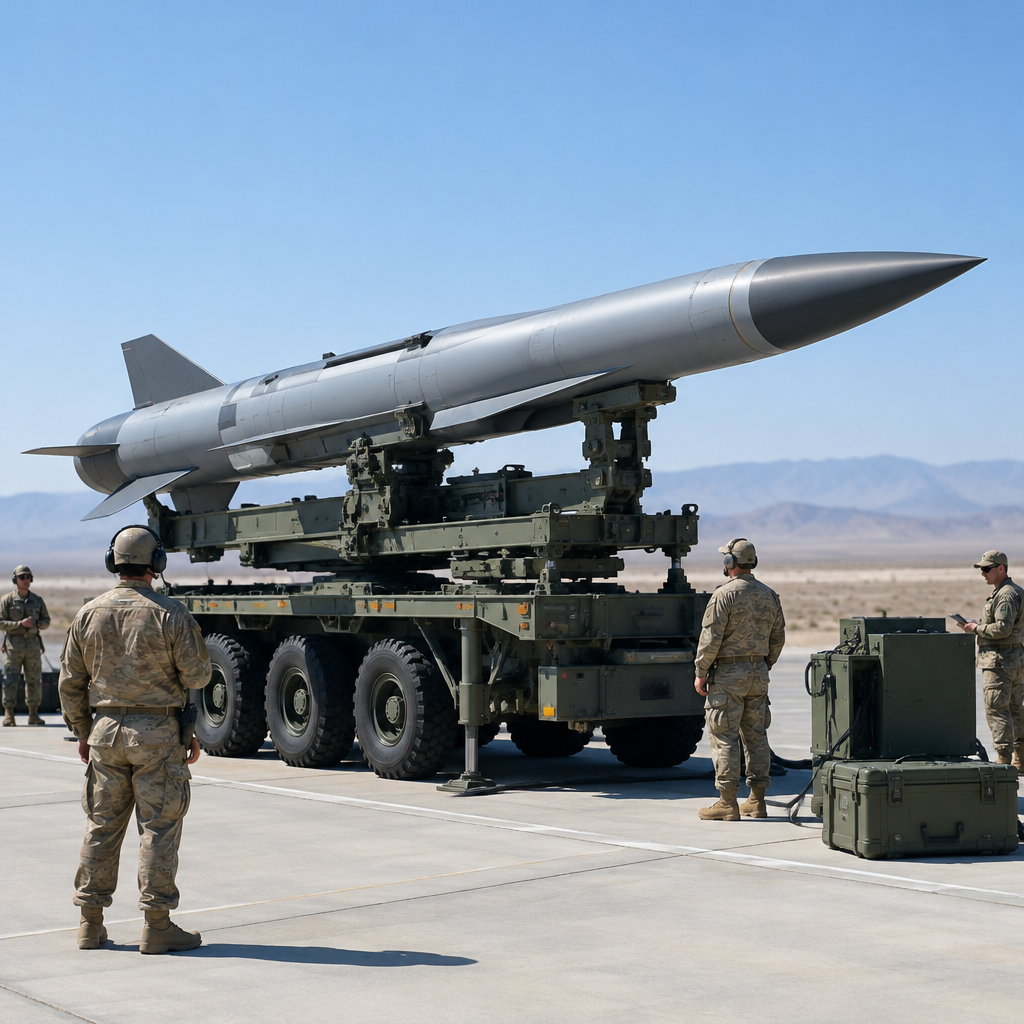
"The Fatah 3 is equipped with advanced navigation and propulsion systems, and is capable of engaging targets at long range with high precision and lethality at supersonic speed," the Inter Services Public Relations office said on 18 November after the Army Rocket Force Command successfully test-fired the missile.
What the Pakistan Army announced on 18 November
The Army Rocket Force Command (ARFC) publicly reported a successful test-fire of the Fatah 3 supersonic-cruising missile (SSCM) on 18 November, according to an ISPR press release. The announcement described the Fatah 3 as the latest addition to the ARFC’s inventory of long-range, precision-guided surface-to-surface missiles intended for conventional strikes. The ARFC's launch count for 2026 reached five tests with this event, and the test was the command's sixth overall since the ARFC was formed in 2025.
Technical lineage: HD-1C, Poly Technologies, and industrial arrangements
Images and prior disclosures link the Fatah 3 to the HD-1 family of missiles marketed by Poly Technologies. The Army first revealed the Fatah 3 publicly in March 2024 during the National Day Parade, when an announcer stated the missile would have a range of 450 km. In May 2026 a Pakistan Army video showed a missile resembling the HD-1C variant, confirming the Fatah 3 as an SSCM.
The HD-1 was developed by the Guangdong Hongda Mining Company and shown publicly at the 2018 Zhuhai Air Show; Poly Technologies took on marketing of the HD-1 family in 2022 and promoted sub-variants including a surface-launched HD-1C and an air-launched HD-1A. The article cites the Hongda HD-1A specification sheet and CSIS Missile Threat as reference materials for the HD-1 family, noting that HD-1C specifications have not been published and that HD-1A figures serve as the closest available benchmark.
Given how sensitive solid-fuel ramjet technology is, the reporting frames the likeliest industrial arrangement as co-production: China supplying engines while Pakistan's National Engineering and Scientific Commission (NESCOM) carries out assembly, integration, and subsystem manufacturing. It also notes the possibility—over time—that NESCOM could develop its own solid-fuel ramjet technology by building from the HD-1 family, analogous to NESCOM’s earlier development of rocket motors for the Fatah-1 and Fatah-2 lines.

Audit-ready is a season. It shouldn't be.
Evidence in spreadsheets, controls drifting between audits, frameworks multiplying on flat headcount. Nubivance runs continuous compliance on Rapid7 Cyber GRC - SOC 2, HIPAA, ISO 27001, PCI, CMMC.
End the scrambleHow the Fatah family fits into the ARFC’s strike mix and operational logic
The ARFC’s strike mix has expanded rapidly. With the induction of the Fatah-3, the ARFC now fields guided artillery rockets (Fatah 1), conventional ballistic missiles (Fatah 2 and Fatah 2-ER), subsonic cruise missiles (Fatah 4 and Fatah 4-ER), and supersonic-cruising missiles (Fatah 3). The Army will continue to deploy lower-cost, more scalable options such as the Fatah 2 ballistic missiles, subsonic Fatah 4 cruise missiles, turbojet-powered small subsonic cruise missiles, and piston-powered long-range loitering munitions as tools to saturate air-defence systems.
The fielding logic the article outlines is binary: either build stronger defensive layers to intercept incoming SSCMs, or build an analogous offensive capability so an adversary faces the same challenges. Pakistan’s approach, as described in the reporting, has pursued both lines across services—adding SSCMs to its arsenal while also investing in air-defence systems.
Pakistan Navy, Pakistan Air Force, and satellite targeting investments
The report situates the Fatah-3 alongside other recent acquisitions and developments. The Pakistan Navy (PN) had previously acquired the CM-302 SSCM for shipborne use and strengthened shipborne air defences with the CAMM-ER/Albatros-NG from MBDA Italy. The Pakistan Air Force (PAF) invested in short-range HQ-17AE and medium-to-long-range HQ-16FE SAMs from China to bolster defensibility layers; however, the article notes it is unclear whether HQ-16FE deliveries to Pakistan have occurred, since that system was only recently inducted into PLA service.
Separately, Pakistan is expanding its satellite-based targeting architecture. A deal with China’s PIESAT for a constellation of interferometric synthetic aperture radar (InSAR) satellites is cited as a concrete example of investment in space-based targeting. The reporting frames these procurement and satellite initiatives as complementary: more diverse and denser strike options on the ground, and improved targeting from space.
What this means for the Pakistan Army, Pakistan Navy, and Pakistan Air Force
- Pakistan Army: Gains a supersonic-cruising surface-launched capability analogous to other regional SSCMs, expands the ARFC’s operational toolkit, and increases options for volume and high-speed strikes through a combined mix of SSCMs, subsonic missiles, and loitering munitions.
- Pakistan Navy: Already fields the CM-302 at sea and may view the Fatah-3 as a coastal or auxiliary option, though the PN appears interested in lighter subsonic anti-ship missiles for future surface combatants.
- Pakistan Air Force: Continues to pursue layered air-defence investments (HQ-17AE, HQ-16FE) to blunt SSCM threats even as Army strike capabilities grow; readiness to counter higher-volume SSCM attacks is a stated operational concern informed by prior conflict experience.
The test confirms that Pakistan’s ARFC is building both depth and variety into its surface-strike options. Several concrete uncertainties remain in the public record: whether Pakistan is manufacturing the Fatah-3 wholly domestically or under a co-production arrangement with Chinese-supplied engines; the delivery status of the HQ-16FE SAMs to Pakistan; and the technical details of the Fatah-5 the Army said was also tested. Each of those questions will determine how quickly the ARFC’s new capabilities translate into operational change.
Source: Quwa — Pakistan Army Test Fires Fatah 3 Supersonic Cruise Missile