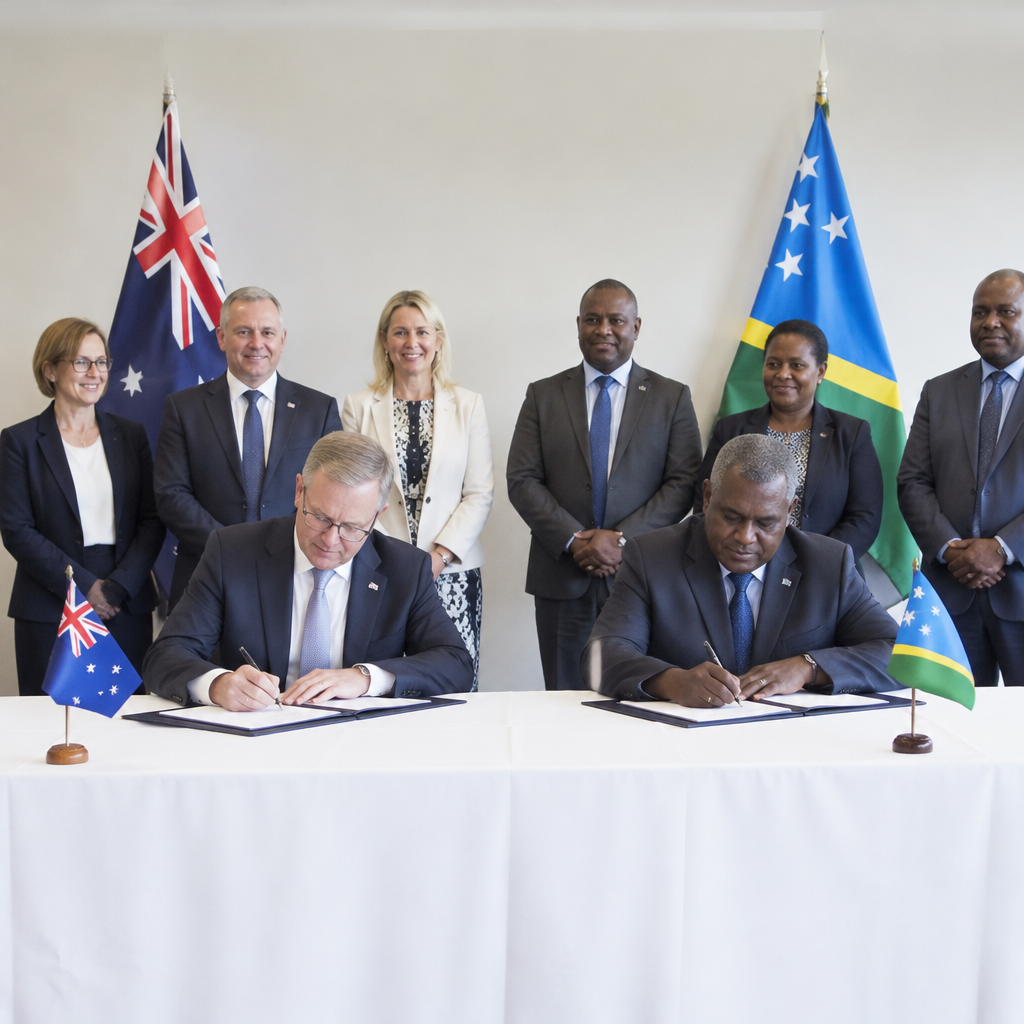
"a major step towards ending the uncertainty that had characterised his country’s regional relationships," Wale said of the new treaty.
The signing on 25 November and the rapid strategic pivot
The Australia–Solomon Islands Treaty, signed on 25 November, capped a six‑month period in which Honiara’s strategic orientation changed markedly. That window began when Matthew Wale became prime minister in May and moved quickly to rebuild ties with Australia, reversing the China‑favouring approaches of former prime ministers Manasseh Sogavare and Jeremiah Manele. Canberra’s diplomatic and official engagement capitalised on persistent trust and goodwill in Honiara and unease with the previous orientation.
The package: A$740 million over 10 years and program priorities
According to a government source, the treaty provides A$740 million to Solomon Islands over 10 years. Much of that funding is targeted at building human capital, including support for Wale’s free education policy. Other stated priorities include health, infrastructure, energy, connectivity, climate resilience, governance and employment, and expanded opportunities under the Pacific Australia Labour Mobility scheme for temporary work in Australia.
Provisions on transparency, accountability, corruption prevention and nationally determined priorities aim to make assistance sustainable and to strengthen institutions. The treaty ties previously opaque Constituency Development Funds to public management initiatives supported by the World Bank—an explicit attempt to raise program standards that the source material argues narrower foreign interests will find difficult to match.

This site is the portfolio.
OSINTSights runs on Cloudflare Workers, D1, R2, and Vectorize, with an AI pipeline on Hetzner ARM. Nubivance designed, built, and operates it. We do the same for clients.
See what we buildSecurity architecture: no bases, intelligence cooperation, and Article 5 clause 5c
Strategically, Solomon Islands sits roughly 2,000 km northeast of Australia—territory Canberra has long regarded as consequential. The treaty reaffirms Australia’s role as the Solomon Islands’ primary security partner, commits to strengthening intelligence cooperation and the Royal Solomon Islands Police Force (noting there is no military), and provides for consultation on sensitive infrastructure and security cooperation with countries outside the Pacific Islands Forum.
Critically, the treaty affirms Solomon Islands’ sovereign decision that there will be no foreign military or security bases on its territory and contains Article 5, clause 5c to “ensure security cooperation comes from Pacific Islands Forum members.” The source frames that clause as likely behind the reported decision by Wale’s government not to renew the 2022 Solomon Islands–China security agreement when it expires in April 2027, since Australia is a Forum member and China is not.
How this fits Canberra’s two‑speed China policy and regional integration agenda
The treaty is presented in the source as the latest in a run of diplomatic and security agreements: deals with Tuvalu, Nauru and Vanuatu, and alliances with Papua New Guinea and Fiji. Canberra’s approach is described as a two‑speed China policy—public‑facing diplomatic outreach coupled with a “behind‑the‑scenes security and deterrence posture” for where disagreement is necessary. The integration agenda the source describes links Australia’s security to the prosperity and institutional strength of its Pacific neighbours and emphasises long‑term stability through economic opportunity, institutions and human development.
The report recalls Australia’s experience with the Regional Assistance Mission to Solomon Islands (RAMSI), which ran from 2003 to 2017 and cost about A$3 billion, noting the deaths of Australian Protective Service Officer Adam Dunning and Private Jamie Clark during that mission as reminders of the human costs of securing peace.
How it lands for the Solomon Islands government, Australia and Beijing
- Solomon Islands government: The treaty is framed as delivering economic, development and institutional support and a “trusted security partner.” Wale signalled its domestic importance by calling it a major step to end years of regional uncertainty; the agreement also ties assistance to transparency and World Bank‑backed public management reforms.
- Australian government: Canberra gains an explicit affirmation of its role as the primary security partner and a formal mechanism to consult on sensitive infrastructure and external security cooperation. The source argues a stable, capable and friendly Solomon Islands is vital to Australia’s security and broader interests in a peaceful, prosperous and resilient Pacific.
- Beijing: The source predicts Beijing will respond. It states China retains economic interests, political relationships and the capacity to cultivate influence, and that those ties were likely mobilised in the motion of no confidence filed against Wale in August. The treaty’s institutional and transparency conditions are presented as standards that narrower foreign interests will find difficult to meet.
The treaty sets a detailed framework: substantial long‑term aid, institutional conditions, explicit security cooperation terms and a clear political signal that Solomon Islands intends to anchor security ties within Pacific Islands Forum membership. Yet the source closes with a caution drawn from the region’s history—permanent contest for influence guarantees impermanence. Australia, the piece argues, cannot rely solely on a diplomatic achievement; it must show the partnership improves Solomon Islanders’ lives, respects their sovereignty and responds to their priorities if the treaty is to deliver the stability Canberra seeks.