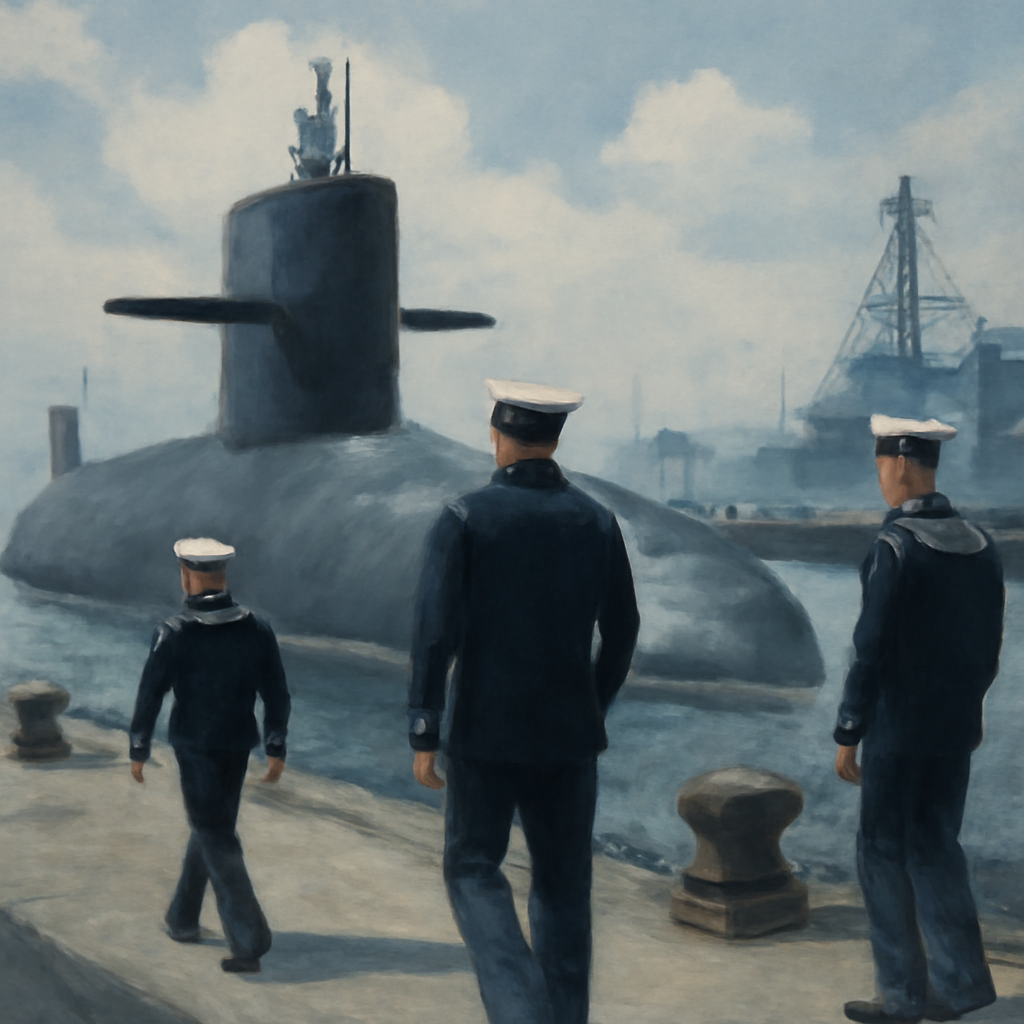
"The disproportional impact of a nuclear-powered submarine in combat is remarkable." — Vice Admiral Mark Hammond
Vice Admiral Mark Hammond’s case for SSNs
At the ASPI Defence Conference on 25 June, Vice Admiral Mark Hammond, the chief of the Royal Australian Navy and soon-to-be chief of the defence force, framed nuclear-powered submarines (SSNs) as a decisive instrument for multi-domain deterrence. He pointed to two historical combat examples to illustrate the point: the 1982 sinking of the Argentinian cruiser General Belgrano by HMS Conqueror, and a more recent engagement earlier this year in which "one US nuclear-powered submarine [sank] an Iranian frigate." In both cases, Hammond argued, surface fleets withdrew or sheltered after the engagement, demonstrating what he called the disproportionate effect an SSN can have on opposing naval forces.
AUKUS Pillar One Optimal Pathway: boats, timeline, and build site
Hammond linked the operational argument directly to Australia’s acquisition plan under the AUKUS Pillar One Optimal Pathway and the 2026 National Defence Strategy. Under that pathway, Navy will receive an initial fleet of conventionally armed but nuclear-powered submarines: "first three Virginia-class SSNs in the 2030s (potentially two more later)" followed by submarines of the SSN-AUKUS class "beginning in the 2040s." The SSN-AUKUS boats are slated to be built at Osborne in South Australia. Hammond presented this transition as central to enhancing Defence’s ability to undertake a stated strategy of denial.

Audit-ready is a season. It shouldn't be.
Evidence in spreadsheets, controls drifting between audits, frameworks multiplying on flat headcount. Nubivance runs continuous compliance on Rapid7 Cyber GRC - SOC 2, HIPAA, ISO 27001, PCI, CMMC.
End the scrambleHow SSNs alter the denial equation: endurance, speed, and joint effects
Hammond stressed that SSNs increase the uncertainty and cost faced by any adversary seeking to project power into Australia's approaches. Compared with diesel-electric submarines such as the Collins class, he said SSNs offer "high-speed transit, far greater manoeuvrability and speed in any tactical engagement ... and much greater endurance on station." Those attributes, combined with the ability to hold adversary naval forces "on or below the surface" at risk, form the backbone of the denial argument in the 2026 National Defence Strategy.
The vice admiral also portrayed SSNs as part of a joint, layered capability: they would be integrated with long-range strike by the Royal Australian Air Force, possible Australian Army littoral operations, sovereign space capabilities, and the navy’s surface combatants. In Hammond’s phrasing, SSNs contribute to "an ability to create uncertainty for an adversary seeking to project power against our continent."
Uncrewed underwater vehicles: Ghost Shark, Speartooth, and mass effects
Hammond underscored that SSNs are not intended to operate alone. He emphasised pairing submarines with uncrewed underwater vehicles — named examples include Ghost Shark and Speartooth — to achieve both reach and mass. "In numbers" these uncrewed systems, he said, "can be everywhere else that matters," while SSNs provide "responsiveness at speed in the most survivable of capabilities." Together, the combination is meant to let crewed submarines focus on high-value tasks while uncrewed systems undertake "the dangerous, the dirty and the dull missions."
Hammond also noted a specific mission set for this combined force: supporting maritime surveillance, exploiting secure communications to share information with other ADF units, countering efforts to threaten vital sea lanes of communication, and "disrupt[ing] any attempt to attack submarine cables running through maritime chokepoints."
What this means for the Royal Australian Navy, the Australian Defence Force, and potential adversaries
- Royal Australian Navy: The SSN transition is portrayed as a structural change in capability for a service charged with safeguarding "the third largest exclusive economic zone in the world." Hammond framed SSNs and uncrewed systems as the means to give the navy both survivability and speed across Australia’s "extreme maritime approaches."
- Australian Defence Force (joint planners): The ADF gains a tool for a strategy of denial as articulated in the 2026 National Defence Strategy — a capability intended to raise the cost and uncertainty of maritime power projection against Australia, particularly when integrated with air, land, space and surface forces.
- Potential adversaries and coercive strategies: Hammond pointed to two pressures the SSNs are meant to counter — direct power projection (citing last year’s deployment by China of two naval task groups, including an unannounced live-fire exercise in the Tasman Sea) and off-shore coercion aimed at disrupting maritime trade routes. In his formulation, SSNs raise the risk for any force attempting either course.
Hammond’s argument is emphatic but measured: SSNs are "extremely difficult and extremely expensive to neutralise, let alone locate," yet they are "not, by themselves, a complete solution." The Optimal Pathway — initial Virginia-class boats in the 2030s, SSN-AUKUS in the 2040s, and a buildup of uncrewed systems — is presented as a calibrated mix to deliver responsiveness, survivability and mass across Australia’s maritime approaches. Whether that mix arrives on schedule and delivers the layered denial Hammond describes is the central operational test implicit in his message.
https://www.aspistrategist.org.au/how-australian-ssns-will-fit-into-multi-domain-deterrence/