"Transitions of major defense production programs from one manufacturer to another are inherently complex," AM General President and CEO John Chadbourne said in a company statement defending the A2 variant of the Joint Light Tactical Vehicle (JLTV) after lawmakers moved to reduce funding for the program.
AM General frames delays as a difficult handoff
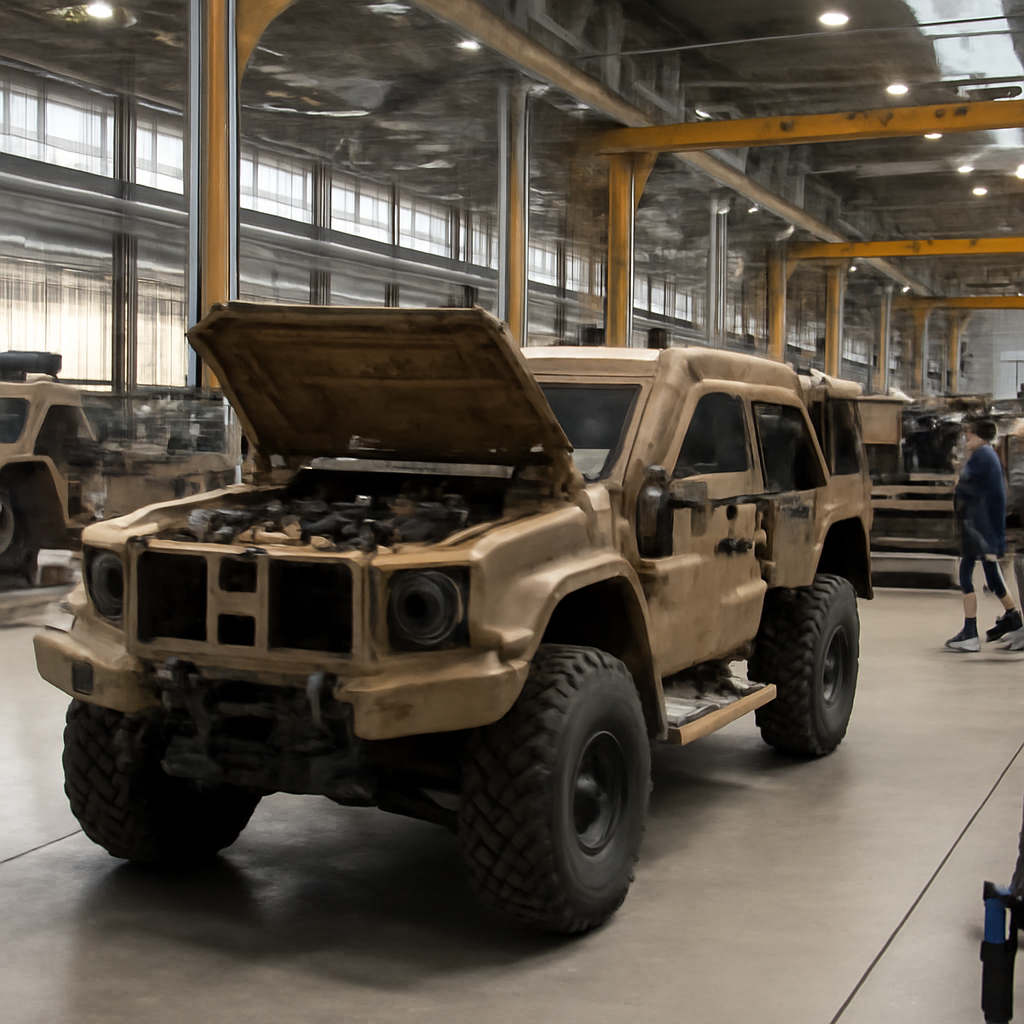
AM General acknowledged delivery delays for the JLTV A2 and placed responsibility on the challenges of moving production from one supplier to another. In its press release, the company said the A2 transition "proved especially challenging due to the unforeseen condition of the technical baseline we inherited, the engineering effort required to mature the design for production, and supplier transition issues encountered during execution."
Chadbourne added that these "unforeseen conditions 'complicated the transition and required our team to take substantial corrective action.'" AM General said it intends to reach full-rate production by 2027 and argued the A2 is not merely a variant but "the next evolution" of the JLTV, offering "a more capable, more dependable vehicle while reducing lifecycle costs for the Department of Defense." The company also stated that "following an extensive evaluation, Army acquisition professionals determined that AM General offered the best overall value to the government."
House appropriators propose cutting $133 million and reprogramming it
House appropriators on the defense subcommittee told staff drafting the Defense Appropriations Act they would reduce $133 million from the proposed $245 million set aside for JLTV A2 production and reallocate the money to buy non-developmental JLTVs and trailers. The committee said it "remains seriously concerned by significant delays in JLTV A2 production and the resulting delays, specifically in fielding to Marine Expeditionary Units and Marine Littoral Regiments."
The appropriators said production is "more than 20 months behind schedule, with approximately 2,000 vehicles in arrears," and called pursuit of a non-developmental, rapidly fieldable source "a prudent step to mitigate program risk and preserve the Marine Corps’ ability to meet its 12,500-vehicle requirement." The committee's recommendation explicitly ties a reduction in JLTV A2 funding to an increase for nondevelopmental JLTVs and trailers in the accompanying funding tables.

Audit-ready is a season. It shouldn't be.
Evidence in spreadsheets, controls drifting between audits, frameworks multiplying on flat headcount. Nubivance runs continuous compliance on Rapid7 Cyber GRC - SOC 2, HIPAA, ISO 27001, PCI, CMMC.
End the scrambleMarine Corps request and Army acceptance figures underscore operational pressure
The Marine Corps last month issued a request for information seeking a potential second supplier for JLTVs, saying it is looking for "rapidly fieldable" commercial off-the-shelf and/or non-developmental items in the JLTV family and trailers. That solicitation followed concern over fielding delays cited by appropriators.
An Army spokesperson told Breaking Defense that, as of June 12, the service had accepted deliveries of 82 trucks and 303 trailers. The same Army spokesperson noted that because the JLTV program had previously reached full-rate production under Oshkosh Defense, "a second full-rate production decision was not required" for AM General's entry.
Oshkosh offers to supply A1s as a rapid fielding option
Oshkosh Defense — the original and incumbent JLTV supplier for the Army's A1 variant — told Breaking Defense it intends to compete to fill near-term demand with its fielded A1 model. Logan Jones, chief growth officer for Oshkosh Defense, said, "In moments like this, second-source capacity is not about revisiting the past. It's about reducing readiness risk now."
Jones added that Oshkosh "stands ready to support the Department's tactical wheeled vehicle requirements with fielded JLTV experience, mature manufacturing capability, and a supply base that has already delivered at scale," language aimed at presenting a non-developmental, rapidly fieldable option for services facing shortfalls.
What this means for the Marines, the Army, and AM General
- Marines: The service's RFI for non-developmental JLTVs and trailers and the appropriators' emphasis on fielding to Marine Expeditionary Units and Marine Littoral Regiments signal urgency to close the cited readiness gaps; the Marines will evaluate proposals that can be "rapidly fieldable" rather than development-heavy solutions.
- Army acquisition and logistics planners: With the Army having accepted 82 trucks and 303 trailers as of June 12 and the Army spokesperson saying a second full-rate decision was not required, planners must weigh continuing with the A2 transition timeline versus procuring additional non-developmental inventory to meet near-term needs.
- AM General: The company has acknowledged corrective action and set a full-rate production target of 2027 while defending the A2 as a next-generation vehicle that reduces lifecycle costs—a commercial and programmatic argument it will need to sustain if Congress enacts funding cuts proposed by House appropriators.
The dispute now turns on funding decisions in the appropriations process, the Marine Corps' evaluation of non-developmental solutions, and whether AM General can close the production shortfall before policy makers reallocate funds. AM General is projecting a path to full-rate production by 2027, the appropriators have quantified both the proposed cut — $133 million — and the shortfall they cite — roughly 2,000 vehicles — and the Marine Corps has signaled willingness to consider quickly fielded alternatives. Those three facts will shape the next chapter for the JLTV fleet.