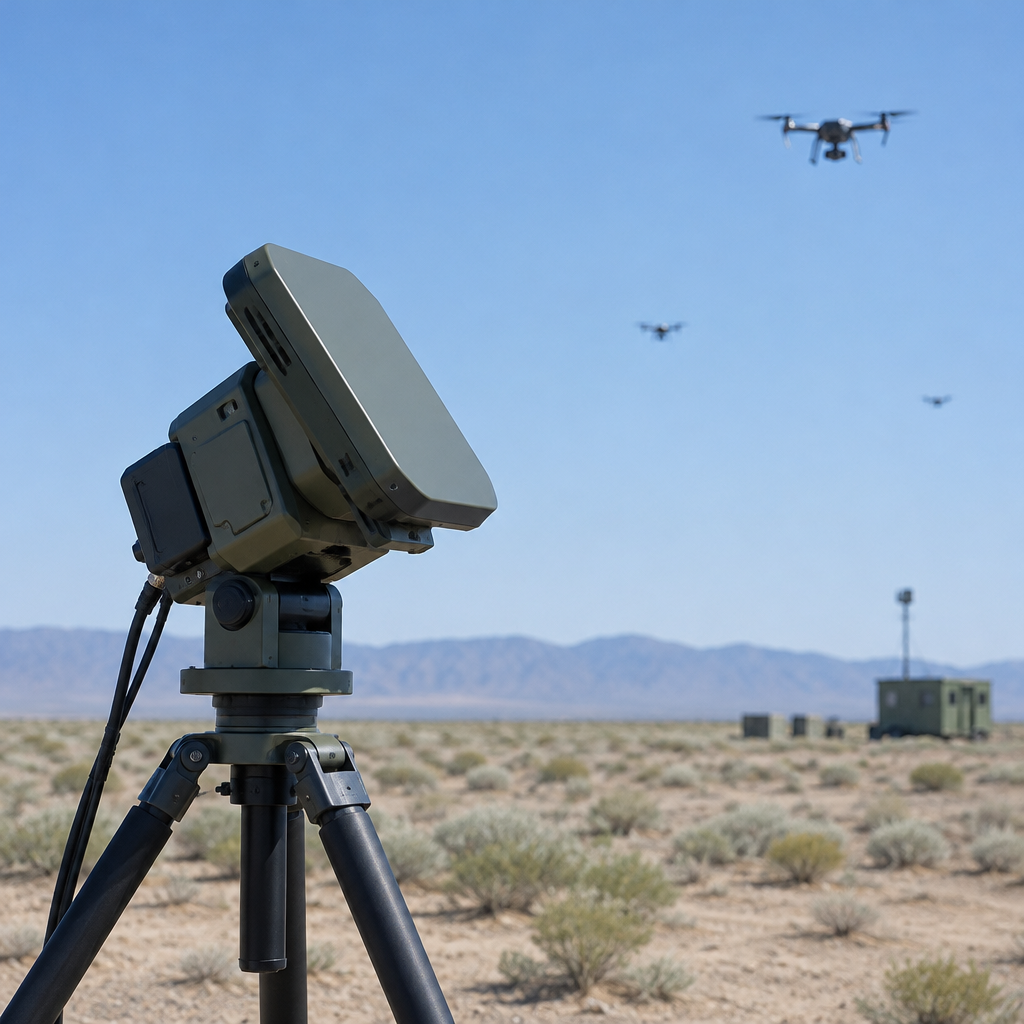
"Warden’s passive, first layer of detection complements EO/IR and radar," the sponsored piece states — a compact claim that frames the product as a sensor designed to sit ahead of established electro‑optical/infrared and radar systems.
Warden’s "autonomous perception"
The coverage presents Warden as a system that "finds and classifies targets at standoff distance with 'autonomous perception'." That phrase is the central technical claim in the piece: Warden is described as able to both detect and classify targets while employing what the sponsor calls "autonomous perception." The article positions that capability as the defining characteristic of the product.
Described as a "passive, first layer of detection"
The sponsored copy explicitly characterizes Warden as "passive" and as a "first layer of detection." Those three descriptors — passive, first layer, detection — are presented together, indicating the system is intended to occupy an early position in a sensing chain while relying on the passive attributes cited in the piece.

This site is the portfolio.
OSINTSights runs on Cloudflare Workers, D1, R2, and Vectorize, with an AI pipeline on Hetzner ARM. Nubivance designed, built, and operates it. We do the same for clients.
See what we buildHow it is said to complement EO/IR and radar
The piece names EO/IR and radar as the adjacent technologies that Warden is meant to complement. The copy states that the system "complements EO/IR and radar," placing Warden in a complementary role rather than as a substitute for those sensors. In the terms used by the sponsor, Warden sits alongside electro‑optical/infrared and radar systems as part of a layered detection approach.
What this means for operators, procurement leaders, and technologists
- Operators: Given the description of Warden as a "passive, first layer of detection," operators focused on layered sensor architectures will find the product's positioning notable; the sponsored piece presents Warden as an initial detection capability that complements EO/IR and radar.
- Procurement leaders: The sponsored copy frames Warden as a complement to existing EO/IR and radar investments, which suggests the product is being marketed for integration into multi‑sensor suites rather than as a replacement platform.
- Technologists and integrators: By invoking "autonomous perception" and a complementary role to EO/IR and radar, the piece signals that integration work — connecting a passive detection layer to other sensors — is central to the system's intended deployment model.
Warden’s claim and the questions it raises
The sponsored description is concise: Warden "finds and classifies targets at standoff distance with 'autonomous perception'" and is a "passive, first layer of detection" that "complements EO/IR and radar." Those are the facts the piece records. The combination of detection, classification, autonomy, passivity, and a complementary posture outlines a specific market role for Warden — an early, non‑emissive sensor feeding or working alongside EO/IR and radar systems.
Beyond those central phrases, the sponsored copy does not elaborate further in the excerpt provided here; readers and potential buyers are left to interpret how "autonomous perception" is implemented, what "passive" precisely entails in operational terms, and how integration with EO/IR and radar would be achieved in practice. What is explicit is the sponsor’s framing: Warden is positioned as an adjunct, not a replacement, to established optical and radar sensors.
Whether that positioning changes procurement choices or operational concepts will depend on the technical specifics and integration results that go beyond the summary claim. For now, the published record is a succinct product description: the sponsor asserts that Warden offers a passive, autonomous-capable, standoff detection and classification layer that complements EO/IR and radar.