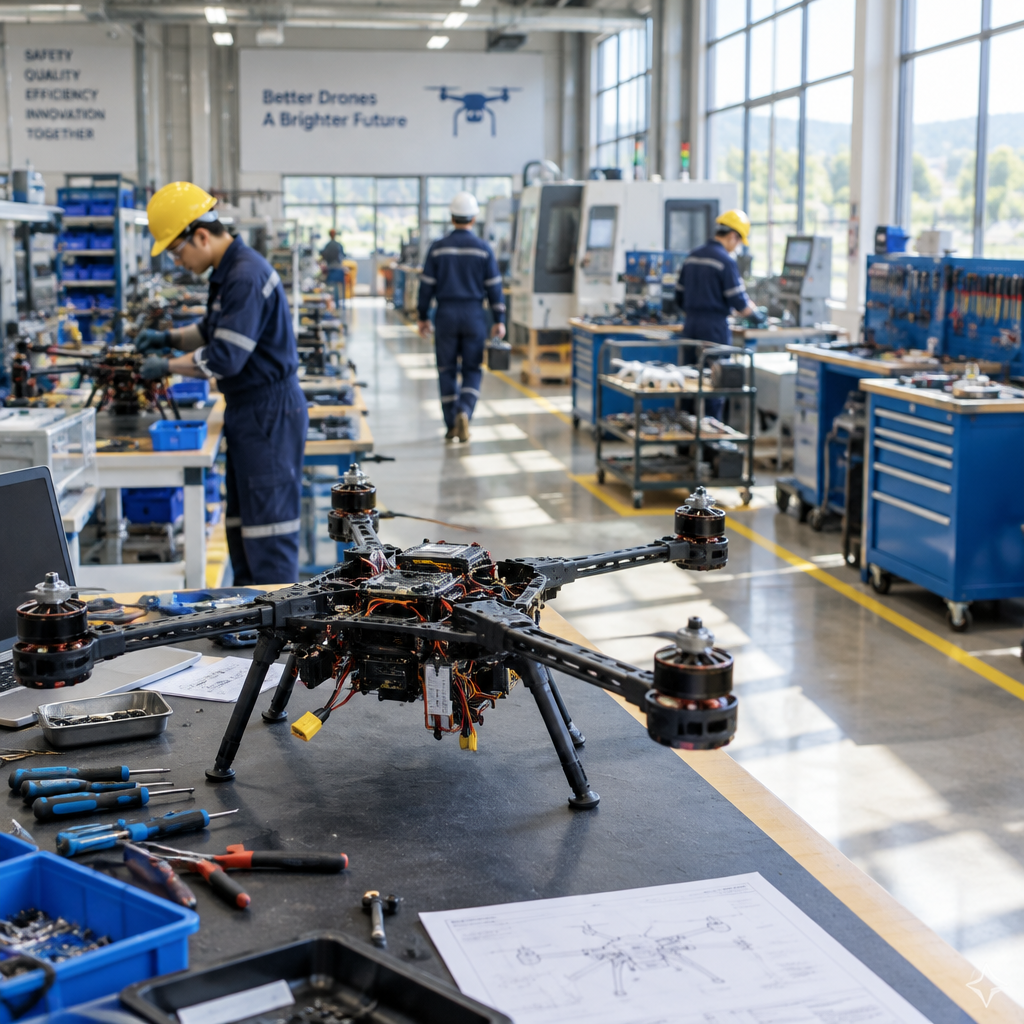
On 16 October, Taiwan’s cabinet approved T$44.2 billion (A$1.94 billion) for domestic drone production over the next six years — a concrete investment aimed at turning the island into “Asia’s democratic drone supply‑chain hub,” even as Beijing-made parts repeatedly surface where they should not.
Taiwan’s T$44.2 billion drone production push
The cabinet decision follows months of budget wrangling with an opposition‑controlled parliament that in August agreed to release T$240 billion over six years for drones. The funding approved on 16 October represents a step toward that compromise, but the source notes Taipei has allocated less than a fifth of the larger package so far, signaling more announcements are likely. The stated intent is to support a hedgehog strategy — many small, mobile systems to complicate an invasion — and to use Taiwan’s advanced manufacturing base to reduce dependence on Chinese components.
Jiin Meng, Han Jian and Guangzhou Yixin: supply‑chain breaches under investigation
That ambition collides with persistent supply‑chain leakage. Taiwanese prosecutors this month accused local defence contractor Jiin Meng Industry Co of breaching the National Security Act by knowingly using prohibited Chinese‑made chips and camera lenses in military drones; two senior executives were arrested for allegedly falsifying certificates of origin. In August, Han Jian Technology was found to have used Chinese parts in military drones.
A separate but related case emerged from a routine cybersecurity audit of Taiwan’s Ministry of Foreign Affairs in December 2025: China‑developed source code was identified in IT management software used at overseas missions. Three Taiwanese companies are alleged to have collaborated to repackage software developed by Guangzhou Yixin Technology and market it as Taiwanese‑developed to win government contracts. All three cases are either in court or under investigation — a reminder, the source says, that building a domestic industry is only half the battle; securing the supply chain is the other.

Audit-ready is a season. It shouldn't be.
Evidence in spreadsheets, controls drifting between audits, frameworks multiplying on flat headcount. Nubivance runs continuous compliance on Rapid7 Cyber GRC - SOC 2, HIPAA, ISO 27001, PCI, CMMC.
End the scrambleExercise Keen Sword 27, the Yalu bridge and a crowded neighbourhood
Regional military activity across Northeast Asia underlines the security context in which these industrial and political moves occur. Exercise Keen Sword 27 began on 19 October, the largest iteration to date: 45,000 Japanese and 11,000 US personnel joined forces from seven other countries, including Australia, using more than 40 vessels and 260 aircraft. Opening activities were held on Ishigaki, at the southern end of Japan’s Ryukyu chain.
During the exercise a Chinese strike group built around the aircraft carrier Liaoning transited the Ryukyus and moved on to waters around the Philippines, where it remained as of midweek. Japanese fighters scrambled to monitor Russian intelligence‑gathering aircraft before and after Keen Sword commenced. Other flashpoints: on 15 October the new Yalu River Bridge linking North Korea with China opened after a 12‑year delay; Kim Jong Un crossed into Dandong to meet Wang Huning. And on 18 October Taiwan’s coast guard said it had driven away 16 Chinese coast guard, research and fishing vessels in an “unusually large,” coordinated “maritime harassment” operation, prompting Beijing’s Taiwan Affairs Office to assert “indisputable sovereignty” over the South China Sea islands and warn Taiwan must “bear the consequences” of separate use‑of‑water‑cannon incidents.
Australia and Timor‑Leste sign what Richard Marles called the “last link in the chain”
On 22 October in Dili, Australia signed a defence cooperation framework with Timor‑Leste. Defence Minister Richard Marles described the agreement as the “last link in the chain” of security agreements in Australia’s immediate neighbourhood and said it formed part of Australia’s bid to be Timor‑Leste’s “natural partner of choice.” Signed by Marles and Prime Minister Xanana Gusmao, the framework builds on January’s Parseria Declaration and comes with A$62 million in Australian security assistance over five years.
The package includes provision of cybersecurity advisers, incident‑response support, digital forensics assistance, disaster preparedness help and three maritime patrol vessels for Timor‑Leste’s police. It is also expected to enable more Australian exercises in Timor‑Leste and greater opportunities for Timor‑Leste Defence Force personnel to train in Australia.
EU–New Caledonia nickel memorandum met with a boycott
In the Pacific, New Caledonia’s pro‑independence opposition boycotted the signing of a memorandum of understanding with the European Union on critical minerals, including nickel. The EU’s executive vice‑president for prosperity and industrial strategy, Stephane Sejourne, framed the goal as “to make New Caledonia a preferred supplier for European industry while making Europe a partner of choice for investment financing and new industrial opportunities.” Sejourne also warned during a speech that “those empty seats will not help me convince my European colleagues to bring support to projects.”
Nickel matters to New Caledonia: it is one of the world’s top five sources of the metal, and in 2025 roughly one in five jobs and 94 percent of exports depended on the industry, even though the commodity typically contributes only single digits to GDP. But Indonesia’s surge since 2020 — capturing more than 60 percent of the global market and driving down the global price by about 40 percent — plus pro‑independence riots in 2024 that chased away investors have left the territory’s industry in trouble. The MOU is a roadmap only: no investment commitments or supply agreements were secured, and it remains unclear how Brussels and Nouméa plan to counter Indonesia’s dominance, particularly given estimates that roughly 75 percent of Indonesia’s refineries are controlled by Chinese firms.
What this means for Taiwan’s defence planners, manufacturers and diplomats
- Defence planners: the T$44.2 billion cabinet approval buys capacity to build distributed drone forces, but the reported supply‑chain breaches and the MFA software finding mean operational resilience will depend on resolving provenance and procurement controls.
- Manufacturers: firms face higher scrutiny — prosecutors have charged Jiin Meng executives, Han Jian was exposed, and three private companies are implicated in the MFA case — so compliance systems and verified non‑Chinese sourcing will be immediate priorities.
- Diplomats and foreign missions: the December 2025 audit that detected Guangzhou Yixin Technology code in overseas IT management tools underscores exposure beyond weapons supply chains; procurement and cybersecurity vetting for overseas contracts will be front of mind.
Taken together, the fortnight’s reporting sketches a region where industrial ambition, legal accountability and kinetic signalling intersect. Taiwan’s push to localise drone production is now constrained as much by contested supply‑chain provenance and legal action as by budget arithmetic. Elsewhere, new defence pacts, exercises and resource diplomacy — from Dili to Nouméa — show states juggling capabilities, access and economic survival under shifting strategic pressure.