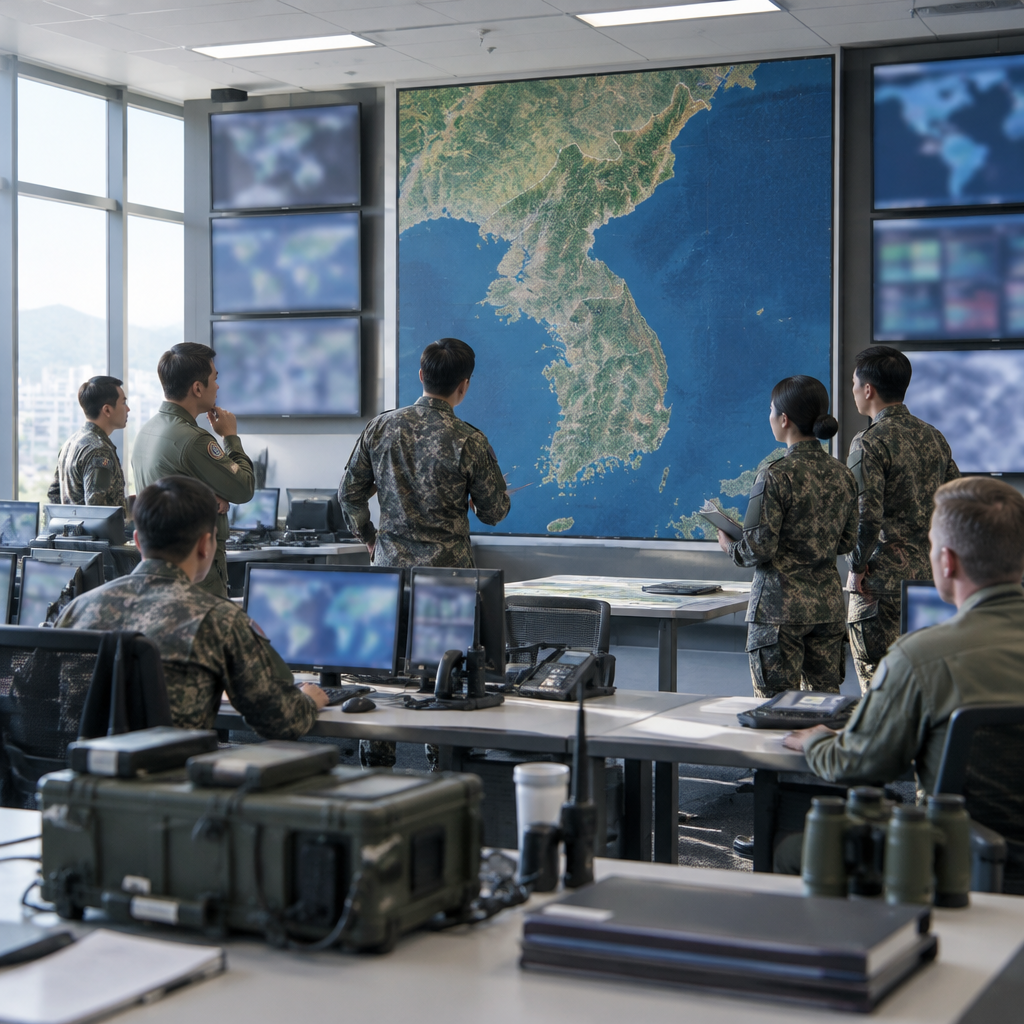
“Our adversaries practice electronic attack daily. They jam GPS in the West Sea. They attempt to blind our servers, our sensors, and our networks,” Gen. Xavier Brunson, commander of US Forces Korea, told an industry audience, laying out what he called one of the most “violently contested electromagnetic environments on the planet.”
Gen. Xavier Brunson’s assessment of the operational environment
Speaking at AFCEA TechNet Indo-Pacific in Hawaii, Gen. Brunson said electronic systems used by U.S. and allied forces on the Korean Peninsula are jammed daily. He framed the environment as one in which adversaries regularly practice electronic attack, and he tied that reality to the unique geography and threat posture across the demilitarized zone — noting explicitly that earlier in his remarks he referenced a “nuclear-armed adversary that constitutionally designates the Republic of Korea as its principal enemy,” a reference to North Korea. He also acknowledged that China is known to have advanced electronic attack capabilities in the region.
Resilient communications: high-frequency, LEO satellites, and mesh networks
Brunson warned bluntly about brittle systems. “If your capability requires pristine satellite communications, infinite bandwidth, and uninterrupted fiber optic backbone to function, it will not survive 48 hours on the peninsula,” he said. To mitigate that, US Forces Korea is fielding a layered approach: resilient high-frequency (HF) networks, proliferated low-Earth orbit (LEO) satellite communications, and terrestrial mesh networks to maintain command and control when primary links are disrupted.

The cyber insurance questionnaire just landed. Now what?
SOC 2, HIPAA, insurance renewals - someone has to own security strategy. Nubivance provides fractional CISO leadership without the full-time salary.
Get a security leadFrom hardened pipes to data-centric security
Arguing that long-standing architectural habits are a liability in a combined fight, Brunson urged a security mindset shift. For more than 30 years, he said, the model centered on hardened pipes and perimeter defenses in closed, classified networks; sharing with partners required building a new pipe. “In a combined fight inside the weapons engagement zone, that model has failed. Hardened pipes isolate our formations. They create operational blindness,” he said. His prescription: “We must shift from network-centric perimeters to data-centric security. Tag the payload and not the pipe.”
Industry’s checklist: jam-resistant waveforms, open APIs, edge sensors
Brunson made direct technical and procurement asks of the industrial base. He implored companies visiting the peninsula to bring “lightweight, jam-resistant waveforms with low probability of intercept and low probability of detection.” He also requested Open Application Programming Interfaces and edge sensors designed to integrate with joint mission networks “without vendor lock-in.” He emphasized designing combined systems from the outset rather than attempting to bolt partner interfaces on after a contract is signed: “We must design combined from the first line of code,” he said.
To drive the point home for an industry audience, Brunson used a commercial analogy: Vlasic became “pickle millionaires” by recognizing the need for sliced pickles for burgers rather than whole spears. “What is your sliced pickle? And if it doesn’t fit with where someone’s going, you cannot try to force it in there,” he said, urging firms to align product form and function with how the services plan to fight.
What this means for technologists, procurement leaders, and allied forces
- Technologists and security teams: Expect explicit requirements for low-probability-of-intercept/detection waveforms, edge-capable sensors, and systems that prioritize data tagging over protected pipes; systems that cannot “operate on the edge” will struggle, Brunson warned.
- Procurement leaders and vendors: Contracts and design cycles will need to bake in coalition interoperability and open APIs from the first line of code rather than as post-delivery add-ons, aligning with service documents such as the Army’s “How the Army Fights,” which Brunson cited as an example of useful operational guidance.
- Allied and partner forces: Information-sharing expectations will be millisecond-scale; Brunson described a process where a Korean radar’s track is verified, ingested, and pushed to coalition fires networks in milliseconds, not seconds, underscoring the need for tightly integrated, resilient data flows.
Gen. Brunson left industry with a stark operational benchmark and a set of practical demands: build for contested electromagnetic environments, enable coalition operations from the start, and move to data-centric security. The question he posed, implicitly and explicitly, is whether vendors will change long-established design and security mindsets to meet those demands “inside the weapons engagement zone.”