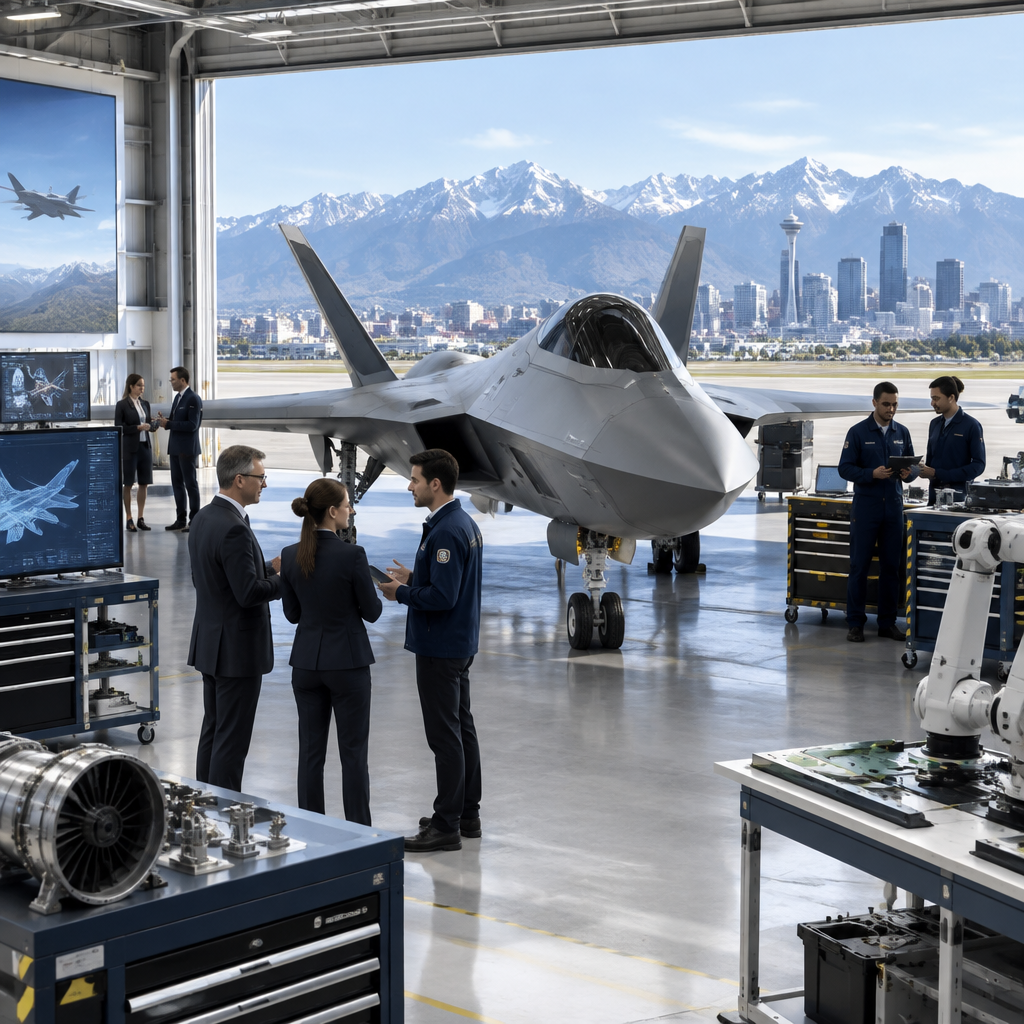
"This MoU marks an important step in exploring how Bombardier’s aerospace expertise, advanced manufacturing capabilities and defense integration experience could contribute to the development of next‑generation air combat capabilities," Bombardier said in a press release this week.
Bombardier and BAE Systems sign a cooperative Memorandum of Understanding
Montreal‑based Bombardier and Britain’s BAE Systems announced a Memorandum of Understanding to "collaborate toward next‑generation combat air programs," the two companies said. The public statement did not enumerate concrete tasks or contracts; instead it said the parties aimed to identify which technological sectors and capabilities made the most sense for cooperation. The phrasing in the release ties the MoU to Canada’s potential participation in the British‑Japanese‑Italian Global Combat Air Programme (GCAP), though the announcement itself stops short of stating any definitive industrial commitments.
Canada’s GCAP observer status and the Italian ministry’s caution
Canada joined GCAP as an observer in July. At that time, the Italian Ministry of Defense told Breaking Defense that being an observer "did not entail that Canada had an industrial role in GCAP," and that it was infeasible then "to predict the timing, modalities, or conditions of any potential expansion" of participation. Since July, public detail about Ottawa’s formal role in the sixth‑generation fighter program has been limited, even as Canadian companies step forward to signal readiness to contribute if opportunities materialize.

The cyber insurance questionnaire just landed. Now what?
SOC 2, HIPAA, insurance renewals - someone has to own security strategy. Nubivance provides fractional CISO leadership without the full-time salary.
Get a security leadSaab lays out Canadian industrial partners for a possible Gripen program
Swedish firm Saab announced this week that it intends to collaborate with three major Canadian companies should Ottawa proceed with acquiring the Gripen E. Saab said it "confirms its intention to collaborate with several of Canada’s major international aerospace firms in a first step to establish a broad, national ecosystem that will build, deliver and support the Gripen E should the Canadian government proceed with a Gripen acquisition."
Saab’s agreements name Halifax‑based IMP to oversee a new Canadian final assembly line and electrical production; Magellan Aerospace to locally produce aerostructures and composite structures; and CAE to provide pilot and technician training plus mission systems engineering. Saab’s proposal envisions producing and finally assembling the Gripen in Canada, contingent on a government decision to proceed.
F‑35 review since March 2025 leaves mixed‑fleet possibility open
Canada’s planned purchase of 72 additional F‑35s from Lockheed Martin — after confirming an initial order for 16 aircraft — has been under review since March 2025. That review has kept open the possibility of a mixed fleet that could include Saab‑made Gripen jets, a path Saab has lobbied for in Canada. Canadian Defense Minister David McGuinty told reporters in July that the decision status "had not moved and would remain under consideration 'until we take the time to get it right for Canadians.'"
How CAE, Magellan Aerospace and IMP are positioned
- CAE: The company has been named by Saab to deliver pilot and technician training and mission systems engineering for a potential Canadian Gripen program. Separately, CAE president Pascal Grenier told reporters at the Farnborough International Airshow that he hoped Ottawa’s GCAP observer status could pave the way for new opportunities for Canadian aerospace firms.
- Magellan Aerospace: Saab’s agreement envisions Magellan producing aerostructures and composite structures locally, a role that would tie the company directly into production and supply lines if a Gripen acquisition proceeds.
- IMP: Saab named Halifax‑based IMP to oversee a Canadian final assembly line and electrical production, a commitment that would localize final assembly work in Canada under Saab’s proposal.
- Bombardier and BAE Systems: The MoU between those two firms sets out a joint examination of "which technological sectors and capabilities" suit collaboration, signaling a private‑sector readiness to align capabilities with potential GCAP industrial needs should Ottawa decide to expand its role beyond observer status.
Canadian firms are moving now to position themselves for two distinct pathways: industrial participation in GCAP if Ottawa expands beyond observer status, and an industrial ecosystem to support a possible Gripen acquisition that would produce and assemble aircraft in Canada. The near‑term decision rests with the government — including outcomes from the F‑35 review that has been ongoing since March 2025 — and the precise scope of any Canadian industrial role will depend on how Ottawa chooses to proceed.
Original report: https://breakingdefense.com/2026/10/canadian-firms-line-up-for-potential-gcap-gripen-work/