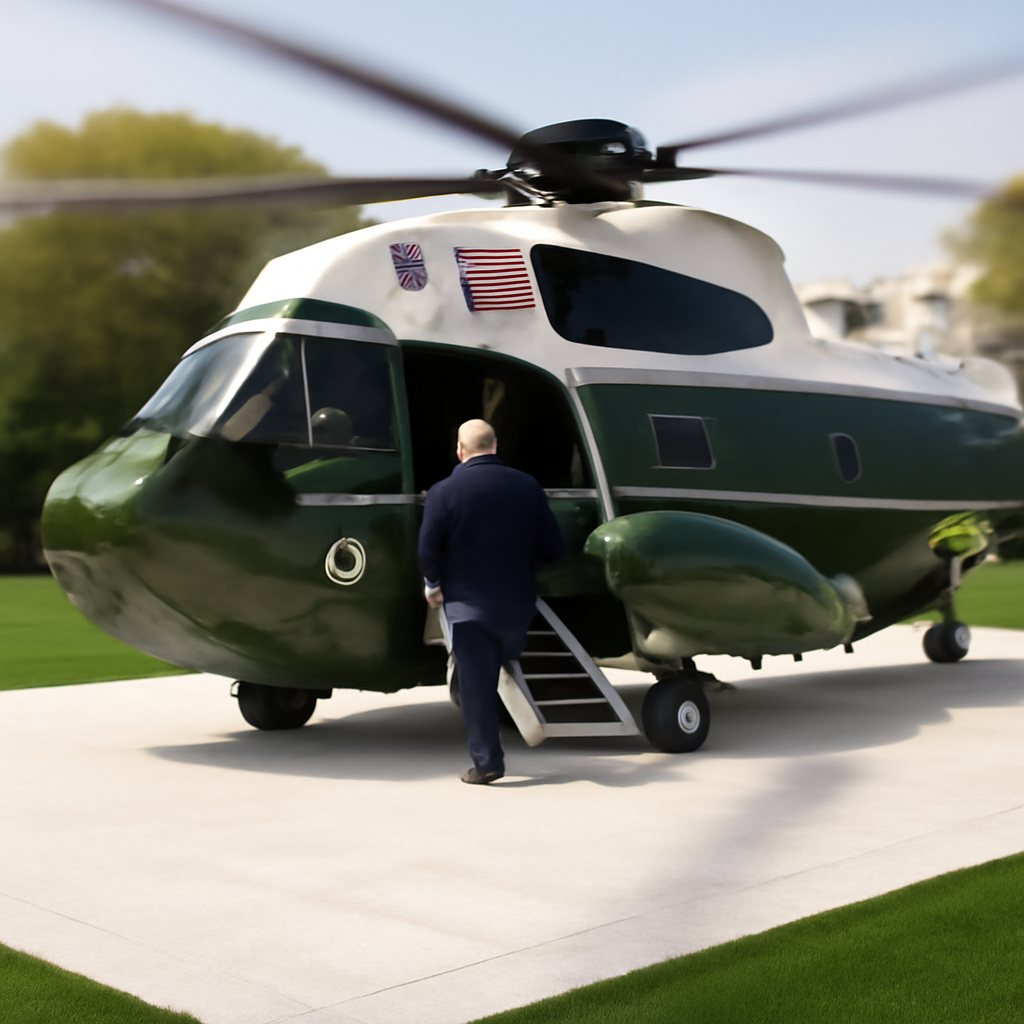
"The flight was the 'maiden voyage' from the newly completed pad," President Donald Trump posted after stepping onto a helicopter that — for the first time — lifted him from a new granite helipad on the South Lawn.
President Donald Trump's ribbon-cutting and departure
On September 21, 2026, President Donald Trump performed a ribbon-cutting on the South Lawn, using oversized gold scissors to sever a red, white, and blue ribbon before boarding Marine One. Auxiliary power unit noise from the waiting VH-92A Patriot drowned out any remarks the president may have made on the landing area, and he did not take shouted questions from reporters before boarding. The VH-92A carried him first to Joint Base Andrews, Maryland, and then on to New York for the United Nations General Assembly.
The granite helipad: construction, cost and controversy
The roughly $5–6 million helipad is four inches thick, quarried in California, and has been promoted by the president as effectively indestructible with a "million-year" lifespan — a durability claim the report notes has not been independently substantiated. Construction began in late June and hit a snag in early August after President Trump ordered contractors to tear out and redo weeks of work, including removal of a 100-foot-wide carved granite presidential seal already taking shape, reportedly over dissatisfaction with the pad’s appearance and the slope of the surrounding lawn.
Earlier workarounds included using the Ellipse as a temporary landing zone. The South Lawn's natural grade reaches up to 20 degrees in places, a slope that the story says exceeds FAA heliport guidance calling for landing surfaces to be reasonably level.

The cyber insurance questionnaire just landed. Now what?
SOC 2, HIPAA, insurance renewals - someone has to own security strategy. Nubivance provides fractional CISO leadership without the full-time salary.
Get a security leadVH-92A Patriot: operational limits and program history
The flight was a dual milestone: the first time a VH-92A carried the president from the White House and the first operational use of the new helipad that was built to enable routine operations by that helicopter. The VH-92A’s earlier limitation in this context had been its exhaust and rotor system; heat and rotor wash directed downward previously scorched and tore up the South Lawn turf badly enough that the Marine Corps continued to rely on the older VH-3D Sea King and VH-60N White Hawk for White House landings even after the VH-92A entered presidential service under Biden in August 2024. President Trump has said the newer helicopter is "roughly two and a half times more powerful" than the airframes it replaces, and by his account a single landing once left "half of the grass…sitting in front of the Oval Office front door."
The report places the VH-92A within a troubled program: TWZ has tracked the $5-billion, 23-aircraft program's string of setbacks. A 2021 Pentagon testing report is cited as finding the helicopter failed to meet reliability, availability, or maintainability thresholds, judging it fit for routine "administrative" runs but not for the emergency contingency missions the role demands. Central to that finding were flaws in the Mission Communication System, the secure link meant to keep the president connected to the National Command Authority, which the Pentagon summary said often delayed critical communications at the beginning of contingency missions.
Marine Corps fleet plans and the continued role of older airframes
The Marine Corps has said it intends to retire the VH-3D Sea Kings fully this year, but plans to keep flying the VH-60N through at least 2030 because of its hot-and-high-altitude performance. That means the VH-60N could continue to make occasional South Lawn appearances even with the VH-92A cleared for routine use. Whether the VH-92A becomes the baseline for Presidential departures from the South Lawn, or whether older airframes will continue regular appearances, will be revealed in how often the VH-92A — versus the older "White Top" fleet — appears on the pad in the weeks ahead, particularly ahead of higher-profile events such as a planned state visit by Chinese Premier Xi Jinping.
Sikorsky financing and the president’s justification
Sikorsky, the Lockheed Martin subsidiary that builds the VH-92A, is financing the helipad project. President Trump has said this financing is intended in part as compensation for not fully disclosing how disruptive the helicopter’s exhaust characteristics would be. The helipad joins other exterior additions the president has made since returning to office, including two roughly 88-foot flagpoles installed on the North and South Lawns in June 2025 that the president said he paid for himself at about $50,000 each.
Today’s flight closed a chapter of visible friction between new presidential transport hardware and the historic White House grounds — but it leaves concrete operational questions in place: will the VH-92A's use be regularized now that a robust landing surface exists, or will the older VH-60N and occasional VH-3D appearances persist as contingencies? The frequency of Marine One rotations to the new pad in the coming weeks will answer whether the ribbon-cutting was truly the start of a new baseline or an isolated ceremonial debut.
Original TWZ report: Marine One VH-92A Makes First Operational Use Of New White House Helipad