“We are really focused on growing the foundation that we have to be able to scale to meet the commercial and government demand that we're going to have for this system,” Tom Barron, chief operating officer for Venus Aerospace, told Defense One.
Venus Aerospace’s funding leap and what it buys
Venus Aerospace, a six-year-old Houston startup, announced a $91 million Series B round led by Mercury Fund with participation from Lockheed Martin Ventures and other investors. Lockheed Martin Ventures said its reinvestment reflected Venus’s rapid development of a rotating detonation rocket engine, calling the technology “a welcomed addition to the defense ecosystem,” and pointing to company progress on speed to manufacture, cost management and supply-chain constraints.
The funding is positioned explicitly to scale the company’s operations: Barron said the company will hire “technical and business talent,” grow “in-house manufacturing capacity,” and expand the business processes and architecture needed to win high-consequence government contracts. He declined to give dates for production, manufacturing targets, or concrete hiring numbers.
The rotating detonation engine: claims and capabilities
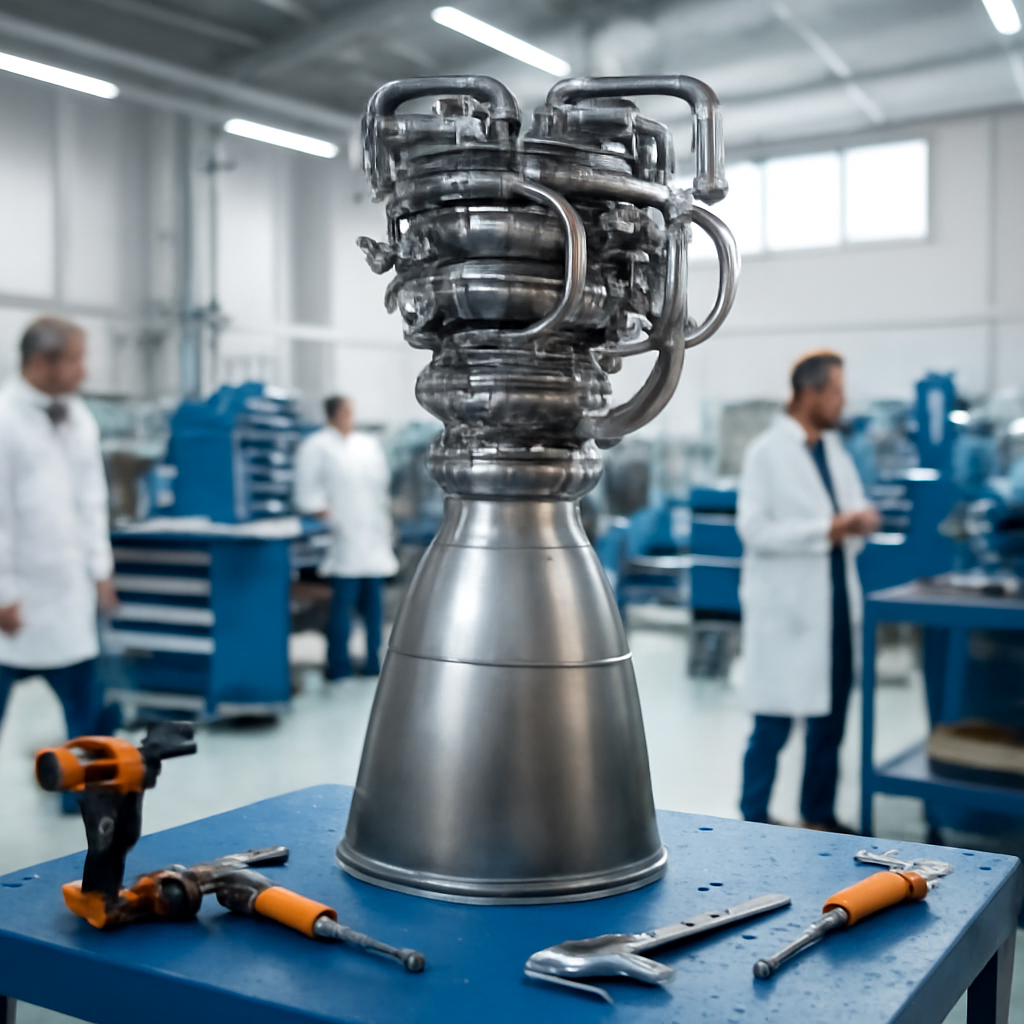
Venus describes its propulsion concept as a rotating detonation rocket engine that uses continuous supersonic detonation waves to generate thrust. The engine’s test-flight data — from a flight test completed last year — showed, the company says, roughly 15 percent better performance than traditional rocket motors in efficiency and range. Venus also says the engine can deliver “performance that doubles the range relative to solid rocket motors for several classes of munitions” and offers larger payload or cost reductions for space launches.
Technical details provided by the company in the interview include that the engine is made up of 3D-printed components, the engine body consists of “only three pieces,” and that producing a unit takes about two weeks using machining and additive manufacturing. Barron highlighted an operational advantage: co-locating testing, manufacturing and design so the team can iterate quickly. “We test rocket engines 500 feet behind me,” he said, contrasting Venus’s setup with other major engine designers that test in remote deserts and therefore face longer logistics and schedule lags.

The cyber insurance questionnaire just landed. Now what?
SOC 2, HIPAA, insurance renewals - someone has to own security strategy. Nubivance provides fractional CISO leadership without the full-time salary.
Get a security leadNATO Secretary General Mark Rutte on industrial scale and spending
At the NATO Summit Defense Industry Forum in Ankara, NATO Secretary General Mark Rutte delivered a keynote that tied allied defense spending and industrial capacity to battlefield and stockpile needs. Rutte said that “by next year, the alliance will have the capacity to produce around four million artillery shells annually. Almost twice as many as last year.”
Rutte framed recent defense spending increases as substantive: he said European allies and Canada increased defense spending by nearly 20 percent, or $139 billion more, from 2024 to 2025, and that number is set to increase again for 2026 to more than $250 billion in additional spending year-over-year. He also announced a consolidated NATO demand signal — a single portal detailing the organization’s defense needs and opportunities for companies — and urged industry to take more risk to enable what he called a “transatlantic defence industrial revolution.”
Anduril’s NATO contract, Fairbanks Morse purchase, and fleet movements
Short items from the same briefing window show continued commercial movement around allied procurement: Anduril secured its first NATO contract for its AI platform, Lattice. Fairbanks Morse Defense purchased the Rolls-Royce Naval Handling facility in Ontario and will use it as the company’s new Canadian headquarters. Separately, the Navy announced four ships participating in the International Naval Review 250 in New York — USS Arlington (LPD 24); USS Nitze (DDG 94); USS Kearsarge (LHD 3); and USS Farragut (DDG 99) — which will depart Wednesday.
How Venus Aerospace, NATO procurement offices, and Lockheed Martin Ventures are positioned
- Venus Aerospace: focused on rapid iteration and scaling. The company is investing its Series B proceeds to hire technical and business staff, expand in-house manufacturing, and formalize business processes to pursue government contracts; it is not committing to production timelines in public comments.
- NATO procurement offices and allied defense ministries: pursuing larger production runs and clearer demand signals. NATO’s consolidated demand portal and Rutte’s pledge of four million artillery shells annually next year are explicit attempts to translate rising budgets into industrial output.
- Lockheed Martin Ventures and strategic investors: betting on novel propulsion to relieve near-term supply constraints and offer performance upgrades. Lockheed Martin Ventures cited speed to manufacture and supply-chain improvements as reasons for reinvestment.
The converging threads are clear in the facts reported: private capital is flowing to novel propulsion concepts even as governments push existing industrial bases to expand capacity. Venus Aerospace is selling speed — in development, in iteration, and in a claimed two-week production cadence — while NATO and allies are emphasizing scale and consolidated purchasing signals. What remains to be seen, based on the company’s public comments, is when rotating detonation engines will move from successful test flights to repeatable, contract-ready production at the volumes NATO and defense buyers are now demanding.