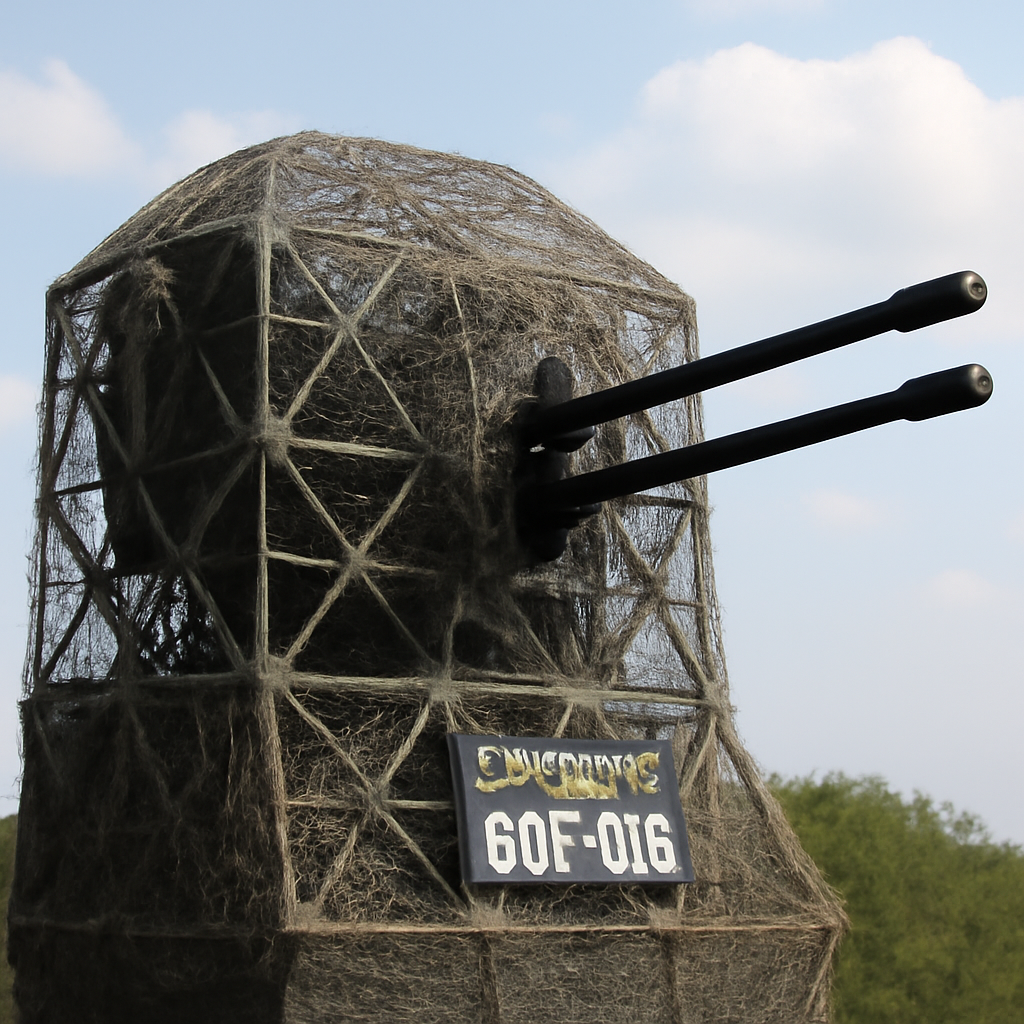
The ROCAF operates around 24 GDF-006 Skyguard systems — and at least some of them are now sheathed in geodesic lattice frames and anti‑drone netting, according to imagery that began circulating this week.
ROCAF GDF-006 Skyguard: 24 systems, netted in the field
An edited image that circulated online shows a pair of Republic of China Air Force (ROCAF) Skyguard towed twin‑barreled 35 mm anti‑aircraft cannons enclosed in dome‑like lattice structures and draped with anti‑drone netting, with the twin barrels protruding to preserve clearance. The design appears aimed mainly at defeating small first‑person‑view (FPV) drones attempting direct, diving strikes on the guns. Thanks to a post credited to Taepodong, the picture and commentary prompted public attention to the new physical protection.
Why the Skyguard still matters: radar guidance and AHEAD ammunition
The Skyguard in ROCAF service — specifically the Swiss‑made GDF‑006 — remains a point‑defense workhorse despite its Cold War origins. It is radar‑guided and can employ Advanced Hit Efficiency and Destruction (AHEAD) programmable airburst ammunition. AHEAD rounds are designed to burst just ahead of a target and release a cloud of sub‑projectiles, increasing the chance of killing small, slow, and maneuvering aerial threats such as drones and also proving effective against cruise missiles, rockets, and mortar projectiles. The airburst profile both improves lethality and reduces the risk of collateral damage on the ground.

Audit-ready is a season. It shouldn't be.
Evidence in spreadsheets, controls drifting between audits, frameworks multiplying on flat headcount. Nubivance runs continuous compliance on Rapid7 Cyber GRC - SOC 2, HIPAA, ISO 27001, PCI, CMMC.
End the scrambleHow the Skyguard fits into Taiwan’s layered air defenses
The Skyguard serves alongside longer‑range and complementary systems. The ROCAF fields U.S.‑made Patriot and the indigenous Tien Kung (Sky Bow) family for long‑range air and ballistic missile defense. Sparrow surface‑to‑air missile launchers can be integrated with the Skyguard’s radar and fire‑control system to add another protective layer. Taiwan formally retired the last of its HAWK surface‑to‑air missile systems in 2023 and later donated some of those systems to Ukraine. Separately, Taiwan moved to procure NASAMS after the United States approved its sale in 2024; NASAMS is described as well suited to defeating cruise missiles and standoff one‑way attack drones and benefits from sharing AIM‑120 AMRAAM inventory with ROCAF fighters.
Republic of China Army assets and other hardening measures
The Republic of China Army fields a broader array of ground‑based air‑defense options, including more mobile systems and man‑portable air defense systems. Its anti‑aircraft guns include the locally made T‑82T towed twin‑barreled 20 mm cannon, based on the M39 developed for the U.S. Air Force in the late 1940s. Taiwan has also employed camouflage and concealment measures for armor and other assets — from hiding vehicles under bridges to making them resemble civilian equipment — and routinely practices dispersal, exercising from secondary airfields and highway strips to reduce vulnerability.
How this move affects the ROCAF, the Republic of China Army, and China
- ROCAF: Netting and lattice frames are a short‑term, physical mitigation to preserve legacy Skyguard batteries against small FPV and one‑way drones. The measure prioritizes keeping point‑defense assets operational during a high‑tempo attack, especially at airbases where Skyguards are frequently deployed.
- Republic of China Army: The Army already fields a wider set of mobile and short‑range air defenses and practices concealment. Adding nets to fixed or towed point‑defense guns echoes those hardening efforts and signals a cross‑force concern about drone vulnerability.
- China (and Chinese unmanned forces): The adoption of physical nets acknowledges the evolving role of Chinese drones — not only one‑way attacks but intelligence gathering, target acquisition for standoff strikes, communications relay, and electronic warfare. The source highlights an experiment showing a Chinese drone swarm launching loitering munitions from a light tactical vehicle and warns that inexpensive swarms could be used to saturate Taiwan’s defenses.
Anti‑drone nets, the source notes, have become visually ubiquitous — draped over roads, armored vehicles, artillery positions, and even warships. That ubiquity helps explain why the ROCAF would add a seemingly low‑tech layer to protect an otherwise capable but finite set of Skyguard systems: the nets are immediate, inexpensive, and tailored against the small, direct‑attack drones that have multiplied around Taiwan’s airspace.
Whether nets will materially change the calculus of an aerial contest remains an operational question the record does not resolve, but the move does make one fact plain: as China expands its unmanned capabilities, even air‑defense systems designed to shoot down small aerial threats are taking additional measures to survive those very threats.
Original story: https://www.twz.com/land/taiwans-skyguard-anti-aircraft-guns-now-equipped-with-anti-drone-nets