“we don’t follow the curve. We stay ahead of it,” Veda Aeronautics managing director Dipesh Gupta told Milipol India 2025, summing up the company’s pitch as it converts a single startup contract into a broader tilt at India’s nascent indigenous loitering‑munition market.
Veda Aeronautics and the Sureshastra Mk1
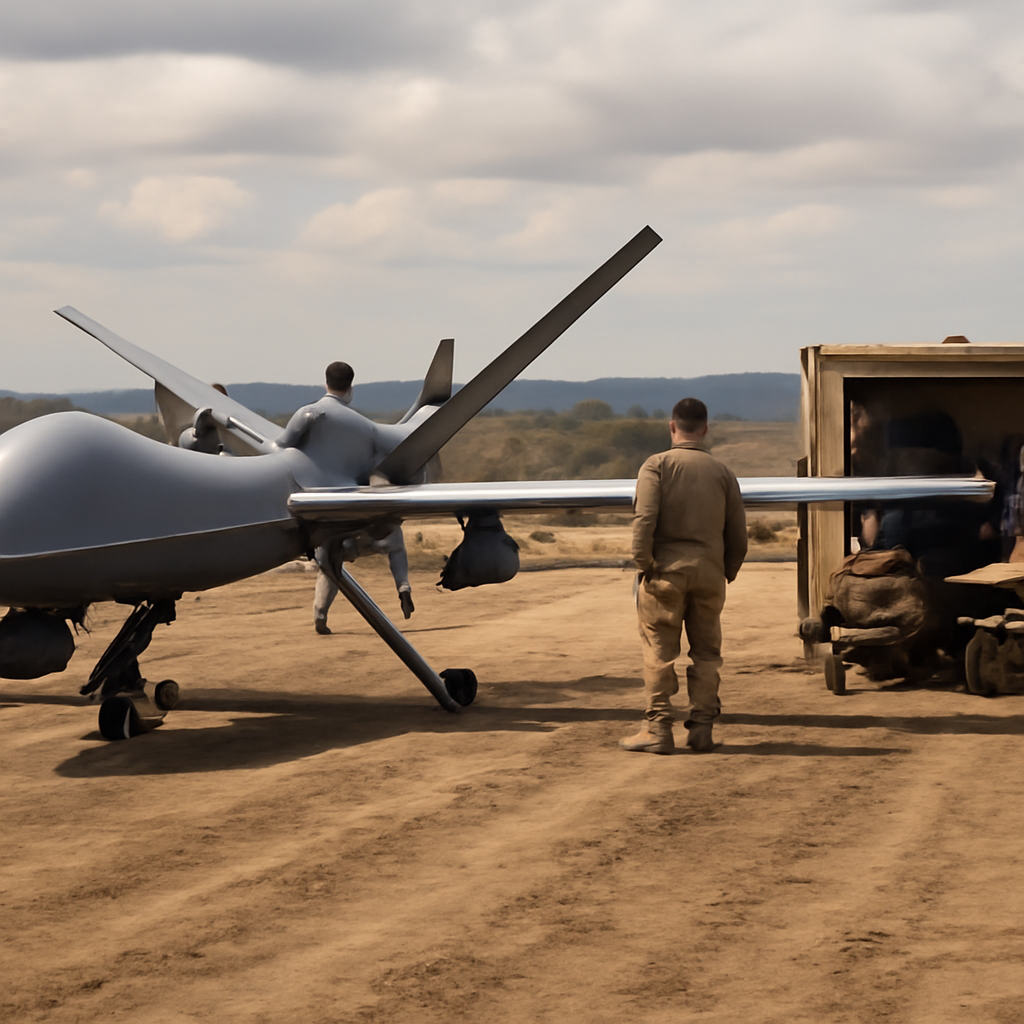
The Sureshastra Mk1 is the product anchoring Veda Aeronautics’ expansion. The baseline vehicle is a 3.5‑metre, roughly 90‑kilogram, jet‑powered fixed‑wing aircraft with a V‑tail configuration. It is catapult‑launched without the need for an airbase, carries an explosive warhead to targets more than 150 kilometres away, and uses satellite navigation and AI‑enabled swarm coordination, according to Veda’s public descriptions. Veda markets a supply chain it describes as “zero Chinese, 60% Make in India,” and has used the Mk1 as a proof point for further bids and development efforts.
Indian Air Force order, trials and deliveries
The Indian Air Force signed a US$31 million (₹300 crore) contract for 200 Sureshastra Mk1 units in August 2023 through its Mehar Baba Swarm Drone Competition. That deal was reported at the time as the largest order any Indian startup had received from the government for unmanned systems. Earlier user trials took place in the Thar desert, and deliveries were reported underway from May 2025. The Sureshastra Mk1 is already in the field in its catapult‑launch configuration; Veda and defence sources stress the difference between that system and the longer‑range variants still under development.

Audit-ready is a season. It shouldn't be.
Evidence in spreadsheets, controls drifting between audits, frameworks multiplying on flat headcount. Nubivance runs continuous compliance on Rapid7 Cyber GRC - SOC 2, HIPAA, ISO 27001, PCI, CMMC.
End the scrambleAir‑dropped 500‑kilometre variant and the medium‑range RFP
In April 2026 Veda announced it was extending the Sureshastra design into an air‑dropped, canisterised swarm variant that the company said would enable strikes beyond 500 kilometres when released in canisters of eight or more drones from strategic transport aircraft such as the C‑17 Globemaster III, C‑130J Super Hercules, or Airbus C‑295. The company and public reporting caution that this variant remains in development and must not be conflated with the shorter‑range, catapult‑launched aircraft the IAF has already contracted and begun fielding.
Separately, the Ministry of Defence issued a request for proposals in October 2025 for 800 medium‑range swarm unmanned munition systems with range beyond 350 kilometres. That RFP is an open competition and, as of the latest reporting, a winner has not been confirmed. The ministry’s solicitation language argued such systems are effective because they “saturate enemy air defence systems, confuse enemy radars” — the same operational rationale Veda has cited for both its Mk1 contract and its proposed longer‑range successor.
Defence Acquisition Council approval and the Indian Army program
On 3 July 2026 India’s Defence Acquisition Council approved a US$5.4 billion (₹52,000 crore) capital acquisition package that includes a jet‑based kamikaze drone system for the Indian Army, a requirement distinct from the IAF’s existing needs. Veda confirmed on 5 July 2026 that it would bid for that Army program, citing its Sureshastra Mk1 delivery record to the IAF as the basis for credibility on a jet‑powered kamikaze design.
The move occurs against an ongoing push to indigenise loitering munitions across services. The Indian Army has fielded the Nagastra‑1, built by Economic Explosives Limited and Z‑Motion Autonomous Systems, in batches through 2024 and 2025. Tata Advanced Systems has delivered its ALS‑50 to the IAF, and Bengaluru’s NewSpace Research and Technologies is developing the longer‑range Sheshnaag‑150. That indigenization drive accelerated after Operation Sindoor, the May 2025 conflict with Pakistan, in which the IAF employed Israeli‑built IAI Harop loitering munitions — systems the Sureshastra family is intended to supplement or eventually replace with domestically built alternatives.
What this means for the Indian Air Force, the Indian Army, and Veda Aeronautics
- The Indian Air Force: The IAF has taken delivery of the catapult‑launched Sureshastra Mk1 from May 2025 and continues to seek longer‑range capabilities, as evidenced by the October 2025 RFP for systems with range beyond 350 kilometres.
- The Indian Army: The Defence Acquisition Council’s US$5.4 billion package formalises an Army requirement for a jet‑based kamikaze drone; official procurement will proceed as an open competition and companies with recent delivery records — including Veda — are positioning to bid.
- Veda Aeronautics: The company is leveraging the 200‑unit IAF contract and reported deliveries to underpin bids for both the MoD’s medium‑range RFP and the Army’s kamikaze program, while advancing an air‑dropped, canisterised variant it says will reach beyond 500 kilometres but which remains in development.
The record in the public reporting is straightforward: a startup turned recipient of a headline domestic order is using that contract to press for larger, longer‑range programs across services. Key program milestones remain unsettled — the open RFP for 800 medium‑range systems has no confirmed winner, and Veda’s 500‑kilometre air‑dropped variant is still under development — but the sequence of contracts, trials and public announcements makes clear that loitering munition procurement and indigenous development have moved from experimentation into formal acquisition pipelines.