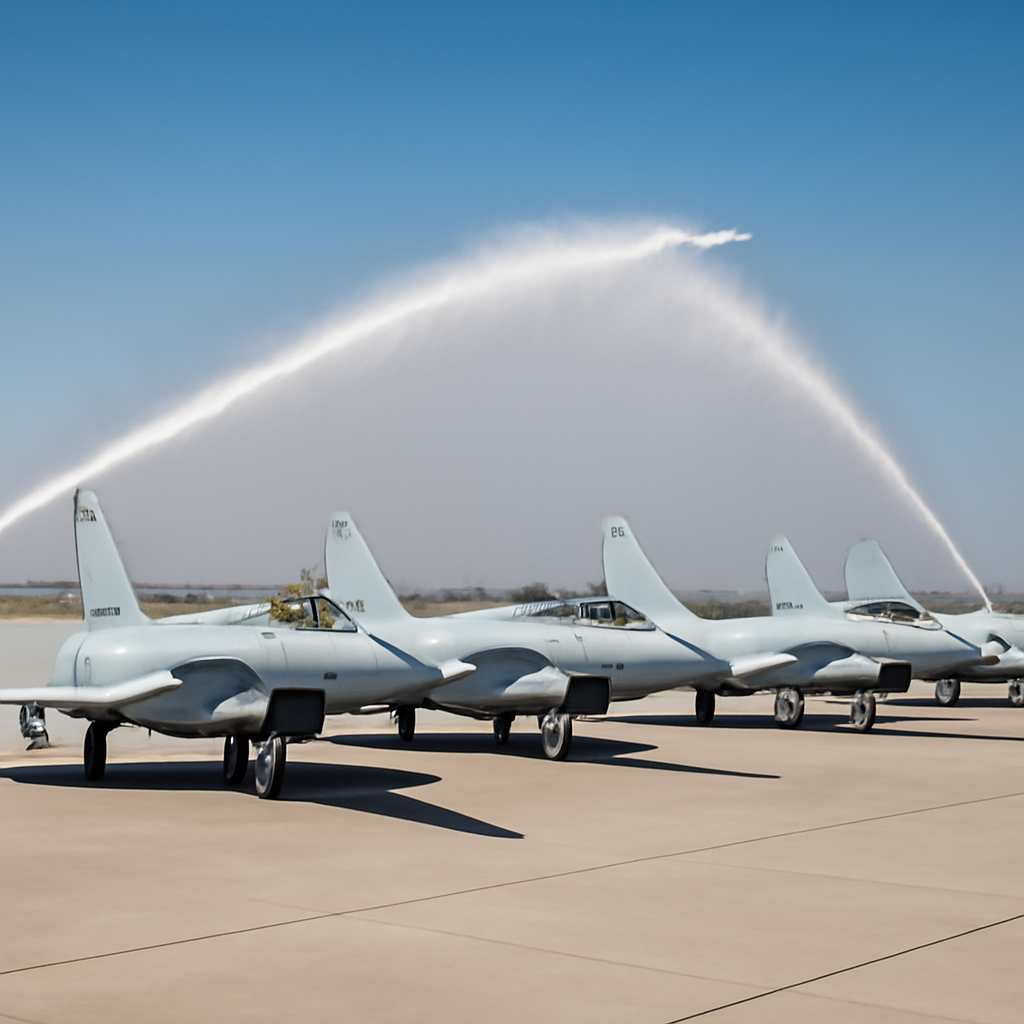
At least six Chengdu J-10CE fighters were visible in state television footage of their arrival in Uzbekistan, a public showing that Quwa Pro recorded on O’zbekiston 24 around 28 August 2026 and which the presidential office amplified on 30 August as part of independence-day coverage.
Public debut and official footage
State television first aired a feature showing the J-10CEs arriving in Uzbekistan on or about 28 August 2026, and the presidential office released additional official footage on 30 August during coverage marking the country’s 35th independence anniversary, according to Quwa Pro. The broadcast images included at least six airframes arriving at their base under a water-cannon salute, signalling a formal presentation rather than a quiet delivery.
What the aircraft on display reveal
The feature showed each aircraft carrying three external fuel tanks — two underwing tanks and a single centreline tank — a configuration that emphasises range or transit endurance rather than an immediately visible weapons load. No weapons were shown with the jets in the footage, Quwa Pro reported.
One airframe bearing serial 1020 had been photographed earlier undergoing testing at Chengdu prior to delivery, with additional airframes reported in the 101x serial range. Tashkent is confirmed only as the arrival point for the delivery flights; reports that the jets are based at Karshi‑Khanabad in southern Uzbekistan remain unconfirmed by Uzbek authorities.

Audit-ready is a season. It shouldn't be.
Evidence in spreadsheets, controls drifting between audits, frameworks multiplying on flat headcount. Nubivance runs continuous compliance on Rapid7 Cyber GRC - SOC 2, HIPAA, ISO 27001, PCI, CMMC.
End the scrambleScale, cost estimates, and the sourcing relationship
Reporting has converged on a figure of 24 J-10CE aircraft for Uzbekistan, though that number has not been officially stated by the Uzbek government. Analysts cited by Quwa Pro have estimated unit procurement costs in the range of USD 40–50 million per airframe.
Quwa Pro notes that Uzbekistan is the only Central Asian state to buy Chinese “big-ticket” military systems at scale, having inducted a range of Chinese air-defence systems through the 2010s; the J-10CE sale therefore extends an existing supplier relationship rather than opening a new one.
Weapons package assumptions and operational questions
Although no armament appeared in the public footage, reporting assumes the J-10CEs would be equipped around a common Chinese air‑to‑air package: the short‑range PL‑10, the medium‑range PL‑12, and the beyond‑visual‑range PL‑15. Quwa Pro frames that as the likely weapons fit, but emphasises that armament has not been shown in the Uzbek broadcasts.
Regional production pipeline: Bangladesh and Indonesia
Quwa Pro reported parallel export interest that matters to the aircraft’s production outlook: Bangladesh is negotiating for 20–24 J-10CEs, and Indonesia is reviewing terms for as many as 42. Taken together, those potential orders plus the Uzbek shipment would create a combined pipeline capable of extending J-10CE production well into the 2030s, according to the reporting.
What this means for Uzbekistan, regional militaries, and Chinese producers
- For Uzbekistan’s air force: public display of multiple jets and ferry arrivals to Tashkent demonstrates a visible, near-term boost in fighter capability — though the absence of shown weapons and unconfirmed basing leave immediate combat capability and basing posture open to further clarification.
- For neighbouring militaries and planners in Central Asia: an Uzbek fleet of J-10CEs would be notable because Uzbekistan is already the only regional buyer at scale of Chinese major systems, meaning neighbours will watch how these fighters are armed, based, and exercised.
- For Chinese defence manufacturers and export planners: the Uzbek delivery, together with active negotiations in Bangladesh and Indonesia, represents demand that could sustain J-10CE production through the next decade if those potential sales proceed.
The public showing closes one chapter — confirmation of deliveries to Uzbekistan — while leaving others open: the government has not stated an official fleet size, basing reports at Karshi‑Khanabad remain unconfirmed, and no armament has been displayed. The combination of a reported 24-jet order and parallel export interest in Bangladesh and Indonesia, however, points to a longer production and export horizon for the J-10CE family.
Source: Quwa — "Uzbekistan Shows Its J-10CE Fighters for the First Time"