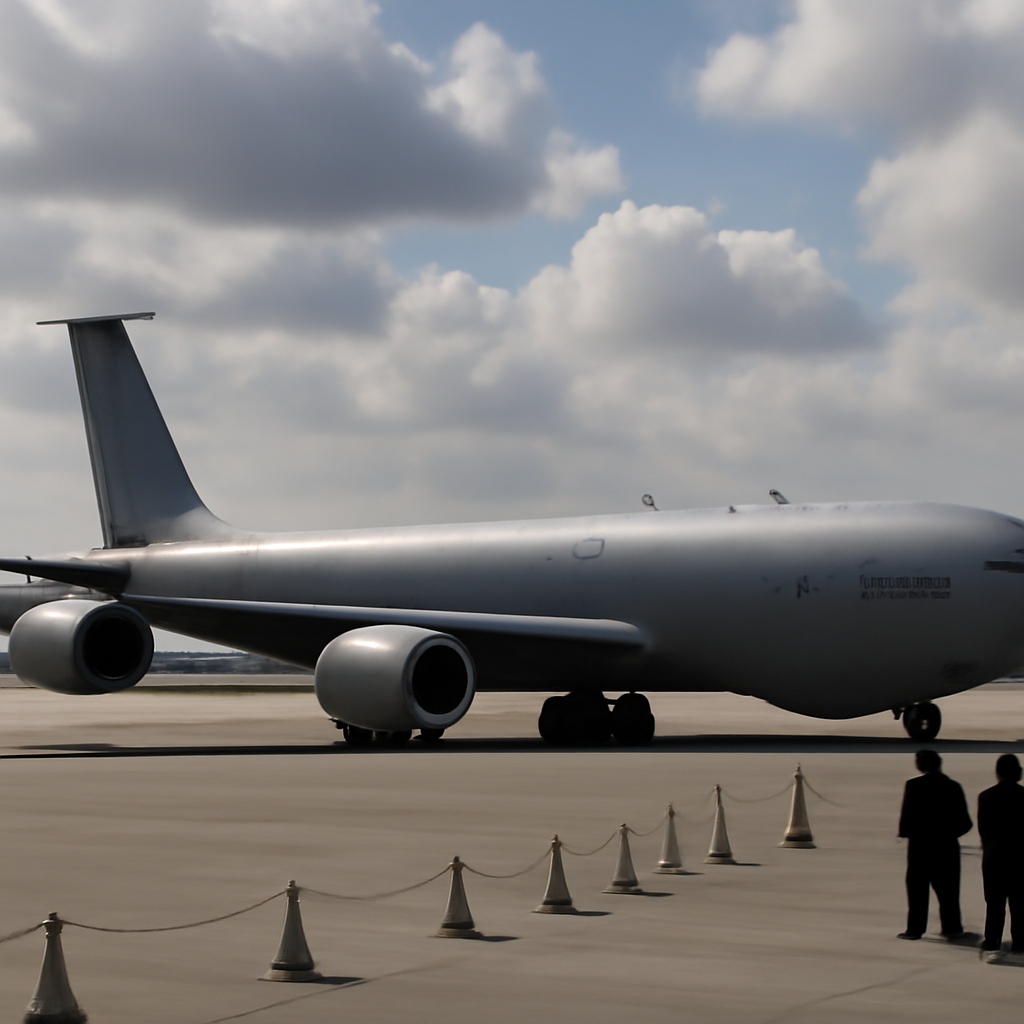
"We promised that we will enable commercial flights and we will not cancel a single ticket because of American refueling planes," Israel’s Transportation Minister Miri Regev said on July 14, 2026, as she ordered that no more than 20 U.S. Air Force refueling tankers be allowed to land at Ben Gurion Airport.
Miri Regev’s limit: 20 tankers at Ben Gurion
On July 14, 2026, Minister Miri Regev instructed that Ben Gurion Airport will not allow any U.S. refueling tankers to land beyond an agreed number of 20 aircraft, and that remaining tankers should instead land at Air Force bases. Regev justified the move by citing the summer travel season and the need to honor hundreds of thousands of civilian flight reservations. Israeli reporting cited by TWZ estimated that, after a partial removal in recent weeks, more than 30 U.S. refueling planes remained at Ben Gurion and that earlier in the buildup roughly 75 U.S. refuelers and cargo planes had been parked there.
CENTCOM’s position and ongoing operations
U.S. Central Command announced additional strikes against Iranian targets on July 14 and said forces would prepare to resume a naval blockade of Iranian ports and coastal areas, with the blockade due to begin at 4 p.m. ET. Navy Capt. Tim Hawkins, CENTCOM’s spokesman, told TWZ the command "will continue working with our Israeli partners to best position U.S. aircraft to support operations," while declining to elaborate. Israeli media reported that senior CENTCOM officials contacted the Israel Defense Forces’ top brass after the Transportation Ministry decision, saying the limitation "directly harms the operational needs of U.S. forces," though TWZ could not independently confirm that report.

Audit-ready is a season. It shouldn't be.
Evidence in spreadsheets, controls drifting between audits, frameworks multiplying on flat headcount. Nubivance runs continuous compliance on Rapid7 Cyber GRC - SOC 2, HIPAA, ISO 27001, PCI, CMMC.
End the scrambleAlternatives and operational constraints across the region
The story lays out a constrained set of basing options for the dozen or so KC-135s and KC-46s that now need a new home. Several bases in the region can host tankers, but each option carries tradeoffs: bases closer to Iran have come under dense Iranian fire; five tankers were reportedly damaged in an Iranian long-range strike on Prince Sultan Air Base in Saudi Arabia in March. Al Udeid Air Base in Qatar, a traditional hub, is described as too risky to operate from due to Iranian standoff weapons. Other bases, such as Muwaffaq Salti Air Base in Jordan, are already packed with aircraft and offer limited ramp space. Satellite imagery noted in reporting indicates the U.S. withdrew 32 of roughly 60–72 refueling tankers previously stationed at Ben Gurion, leaving about 32 as of early July 2026.
Expert assessments: U.S. and Israeli officials on impact
Two former U.S. Air Force leaders and a high‑ranking IDF official interviewed for the story converged on a common assessment: the restriction is a significant inconvenience but not an immediate showstopper. A former senior USAF leader emphasized Ben Gurion’s strategic value—its central location and integrated air‑defense environment—and said the new limits "don’t automatically mean a restriction in U.S. air operations." He described the planners’ tradeoffs: runway and ramp availability, distance to tanker orbits, proximity to threats, and sortie-generation capacity.
Retired Col. Troy Pananon, who once commanded a tanker base, said the limit "has an impact on the overall plan, but it doesn’t limit the ability to execute," noting planners can compensate by using other bases, adjusting loiter times, or changing target sets. The IDF official framed the decision as operational and economic rather than political: Ben Gurion can "operationally accommodate roughly 20 U.S. Air Force refueling tankers" and beyond that parking U.S. aircraft "becomes significant" for civilian traffic, while also calling Ben Gurion "arguably the safest airport in the region for U.S. aircraft."
What this means for U.S. forces, Israeli civil aviation, and regional deterrence
- U.S. forces: CENTCOM and Air Force planners will redistribute tankers among remaining Israeli bases and regional hubs, accepting longer transit times or altered loiter profiles. TWZ reporting notes aircraft redeployments are already underway — for example, F-22 Raptors that had flown from Ovda Air Base were returned to the United States and ten F-22s arrived at RAF Fairford on July 10.
- Israeli civil aviation authorities and travelers: The Transportation Ministry seeks to preserve summer commercial flight schedules by limiting tanker parking at Ben Gurion; Israeli reporting cited a backlog of civilian tickets and concerns about parking-space shortages caused by U.S. military aircraft.
- Regional deterrence and combat operations: While experts stress tanker planners can mitigate basing constraints, the story makes clear that tanker proximity affects sortie duration and frequency—"how much gas is available in the sky" versus mission needs—and that sortie rates and receiver endurance could suffer in a sudden crisis. The piece also notes that in a full wartime scenario, limitations at Ben Gurion would likely be lifted as civilian flights decline.
The operational picture remains in flux: the KC-46s and KC-135s at Ben Gurion form a tanker force larger than Israel’s own tanker inventory, and moving those aircraft around is possible but complex. How long the Transportation Ministry’s 20‑plane cap remains in force — and how rapidly CENTCOM can reconstitute aerial refueling coverage without Ben Gurion’s full support — are the immediate questions that will determine whether the decision is an operational headache or a strategic constraint.