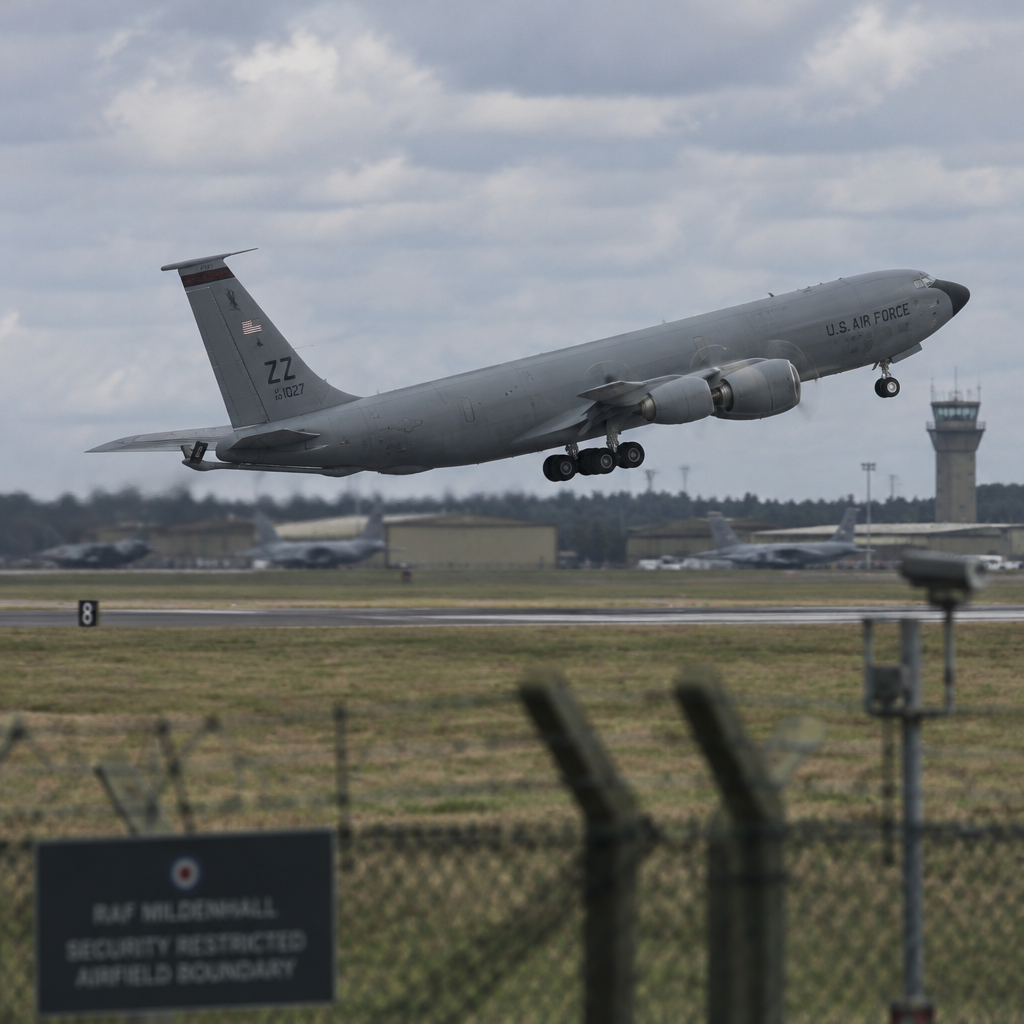
“For operational security reasons, we are unable to discuss specific force protection measures,” USAFE told us on Tuesday morning.
Aircraft movements out of RAF Mildenhall: what happened
Over two days beginning Monday, at least 15 U.S. Air Force aircraft departed RAF Mildenhall in Suffolk, England, amid heightened security measures. Open-source flight trackers and aviation telemetry showed that a KC-135 Stratotanker, tail number 58-0095, took off from Mildenhall toward Germany on Tuesday afternoon local time, and hours later another KC-135, tail number 59-1464, departed, according to Flightradar24 and ADS‑B Exchange. DefenceGeek first noticed the Tuesday flights on X and reported that 10 other KC-135s and three CV‑22 Osprey tiltrotors had left Mildenhall on Monday.
Tracking data and DefenceGeek’s reporting show the tankers flew to Spangdahlem Air Base and Ramstein Air Base in Germany, Moron Air Base in Spain, and Glasgow Prestwick International Airport in Scotland. The three CV‑22s moved to RAF Lakenheath. DefenceGeek posted an update noting that “two further 100th Aerial Refuelling Wing tankers have departed RAF Mildenhall (EGUN) to disperse” after ground crews made them flyable and that some non‑100th ARW assets had also moved.
Public replies and operational security: USAFE, EUCOM, and the White House
When asked about the repositioning and reports of Iranian threats, the White House referred questions to U.S. European Command (EUCOM). EUCOM’s statement declined to offer specifics about aircraft movements or the enhanced security measures. U.S. Air Forces in Europe – Air Forces Africa (USAFE) likewise declined to provide details, saying only the general line quoted above and adding that “we constantly assess a variety of factors that determine what measures are implemented or modified.” USAFE said Mildenhall “remains vigilant” and urged reporting of unusual activity while refusing to comment on matters of intelligence.

This site is the portfolio.
OSINTSights runs on Cloudflare Workers, D1, R2, and Vectorize, with an AI pipeline on Hetzner ARM. Nubivance designed, built, and operates it. We do the same for clients.
See what we buildThe reported threat, alert level, and media reporting
The Wall Street Journal reported Monday night that the departures began after an unspecified threat from Iran; TWZ was the first to report that Mildenhall and RAF Lakenheath were operating under enhanced security measures. TWZ said it could not independently confirm the Journal’s reporting. According to the Journal, U.S. officials were still discussing “the precise nature of the threat to RAF Mildenhall—whether imminent or more general.”
U.K. and U.S. officials raised security to Force Protection Condition Charlie at both Mildenhall and Lakenheath. The source describes FPCON Charlie as the second‑highest alert for U.S. installations, applied “when an incident occurs or intelligence is received indicating some form of terrorist action targeting personnel or facilities is likely.”
Related incidents in the region and recent accusations against Iran
The repositioning at Mildenhall comes a month after U.S. Air Force B‑1B Lancer bombers hastily left RAF Fairford following a security incident that U.S. reporting linked to Iran. Separately, French authorities have publicly blamed the Islamic Revolutionary Guard Corps for a cyber campaign on 11–12 October that targeted nearly 700 retail sites’ refrigeration systems; French Minister Jean‑Noël Barrot said, “we know who is responsible: the Islamic Revolutionary Guard Corps of Iran.”
On Tuesday the U.S. Department of Justice unsealed an indictment charging three men—Mohammad Baqer Saad Dawood al‑Saadi, Mohsen Mohajeri, and Mohammad Ali al‑Hassani—with conspiring to commit terrorist attacks in Europe and the United States on behalf of an Iran‑aligned network “which included the IRGC and Kata’ib Hizballah.” The DOJ alleges al‑Hassani “allegedly orchestrated a terrorist plot at a British Royal Air Force Base (RAF Fairford)” in September and that al‑Saadi attempted to coordinate with co‑conspirators from jail by passing coded messages through third parties.
What this means for the 100th Air Refueling Wing, the U.K. government, and EUCOM
- 100th Air Refueling Wing (host unit at Mildenhall): Retired Col. Troy Pananon, a former commander of the wing, described the departures as “atypical” and said the movements “certainly appears that the hasty departure of all these aircraft is based on a credible threat,” noting decisions to move aircraft can be driven by precautionary operational judgments rather than an indication of an acute, confirmed attack.
- U.K. government: A spokesman for the prime minister told Reuters that protecting Britain’s military bases is a top priority, that the government is working with police and allies, and highlighted investments of “more than £2 billion in air defense and counter‑drone capabilities.” The spokesman said he was confident bases were safe.
- U.S. European Command and USAFE: Both have emphasized operational security and declined to discuss intelligence details publicly. Their current posture, as reflected in the dispersals and FPCON raise, prioritizes force protection and asset dispersal as a mitigating step.
Secretary of State Marco Rubio, speaking at a G7 foreign ministers’ meeting in Paris on Tuesday, said that “at this point the economic campaign and the pressure and the devastation that our economic campaign is having on the Iranian regime is working so well that the President really doesn’t have any need to conduct major combat operations,” while noting the U.S. military stands ready if Iran “crosses certain red lines.”
The immediate facts are straightforward: multiple KC‑135 tankers and CV‑22s left RAF Mildenhall and related bases over 48 hours, security at Mildenhall and Lakenheath was raised to FPCON Charlie, and U.S. and U.K. authorities have limited their public comments. The central unanswered question—whether the departures were prompted by a specific, imminent threat or by a broader intelligence assessment—has not been resolved in public statements from EUCOM or USAFE. That ambiguity, and the recent DOJ allegations tied to plots against RAF Fairford, are the concrete elements now shaping force posture and diplomatic messaging in Europe.