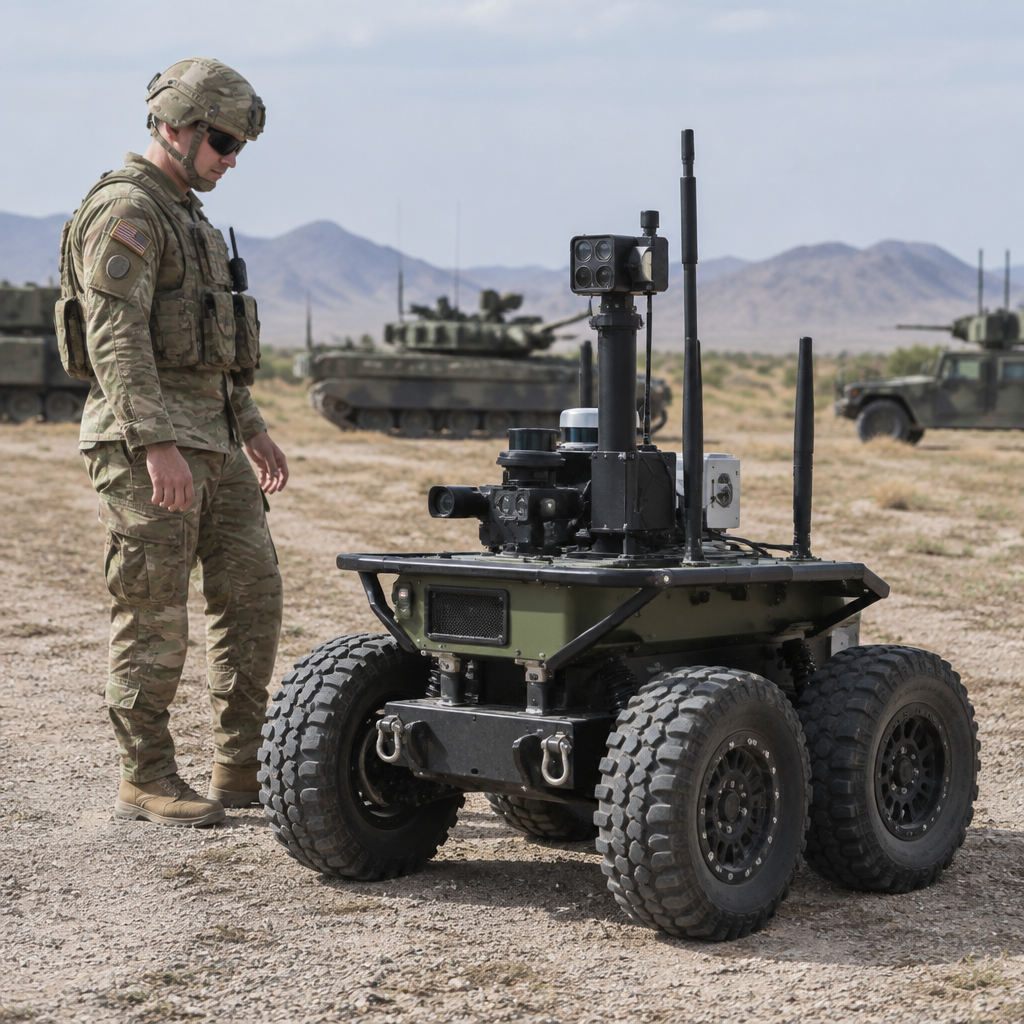
"How the United States and NATO are bringing robotics to the front line of combat." — Defense One
Patrick Tucker sets the stage
Host Patrick Tucker has launched a new podcast, Defense One Futures, to probe a single, pointed question: how rapid technological and geopolitical shifts are reshaping how the United States and its allies prepare for conflict. The trailer for the series promises conversations that focus on the operational and institutional consequences of robotics and autonomy, and frames the discussion around three concrete levers — buying, building, and training — as they are remade in what the show calls "the age of autonomy."
Maj. Gen. Jason Slider and the U.S. Army's educational front
Among the guests announced is Maj. Gen. Jason Slider, who leads the U.S. Army John F. Kennedy Special Warfare Center and School. His appearance signals that the podcast will take seriously the connection between doctrine, force development, and education: the Special Warfare Center is positioned in the trailer as a locus for thinking through how training and institutional practices must change when robotics and autonomous systems move from experimental labs to front-line use. The trailer ties Slider's role directly to the show's organizing questions about reimagining "training" in the face of technological change.

The cyber insurance questionnaire just landed. Now what?
SOC 2, HIPAA, insurance renewals - someone has to own security strategy. Nubivance provides fractional CISO leadership without the full-time salary.
Get a security leadPoland's perspective: Paweł Zalewski and NATO partnership
The podcast will also include Paweł Zalewski, identified in the trailer as the Polish Deputy Minister of National Defence. His participation underscores the series' stated focus on NATO as a collective actor: the trailer explicitly frames the project as an exploration of how "the United States and NATO allies" are bringing robotics to combat. Zalewski's voice, as presented, is positioned to represent an allied national view on procurement, interoperability, and alliance-level choices about adopting autonomous capabilities.
Science and alliance research: João Alves of NATO-CMRE
João Alves, named in the trailer as a principal scientist at NATO-CMRE, joins the lineup to offer a scientific and research-oriented perspective. NATO-CMRE's inclusion in the cast points the conversation toward the technical underpinnings and collaborative research that sit behind any shift toward robotics on the battlefield. In the trailer, Alves' presence is presented as part of a trio—military education, national defence leadership, and alliance science—that the series will use to interrogate "buying, building and training" in the age of autonomy.
How the U.S. Military, NATO allies, and those responsible for buying and building are affected
- The U.S. Military will be asked to rethink training models and institutional learning: the trailer pairs Maj. Gen. Jason Slider’s role leading a major training institution with the podcast’s stated aim of reimagining "training" for autonomous systems.
- NATO allies will be part of a collective conversation about use and interoperability: the trailer frames the project as an inquiry into how "the United States and NATO allies" jointly bring robotics to front-line missions, with national and alliance voices such as Paweł Zalewski contributing.
- Those responsible for buying and building — the actors the trailer repeatedly groups under "buying" and "building" — are placed at the center of analysis, as the podcast promises to examine procurement and development choices in the context of rapid technological and geopolitical change.
The Defense One Futures trailer is compact but deliberate: it assembles a host and three guests who represent education, national defence leadership, and alliance science, and it uses them to map a single argument. That argument is straightforward and consequential as framed by the show itself — that robotics and autonomy are forcing the U.S. and its NATO partners to rethink buying, building, and training. The trailer offers no timetable, budget figures, or policy prescriptions; instead, it points listeners to the conversations that will follow.
Listeners interested in how military education, allied coordination, and alliance research are being shaped by robotics will find the series positioned to address those overlaps. The podcast's next steps are simple and concrete: conversations with Maj. Gen. Jason Slider, Paweł Zalewski, and João Alves about how the U.S. Military and NATO allies are reimagining core practices in the age of autonomy — an agenda the trailer states plainly and leaves to the episodes to unpack.