“We’re exploring a concept for deploying Vektrex-derived maneuvering submunitions from air- and ground-launched missiles to address emerging needs for extended-range precision fires,” Mike Rucker, Vice President of GA-EMS Weapons Programs, said in a statement to TWZ.
General Atomics’ Vektrex: from LRMP to glide submunitions
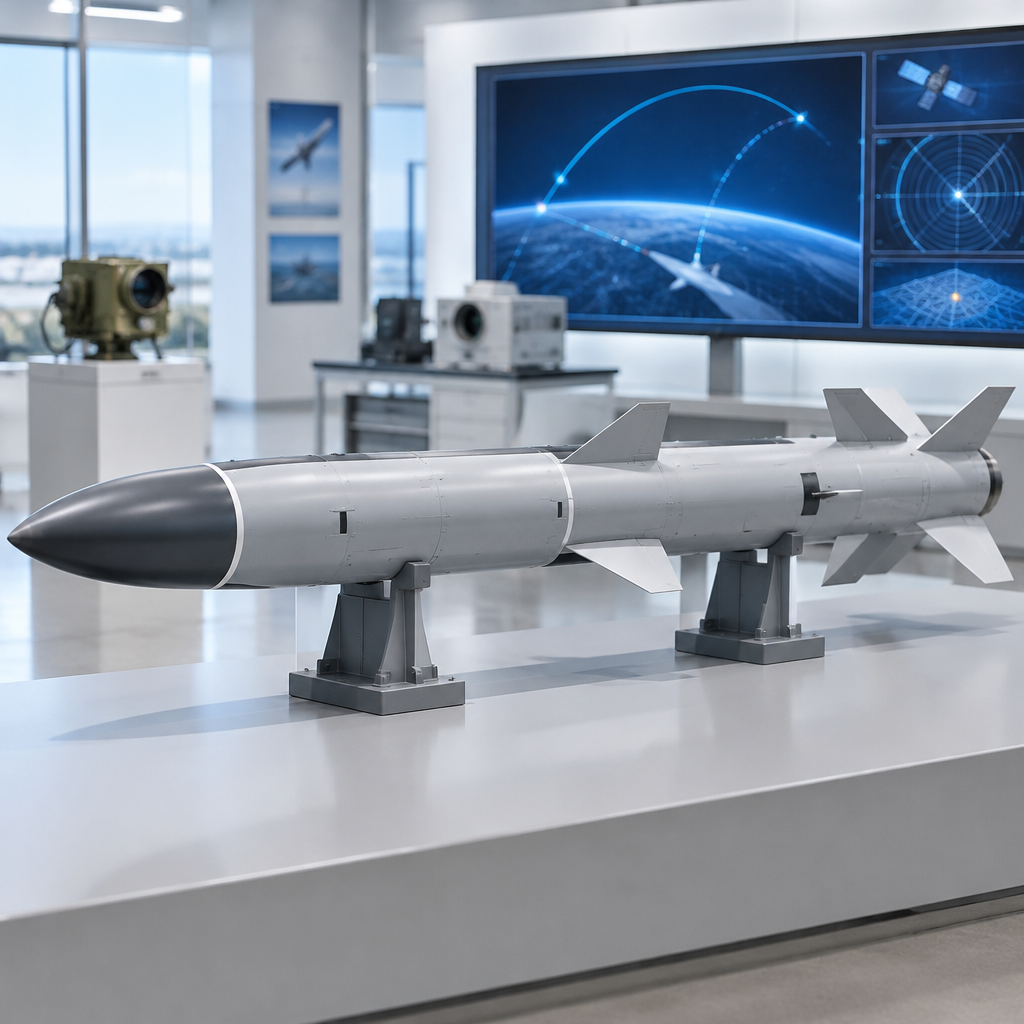
General Atomics first introduced Vektrex in 2023 under the name Long Range Maneuvering Projectile (LRMP). The design is an unpowered precision-guided munition with pop-out wings that deploy after launch to generate aerodynamic glide. According to General Atomics, Vektrex incorporates “advanced redundant guidance systems” that allow it to hit static or moving targets, to operate with resilient navigation in GPS-degraded or denied environments, and to use multiple approach vectors — including a steep terminal dive, alternate shaped flight paths, or switching to an onboard seeker for mobile targets. Initial development has focused on a 155mm howitzer-launched version, with a concept also shown for a 5-inch naval gun configuration.
AIM-174B (Gunslinger) pairing and the seven-submunition concept
At the Euronaval 2026 exhibition in Paris, General Atomics displayed a rendering of an AIM-174B air-to-air missile converted into a strike weapon carrying seven Vektrex-derived submunitions. The rendering, first reported by Naval News and later shared with TWZ, positions the AIM-174B — officially unveiled by the U.S. Navy in 2024 and known as the Gunslinger — as a potential carrier for multiple maneuvering glide munitions. The Navy currently describes the AIM-174B as purely an air-to-air missile, but General Atomics’ concept would repurpose its volume to hold and release multiple submunitions during flight.

This site is the portfolio.
OSINTSights runs on Cloudflare Workers, D1, R2, and Vectorize, with an AI pipeline on Hetzner ARM. Nubivance designed, built, and operates it. We do the same for clients.
See what we buildRange claims and comparative reach
General Atomics projects that a 155mm-fired Vektrex from a 39‑caliber howitzer could exceed 74.5 miles (120 kilometers) and that a 52‑caliber 155mm launch could extend beyond 124 miles (200 kilometers). For context provided in the same materials, existing 39‑caliber 155mm howitzers are generally pegged at about 19 miles with unguided rocket-assisted rounds and about 25 miles when firing GPS-assisted M982 Excalibur shells. The AIM-174B itself benefits from being air‑launched and, given its SM‑6 lineage (the SM‑6 is stated to have a range well over 200 miles), could be understood to have a maximum range measured in the hundreds of miles; Vektrex-derived submunitions released from such a missile would add dozens of miles of further reach from their release points, General Atomics says.
Operational implications for aircraft and ships
General Atomics’ rendering shows an F/A‑18E/F Super Hornet launching an AIM‑174B loaded with seven submunitions; two such missiles on two weapon stations would give that jet 14 glide submunitions, and a Super Hornet fitted with four of the missiles could carry up to 28. The company notes that converting a missile like the AIM‑174B into a submunition dispenser could allow a single aircraft sortie to engage multiple targets across a broader area and to strike deeper into hostile territory while keeping launch platforms farther from air defenses. The concept also extends to surface-launched options: Vektrex-derived submunitions could be housed in surface-launched SM‑6s or other suitably large missiles, and the U.S. military already fields ways to fire SM‑6s from ships and land-based launchers.
Manufacturing, engineering and technical limits
General Atomics stresses the work remains at a conceptual stage and would require additional engineering and validation. The company says its investments in advanced weapons production — including automated precision machining cells, robotics, assembly and systems integration at Mississippi operations announced in June — provide a manufacturing foundation should designs qualify and customers commit. Technical hurdles are acknowledged: safely releasing submunitions from a missile traveling at high speed presents physical and thermal stresses that onboard seekers and components must withstand. General Atomics points out that the core Vektrex design is built from the outset to survive artillery launch stresses and that a missile could perform maneuvers to bleed off energy before submunition release.
What this means for the U.S. Navy, the U.S. Army, and prospective customers
- U.S. Navy: The AIM‑174B pairing would offer a potential new air‑to‑surface mode for a weapon the Navy currently describes as air‑to‑air, enabling single missiles to cover multiple targets at extended ranges and to complement ship‑launched SM‑6 options.
- U.S. Army: Vektrex’s artillery pedigree directly informs the submunition idea; the Army is already a developer of Vektrex 155mm applications and fields options for surface-launched SM‑6s, and it is considering future missile payload diversity (the source notes Army discussions of enhanced PrSM payloads that could include precision submunitions or drones).
- Prospective customers and allies: General Atomics frames the concept as a way to extend precision fires while retaining affordability and producibility, but it also makes clear there is not yet a sponsoring customer and the near-term focus remains maturing the 155mm Vektrex for procurement.
General Atomics has laid out a detailed technical starting point and a set of possible pairings — from artillery tubes to AIM‑174Bs and surface SM‑6s — but has also framed the entire idea as exploratory. The rendering and follow-on statements show where the company is hoping precision glide munitions could evolve; whether militaries will adopt missile‑borne Vektrex derivatives depends on the engineering, testing, cost, and operational trade-offs that remain to be resolved.