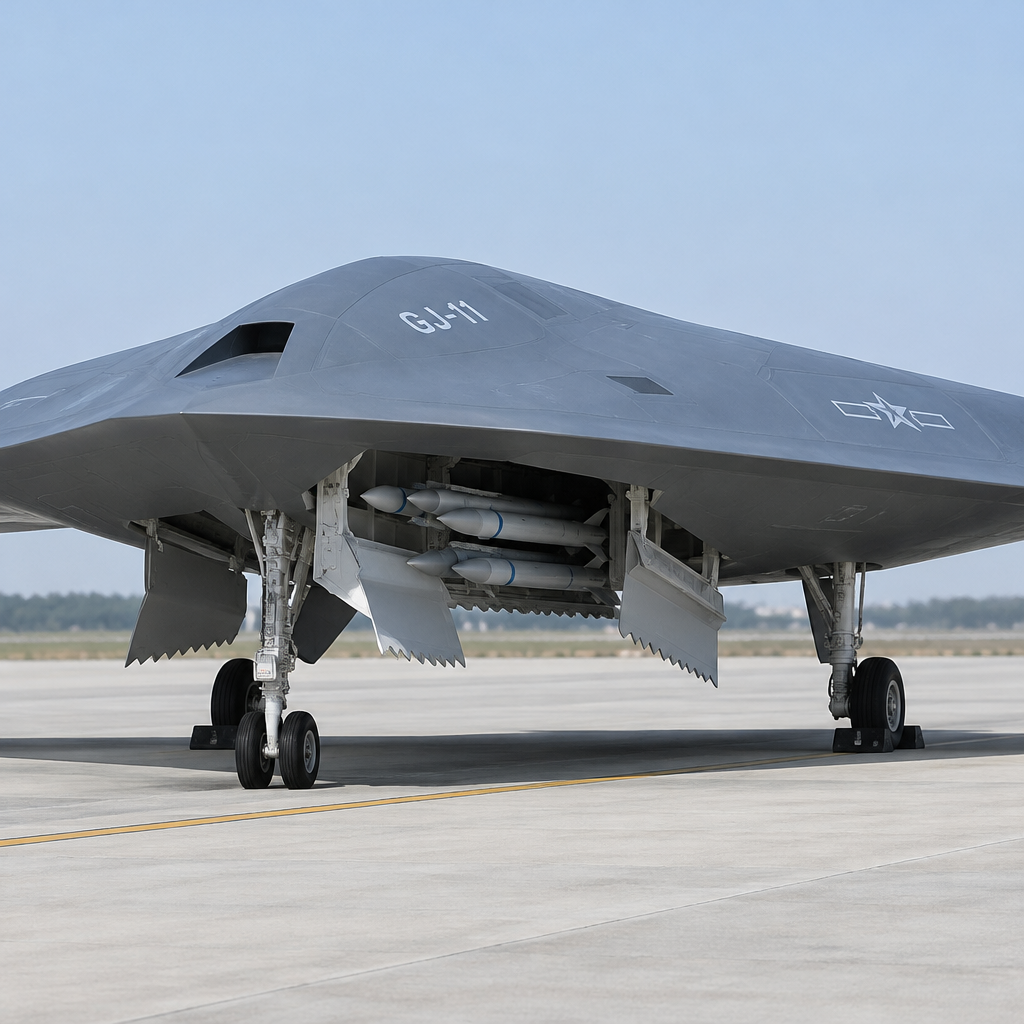
"the GJ-11 has completed its first live-fire strike mission, scoring a hit," CCTV reported, relaying a claim from the People's Liberation Army Air Force.
Internal weapons bays and the low‑observable mission
Chinese state television released the clearest multi‑angle footage yet of the GJ‑11 Xuanlong, showing two ventral internal weapons bays within the flying‑wing blended body. The bay doors have serrated edges — a feature commonly applied on low‑observable aircraft — and CCTV said the bays can carry a variety of air‑to‑ground and surface munitions. While the footage does not disclose precise internal arrangements or weapon lists, analysts in the report estimate each bay could likely accept 1,000‑pound and 2,000‑pound‑class weapons. AVIC had previously displayed a model in 2021 that hinted at internal carriage; the new footage confirms the configuration on the actual aircraft.
Sensors, exhaust layout and landing gear revealed
The video exposes several notable details of the GJ‑11’s external configuration. A trapezoidal glazed fairing beneath the nose appears consistent with an electro‑optical/infrared (EO/IR) sensor installation; CCTV and the report note similar installations on the crewed J‑20 and J‑35 and liken the arrangement to an electro‑optical targeting system (EOTS) type function. The rear view shows a flattened, shielded exhaust outlet integrated into the upper rear of the airframe — reportedly for a WS‑13 turbofan — combined with a dorsal air intake and an absence of exposed engine nozzles, measures intended to reduce radar and infrared signature from critical aspects. Footage also captures the landing gear retracting after takeoff; the nose unit is a heavy‑duty twin‑wheel assembly, and observers note it may be the same gear used on the carrier‑capable GJ‑21 derivative.

This site is the portfolio.
OSINTSights runs on Cloudflare Workers, D1, R2, and Vectorize, with an AI pipeline on Hetzner ARM. Nubivance designed, built, and operates it. We do the same for clients.
See what we buildClaimed first live‑fire strike and questions about autonomy
CCTV reported that two members of the PLAAF’s initial batch of female drone operators participated in the claimed live‑fire event. One operator, named Shi Xiaoran in the broadcast, described cloud cover initially obscuring the target before she circled, located the objective, released the weapon and scored a hit. The footage demonstrates weapons employment, but the coverage and reporting do not establish whether the GJ‑11 located and engaged the target autonomously or under full human direction. CCTV shows the drone operated under man‑in‑the‑loop (MITL) direct control in the sequences released, and the report notes the platform likely features, or will feature, semi‑autonomous control modes for teaming applications.
Manned‑unmanned teaming with J‑16 and J‑20 fighters
One of the clearest operational cues from CCTV is the GJ‑11’s role alongside crewed fighters. The footage includes mission planning and sorties showing the UCAV operating with J‑16 Flanker multirole fighters and in separate sequences with J‑20 fifth‑generation fighters. The report frames the J‑16 as providing strike and electronic‑warfare capability and the J‑20 as a stealthy crewed counterpart; an uncrewed GJ‑11 could extend sensor coverage, carry extra weapons, conduct reconnaissance, or undertake hazardous tasks. The release does not, however, disclose how targeting information is passed between platforms, what tactical datalinks are used, or the precise level of autonomy the UCAV will employ. The PLAAF has previously trialed crewed aircraft as drone controllers, and the concept of crewed aircraft controlling UCAVs is described as part of China’s basic concept for the type.
What this means for the PLAAF, the PLA Navy, and AVIC
- PLAAF: The footage and the claimed live‑fire event underline an intent to field the GJ‑11 as an operational strike and suppression‑of‑enemy‑air‑defenses (SEAD) asset that can integrate with crewed formations.
- PLA Navy: Development of a naval derivative, the GJ‑21, was highlighted by China’s October 2026 announcement that the GJ‑21 completed a first launch and recovery aboard the Type 076 amphibious assault ship Sichuan — a claim for which no independent footage has been released.
- AVIC and program observers: Public displays (AVIC’s 2021 model) and satellite imagery reviewed by TWZ showing activity at the Malan test facility in Xinjiang and deployments to Shigatse in 2025 point to the program moving from test to low‑rate initial production; visible markings such as 0003, 0011 and 0012 have been identified by observers as likely LRIP design numbers.
The CCTV release supplies the most complete public portrayal to date of the Mystery Dragon’s airframe, sensors and weapons carriage — and it brings the program squarely into view as a platform intended for penetration, strike and teaming with crewed fighters. Important operational details remain unshown in the footage: the exact weapons integrated, the extent of onboard autonomy, and the datalinking and command arrangements for manned‑unmanned teaming. Still, the imagery and the PLAAF claim together mark a clear signal: the GJ‑11 is moving from concept and testing toward operational employment within China’s broader combat aviation structure.