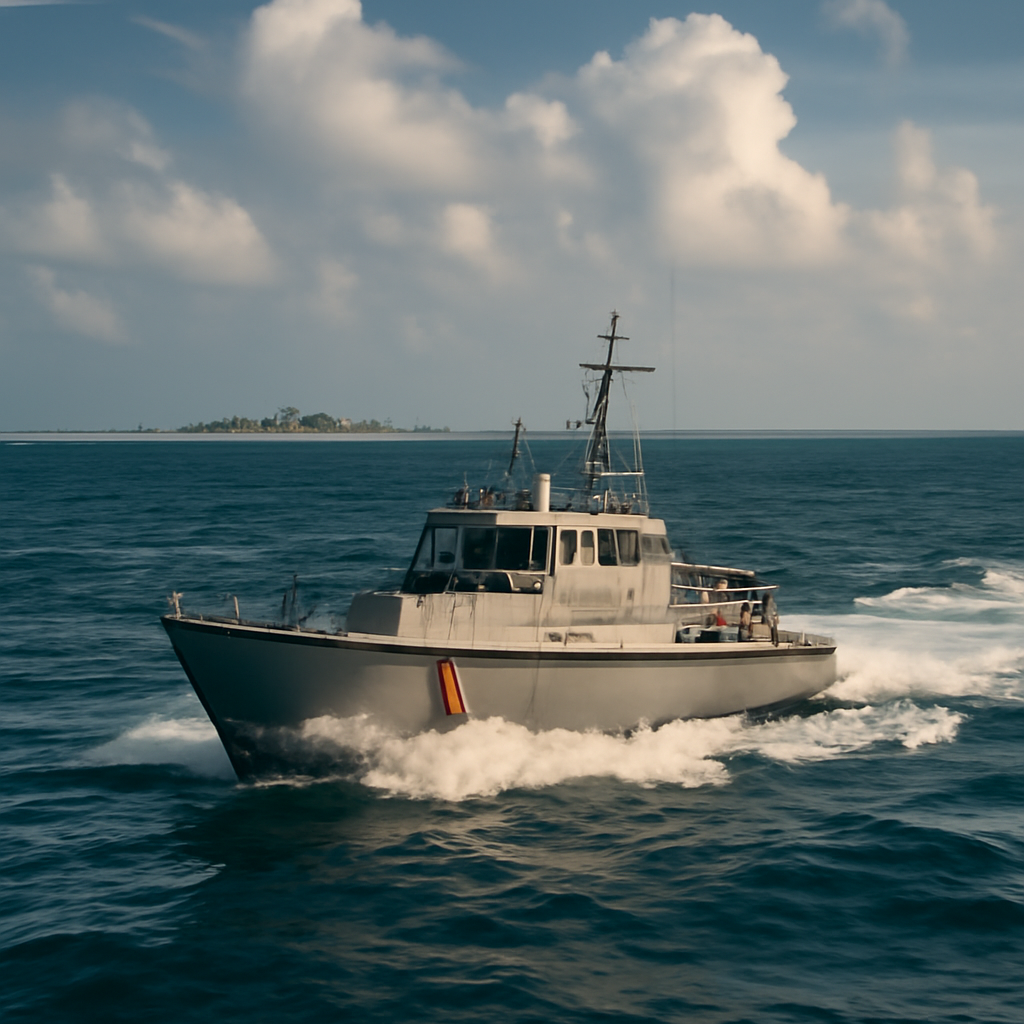
“Passive resistance to Beijing’s actions in the South China Sea is not working.” That blunt assessment from the piece’s author frames what is at stake: whether the United States and its partners will continue to absorb coercive, below‑the‑threshold tactics or adopt calibrated measures that impose costs and change Beijing’s calculations.
Beijing’s refined grey‑zone playbook
The South China Sea has become a laboratory for coercion that stays deliberately below the threshold of armed conflict. The article catalogues the toolkit Beijing has refined over a decade: coast guard vessels ramming Philippine ships, maritime militia swarming disputed reefs and uncrewed aircraft shadowing foreign vessels. Washington’s principal responses so far — patrols, joint statements and expressions of concern — “have imposed few costs and changed little,” the piece argues, effectively reassuring Beijing that these tactics can continue.
Adapting F3EAD into an F2RED response cycle
Rather than mirror China’s blunt instruments, the article proposes the United States adapt an existing targeting template. The military’s F3EAD (find, fix, finish, exploit, analyse and disseminate) is reframed for grey‑zone competition as F2RED: find, fix, respond, exploit and disseminate. The crucial change: replace the kinetic “finish” with calibrated non‑kinetic responses so states can impose costs while remaining below the threshold of armed conflict.

Audit-ready is a season. It shouldn't be.
Evidence in spreadsheets, controls drifting between audits, frameworks multiplying on flat headcount. Nubivance runs continuous compliance on Rapid7 Cyber GRC - SOC 2, HIPAA, ISO 27001, PCI, CMMC.
End the scrambleSoft‑kill, cyber and signalling as calibrated responses
Soft‑kill effects — non‑kinetic measures that avoid destruction or immediate loss of life — are presented as a principal tool. When Chinese vessels launch uncrewed aircraft to harass or surveil allied ships, allied forces can jam or bring down those drones in real time. Operations can also be conducted against Chinese drones elsewhere to divert attention from the site of tension. The article stresses these actions must be paired with signalling so Beijing understands the link between its behaviour and the costs it will bear.
Cyber operations are singled out as a second channel for imposing costs. Beyond public attribution of Chinese cyber activity, the United States could integrate offensive cyber capabilities into the “respond” phase to disrupt systems associated with Chinese maritime operations. Because such effects can be applied from outside the immediate area of a dispute, they provide strategic depth and an alternative means of response.
Law enforcement, financial tools, and legal discipline
The article calls for a disciplined blend of law enforcement and financial pressure. The US Coast Guard and Navy would work alongside partner coast guards to block, stop and arrest militia or fishing crews caught operating illegally in partner waters — with the principle being partners enforce their own laws “in their own waters, with US ships and intelligence backing them.” That enforcement must be strictly legal and confined to those breaking international law and partners’ laws.
On the financial side, the piece points to an existing precedent: in 2022 the US Treasury sanctioned Chinese distant‑water fishing companies, adding more than 150 vessels to the Specially Designated Nationals list over human rights abuses and illegal fishing. Extending that approach to illegal fishing and militia activity in the South China Sea, the article argues, would freeze assets and persuade banks to cut ties, further complicating militia and fishing operations.
What this means for the Philippines, the US Coast Guard and Navy, and regional fence‑sitters
- The Philippines/Manila: The article recommends providing tracking data and other intelligence so Manila can lawfully enforce its rights and arrest illegal fishing vessels in its exclusive economic zone. It envisions US support — jamming Chinese drones, sharing ISR — that enhances Philippine capacity without supplanting it.
- The US Coast Guard and Navy: The piece assigns them a central role in on‑the‑water enforcement, paired with intelligence backing to ensure operations remain within legal bounds while directly countering militia and illegal fishing activities.
- Regional fence‑sitters: Many states “dislike China’s bullying but lack the resources to resist it alone.” The proposed approach aims to give those states practical assistance and visible consequences for coercive Chinese tactics, which could stiffen their resolve.
The article acknowledges critics’ warnings about escalation and accepts that some short‑term friction is likely. Its core argument is straightforward: Beijing currently pays nothing for testing its neighbours, so it will keep testing unless the United States and partners make testing costly. A US‑China hotline is proposed as a complementary confidence‑building measure — alert Beijing before a response begins, and give it an off‑ramp.
The practical question the piece leaves for policymakers is precise: will Washington pair surveillance with deliberate, lawful responses — cyber and soft‑kill measures, partnered law enforcement, and targeted financial penalties — so that coercion in the South China Sea no longer yields benign neglect but real costs?