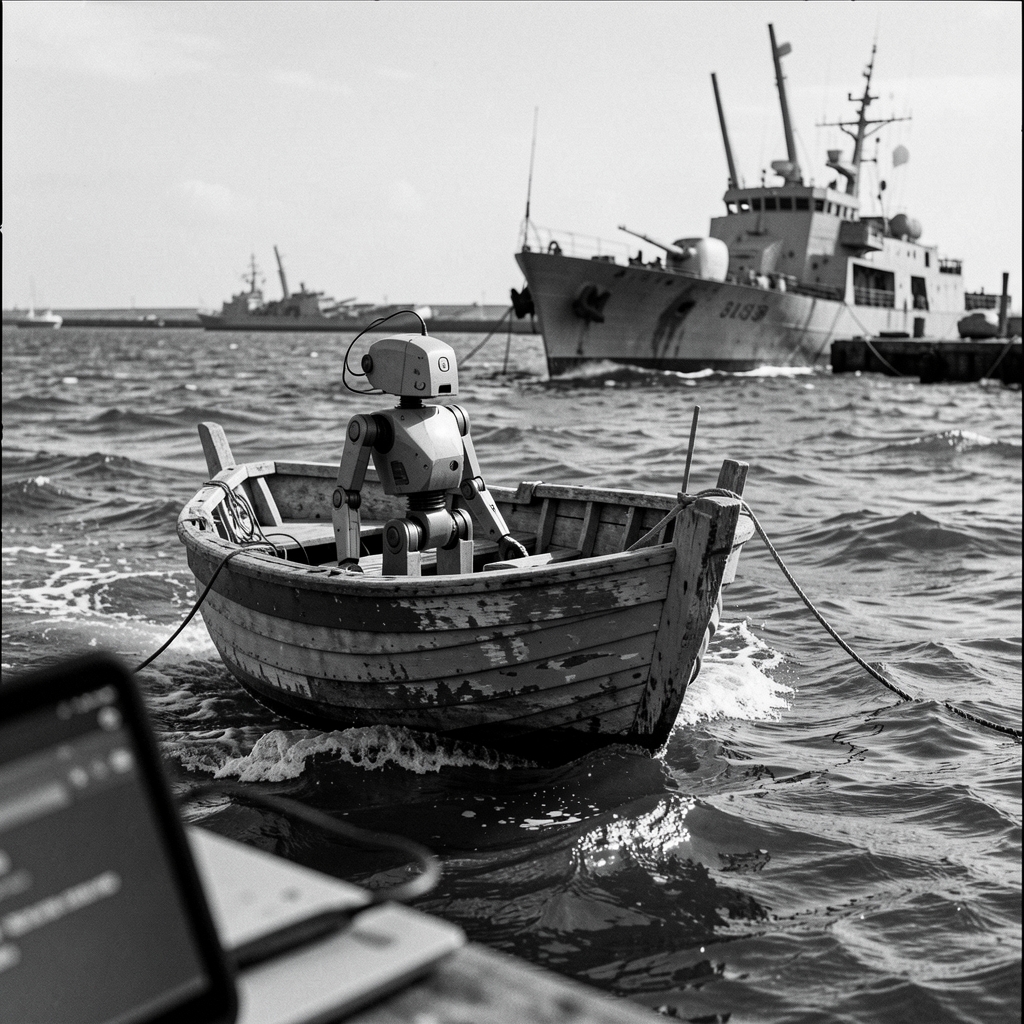
Can a navy built of plastic and code be led by humans? A recent Defense One analysis answers that question bluntly: "Command and control will remain a human endeavor—even as the Pacific fills with robo-boats." That line frames a dilemma at the intersection of robotics, strategy and governance — one the piece says puts limits on straightforward emulation of battlefield innovation.
The central claim
The Defense One article argues that the United States cannot simply copy the so-called "robot navy" model attributed to Ukraine. Rather than presenting a like-for-like blueprint, the article emphasizes a single, overriding point: no matter how many unmanned surface vessels populate the sea, command and control will continue to be exercised by people.
What the article lays out
- The piece cautions against treating an observed operational model as a turnkey solution for other fleets.
- It highlights the persistence of human authority: the article states that command and control will remain a human endeavor even as autonomous vessels proliferate.
- The article situates this question geographically, noting a future in which the Pacific could become dense with "robo-boats," and implies that this density has implications for how forces will be directed.

This site is the portfolio.
OSINTSights runs on Cloudflare Workers, D1, R2, and Vectorize, with an AI pipeline on Hetzner ARM. Nubivance designed, built, and operates it. We do the same for clients.
See what we buildWhy that matters — as the article presents it
By foregrounding human command and control, the Defense One analysis reframes the conversation from one of pure acquisition to one of organizational design and responsibility. The piece suggests that copying hardware or tactics alone would be insufficient if the larger systems that determine who directs action, how decisions are made and where accountability resides are not replicated or adapted.
The article also implies strategic friction: a sea crowded by unmanned vessels is not merely a logistics problem but a governance and doctrine problem. If command and control remain human responsibilities, then scaling up unmanned fleets raises questions about training, decision pathways, legal authorities and operational oversight — all of which the article treats as central to whether a model can be exported from one theater or actor to another.
Different lenses, one caution
Throughout, the Defense One piece invites multiple perspectives without prescribing a single course. Technologists might see replication in platforms; policymakers might look to doctrine and legal frameworks; operators will be concerned with who pulls the levers in combat. The article's core caution — that command and control do not transfer as effortlessly as hulls and sensors — speaks to all those audiences.
Implicitly, the article asks readers to weigh the limits of imitation against the complexity of maritime command structures. It does not reduce the issue to equipment lists. Instead, it advances a broader warning: technological resemblance does not guarantee operational equivalence when the human element remains decisive.
If the Pacific does indeed become a theater crowded with robotic vessels, the Defense One analysis contends that the real question will be less about how many boats can be built and more about how humans will continue to steer, authorize and be accountable for their employment.
What remains unsettled in the article is the precise mix of institutional reforms, training and legal adjustments that would make a transfer of doctrine feasible — a gap the piece presents as both a practical and moral consideration for planners and publics alike.
Is the future of naval warfare a matter of mass-producing robotic hulls, or of reinventing the human systems that control them? The Defense One article urges readers to keep their attention on the latter.