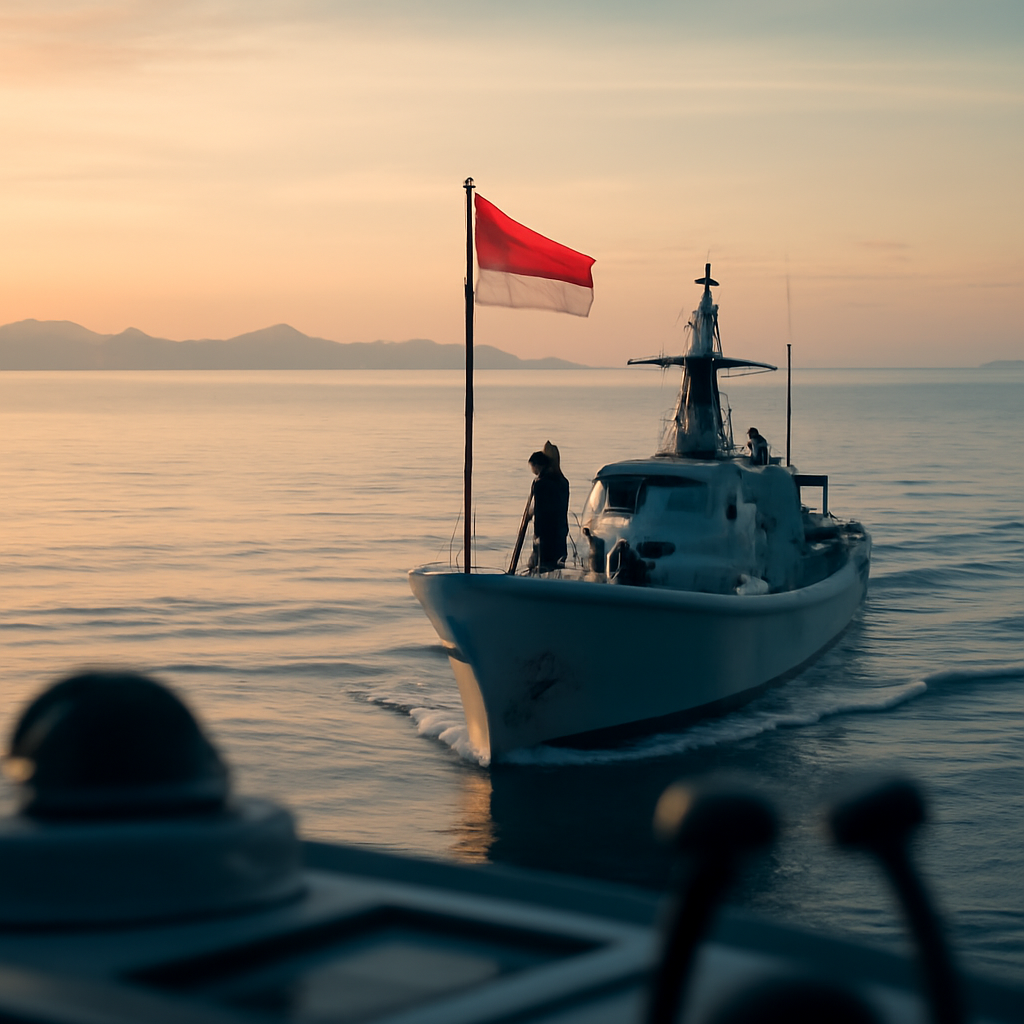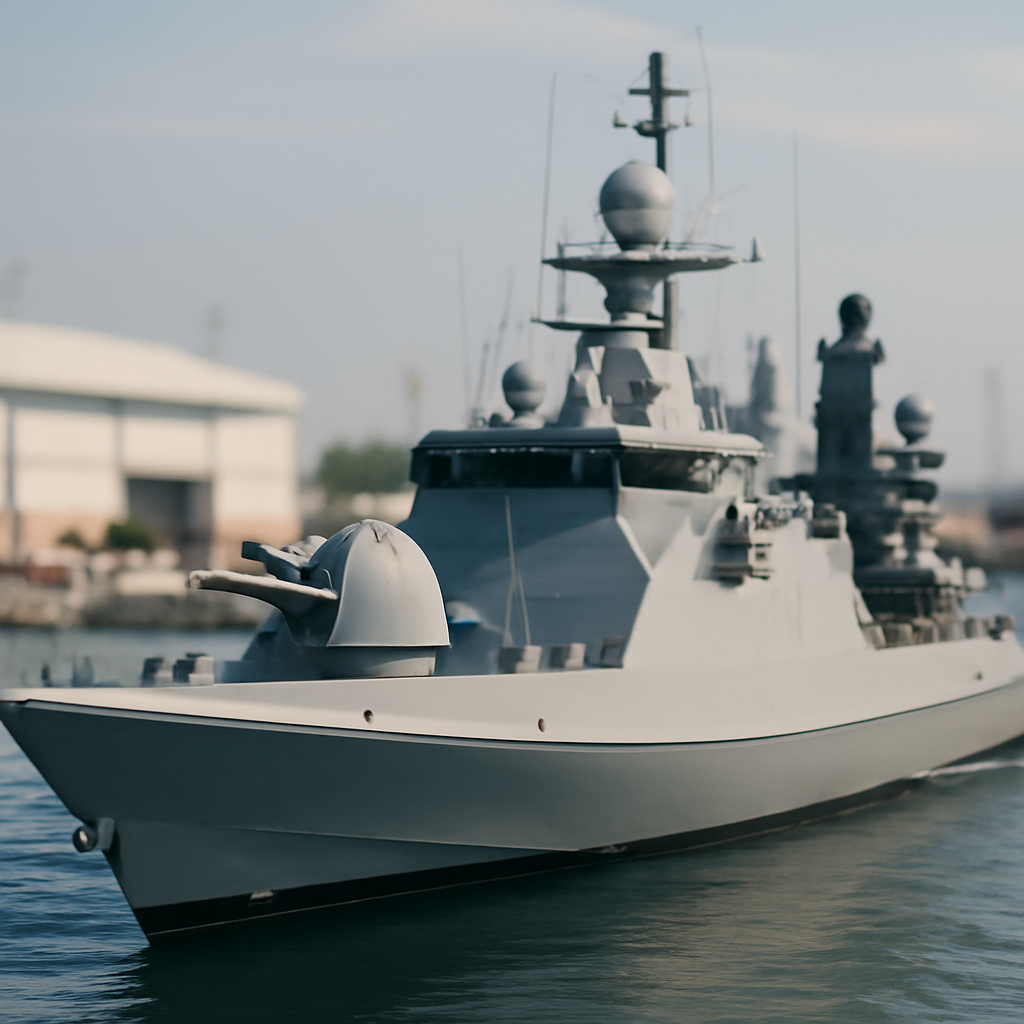
At around 670 tons full load displacement, and a crew of just 39, it may be one of the most heavily armed warships anywhere in the world for its size.
A compact but unusually powerful profile
The Falaj 3 is officially classed as an offshore patrol vessel (OPV) yet measures a little over 200 feet in length and displaces roughly 670 tons at full load. Built by Abu Dhabi Ship Building (ADSB), a subsidiary of Edge Group, the class bucks conventional OPV design trade-offs by concentrating an unusually dense weapons fit into a compact hull. The first ship of the class, Altaf, was commissioned in February 2025.
Layered air defence and anti-ship reach
The Falaj 3 pairs a medium-calibre gun with two independent short-range air-defence layers and a substantive anti-ship strike capability. Forward is a Leonardo 76mm OTO Super Rapid gun equipped with the STRALES guided ammunition system and DART projectiles — a guided, radio-beam–steered round fitted with a proximity fuze, described as effective against manoeuvring supersonic missiles and fast-manoeuvring small boats.
Directly aft of the gun sits an eight-cell vertical launch system loaded with MBDA VL MICA surface-to-air missiles, a “fire and forget” missile with an interception range of up to around 12 miles and reach to about 30,000 feet. Further aft is a 21-cell Raytheon Mk 49 launcher for the RIM-116 Rolling Airframe Missile (RAM), providing an independent point-defence layer. The offensive punch includes four MM40 Exocet Block 3C anti-ship missiles, with an advertised range of around 150 miles.

Audit-ready is a season. It shouldn't be.
Evidence in spreadsheets, controls drifting between audits, frameworks multiplying on flat headcount. Nubivance runs continuous compliance on Rapid7 Cyber GRC - SOC 2, HIPAA, ISO 27001, PCI, CMMC.
End the scrambleClose-in weapons, counter-swarm tools and electronic sensors
For countering small, low-cost threats and saturating attacks, the Falaj 3 carries two 12-cell Low-cost Guided Imaging Rocket (LOGIR) launchers — a U.S.-South Korean co-production developed primarily for coastal defence with a maximum range of around a few miles — and two Electro Optic Systems (EOS) R400-M 30mm remote weapon stations for close-range engagements. Survivability measures include two 32-barrel Rheinmetall Multi Ammunition Soft-kill System (MASS) decoy launchers for countering guided weapons.
Sensors supporting this suite include a Leonardo Kronos 3D G-band multifunction radar housed in the integrated mast’s conical radome, and a SPYNEL infrared search and track suite mounted on the mast. The combination of sensors, medium-calibre guided ammunition, two independent short-range missile layers and electronic self-protection systems produces what the builder frames as a genuine layered air-defence and anti-ship capability in a small hull.
Design lineage, export customers and operational rationale
The Falaj 3 design is based on the Fearless class patrol vessel operated by the Republic of Singapore Navy. Edge Group is also building eight vessels of the same design for Kuwait, where they will be known as the Al Dorra class. The design choice reflects a regional calculus: in the Persian Gulf, a relatively confined operating environment, naval engagements are more likely at short range and under constant threat from anti-ship missiles, drones, helicopters and swarms of fast attack craft. In that context, the Falaj 3’s approach — packing defensive and offensive systems into a smaller, less expensive platform — is presented as operationally sensible.
For higher-end or blue-water demands, the United Arab Emirates Navy retains close to a dozen true missile corvettes drawn from four different active classes constructed in France, Germany and Italy. Those larger vessels displace as much as close to 3,000 tons in their biggest examples and can embark a helicopter, but the Falaj 3 offers a markedly different mix of cost, crew size and concentrated armament for littoral work.
What this means for the United Arab Emirates Navy, Kuwait, and littoral planners
- The United Arab Emirates Navy: Can field a compact, heavily armed platform optimized for confined-gulf operations — a “pocket” missile corvette that supplements larger corvettes for short-range, high-threat scenarios while keeping crew and operating costs low.
- Kuwait (procurement and coastal defence): Will receive eight vessels of the same design as the Al Dorra class, adding medium-range anti-ship strike and layered short-range air defence to its littoral force structure with weapons like the MM40 Exocet Block 3C, VL MICA and RAM plus LOGIR for low-cost counter-drone and counter-swarm engagements.
- Littoral planners and regional operators: Should note the Falaj 3 as an example of a wider trend — advances in radar, combat management, vertical launch and compact missiles enabling frigate-grade weapons on much smaller hulls — and weigh how concentrated firepower on small platforms alters force posture and logistics for confined seas.
The Falaj 3 is a vivid, compact manifestation of a design choice now visible in several navies: rather than trading ordinance for endurance, this class compresses layered air defence, anti-ship strike and counter-swarm systems into a hull roughly one-third the displacement of many corvettes. Whether this “pocket” missile corvette becomes a model widely emulated will depend on operational doctrine, logistics and the specific threat environment — but as built, the Falaj 3 already reads as one of the most heavily armed patrol boats for its size.