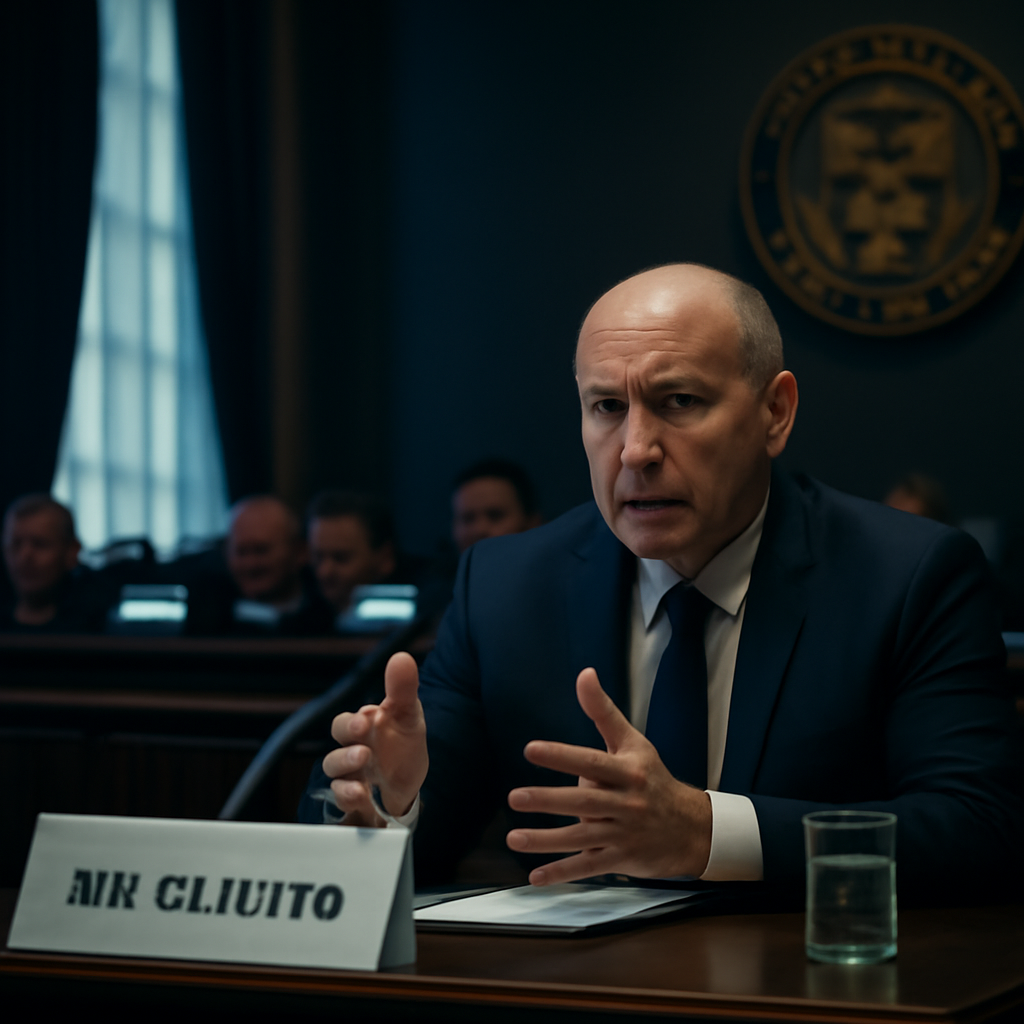
“Of course, our intelligence services and agencies are going to have secrets that are always going to be of top desire for foreign intelligence adversaries, but if you’re [China’s Ministry of State Security] today, you’re looking at frontier model companies,” said Frank Cilluffo, testifying to the House Intelligence Committee on Tuesday.
Former officials told the House Intelligence Committee the intelligence community is behind
At a hearing framed as a review of emerging threats in the 25 years since Sept. 11, 2001, former officials warned lawmakers that U.S. agencies have not kept pace with foreign efforts to acquire advanced artificial intelligence technology. Witnesses argued that China will deploy a mix of intelligence-gathering techniques to obtain proprietary AI research — a prize that can let adversaries close capability gaps without paying the development costs.
The witnesses named included Frank Cilluffo of Auburn University’s McCrary Institute for Cyber and Critical Infrastructure; retired Lt. Gen. H.R. McMaster, who served as national security advisor; Ben Buchanan, a former White House special advisor for AI; and Seth Jones of the Center for Strategic and International Studies. Their testimony placed private AI companies squarely in the crosshairs of foreign intelligence operations.
H.R. McMaster: counterintelligence priorities shifted after Sept. 11
“The counterintelligence threat has lagged way behind,” McMaster said, describing how U.S. emphasis on counterterrorism after Sept. 11 drew away resources that would otherwise have tracked China’s effort to place spies and researchers into American firms. His remarks framed the problem as structural: intelligence and security apparatuses shifted priorities and now face a broader set of targets that includes privately held frontier-model developers as well as traditional government secrets.

Audit-ready is a season. It shouldn't be.
Evidence in spreadsheets, controls drifting between audits, frameworks multiplying on flat headcount. Nubivance runs continuous compliance on Rapid7 Cyber GRC - SOC 2, HIPAA, ISO 27001, PCI, CMMC.
End the scrambleFrank Cilluffo: rethink counterintelligence beyond government labs
Cilluffo pressed the point that national advantage no longer resides solely in government facilities. “I think we’ve got to actually rethink counterintelligence. It’s not just the traditional spy-versus-spy, information-versus-information,” he said, arguing that who “holds the keys” now often lies in the private sector. That shift places new demands on how agencies identify, deter and respond to foreign intelligence activities aimed at commercial AI research.
Ben Buchanan: AI changes intelligence tradecraft and enforcement choices
Buchanan warned that counterintelligence must adapt to a different technical paradigm. “Even if you look at things like human intelligence and detecting human intelligence operations, it is a different technical paradigm that yields different kinds of analysis that AI alone can do,” he said, pointing to how AI both alters cyber operations and reshapes human-intel detection.
He also criticized recent policy choices on export controls, arguing that easing restrictions on advanced chip exports to China undermines a U.S. structural advantage in AI rooted in a democratic chip-production ecosystem. “We should be much more aggressive on enforcement and smuggling to stop China from trying to catch up,” Buchanan said.
States, quantum directives, and a gap in AI-specific counterintelligence policy
Seth Jones told the committee that many U.S. states lack the capacity to monitor and respond to Chinese spying efforts. The witnesses contrasted the government’s approach to quantum computing — where recent executive orders task the FBI and the intelligence community with protection of quantum research — with the lack of an equivalent, dedicated counterintelligence framework for advanced U.S.-made AI. The White House has directed national security agencies to help safeguard advanced AI, but, as the witnesses noted, it has not established the same formal structure used for quantum technologies.
What this means for technologists, policymakers, and companies
- Technologists and security teams: Expect to be treated as front-line counterintelligence targets. The testimony put private AI labs in the same threat model as government programs, cited distillation operations by foreign firms, and urged new detection and analysis paradigms tailored to AI-enabled tradecraft.
- Policymakers and regulators: The witnesses pressed for resource shifts and enforcement to match perceived threats — including tighter export controls and stronger anti-smuggling efforts — and for consideration of a formal counterintelligence framework for AI similar to quantum directives.
- Affected enterprises and procurement leaders: Companies developing frontier models were identified as high-value targets. While the White House has directed assistance from national security agencies, witnesses stressed that a dedicated, codified protection regime for commercial AI research does not yet exist.
The testimony delivered to the House Intelligence Committee drew a consistent thread: commercial AI research is now a national-security priority, but current policy, resourcing and enforcement fall short. Whether the executive branch will follow the quantum playbook and create an AI-specific counterintelligence architecture — or instead broaden enforcement and smuggling interdiction around chip exports and model protection — remains the central unanswered step coming out of Tuesday’s hearing.