"the vulnerability of fixed terrestrial space-enabling infrastructure;" — that is one of four emerging challenges a SPACECOM fact sheet lifts directly from Space Warfighting Environment 2040, the command’s new, 37‑page foundation paper for how the joint force should think about fighting in space by 2040.
A warfighter-first foundation and why it was written
Signed out by outgoing U.S. Space Command commander Gen. Stephen Whiting on July 27, Space Warfighting Environment 2040 is, according to a SPACECOM official, "intended to establish a common understanding of the future space warfighting environment and provide the foundation for follow-on concept development, force development, experimentation, and planning." The Joint Forces Development and Training team helped craft the paper, and the official stressed the document "is not meant to be 'predictive,'" but to surface problems the joint force must consider as the space environment changes faster than current strategy and warfighting approaches can account for.
SPACECOM’s four emerging challenges
- “the vulnerability of fixed terrestrial space-enabling infrastructure;
- proliferated dual-use [commercial/military] spacecraft that absorb and regenerate under attack;
- in-space servicing and maneuver that turn orbit into a dynamic network; and
- quantum developments that reshape trust, timing, and secure communication.”
The paper frames those four items as immediate, operationally relevant stressors that should shape joint planning now rather than later.

Audit-ready is a season. It shouldn't be.
Evidence in spreadsheets, controls drifting between audits, frameworks multiplying on flat headcount. Nubivance runs continuous compliance on Rapid7 Cyber GRC - SOC 2, HIPAA, ISO 27001, PCI, CMMC.
End the scrambleNine forces that will define the warfighter’s reality by 2040
The document then lists nine specific “forces” that will present risks and opportunities for the joint warfighter. They are presented verbatim in the paper as:
- Quantum developments that reshape trust, timing, and secure communication.
- Proliferated dual-use spacecraft that absorb and regenerate under attack.
- Advanced materials technology that will redefine stealth and deception.
- Direct-to-device connectivity that keeps the tactical edge connected.
- Optical and laser links that move data quietly and securely.
- Artificial intelligence (AI)-enabled networks that reroute and self-heal faster than adversaries can disrupt.
- Distributed, mobile, coalition-ready ground nodes that remove single points of failure.
- In-space servicing and maneuver that turn orbit into a dynamic network.
- Stewardship challenges—debris, traffic management, and norms that shape freedom of action.
The paper argues that “advantage will belong to forces that can adapt, maneuver, and sustain trusted effects under pressure,” and that while technologies evolve, "the warfighter’s needs will not: to see, connect, decide, and act with trust and tempo."
Vulnerable ground infrastructure, pLEO and launch-site policy
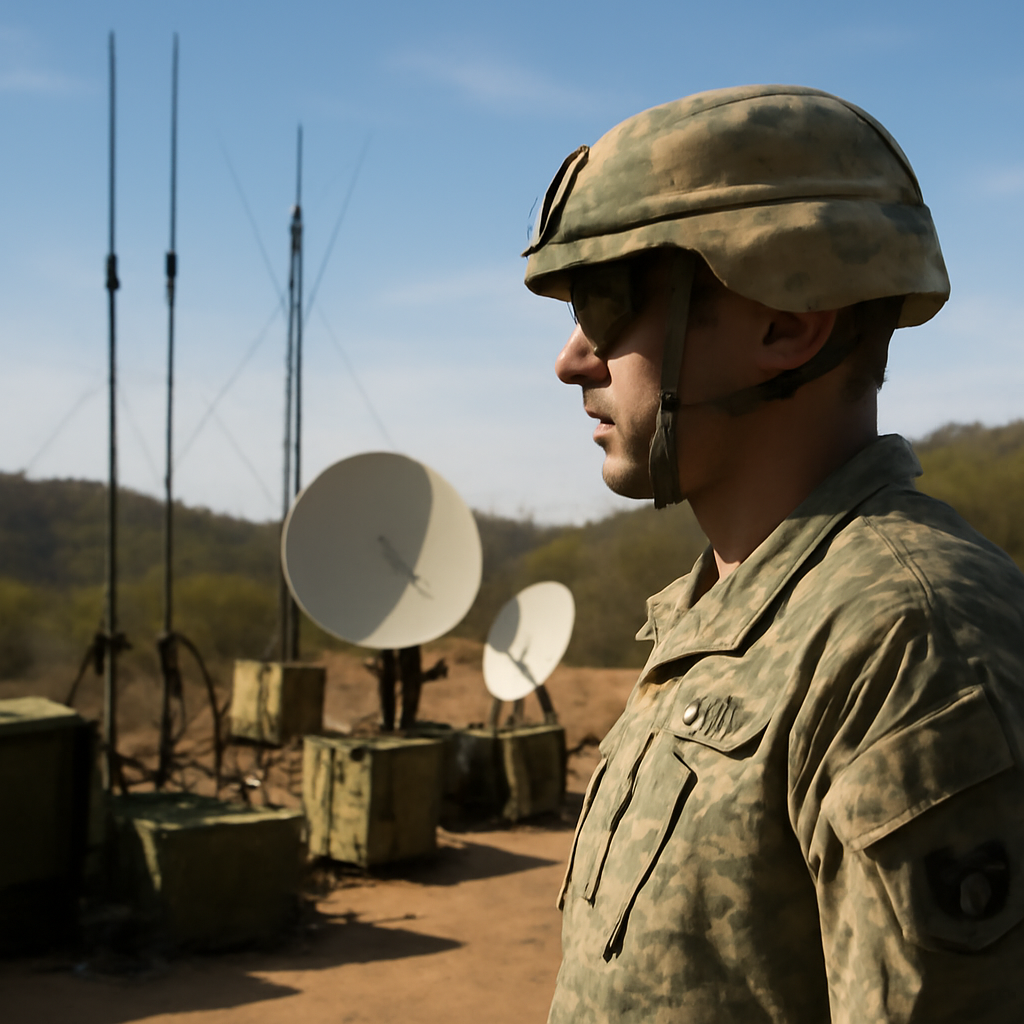
At the Army Space and Missile Defense Symposium in Huntsville, Ala., on Aug. 12, Whiting said one of the most important challenges is the vulnerability of U.S. satellite ground infrastructure, which he described as “based on fixed-site receivers and processing centers.” The document warns that “static ground nodes, once the norm, will become liabilities” because they “represent single points of failure that adversaries can attack through cyber intrusion, directed energy, precision fires, or sabotage.”
Whiting also placed a requirement to develop weapon systems capable of taking out adversary proliferated LEO (pLEO) constellations as second on his "Integrated Priorities List" for fiscal 2029–2033, and noted that attacking adversary ground systems is one way to achieve that objective.
The task of hardening launch and ground infrastructure received new policy focus from the White House: a recently signed executive order on space transportation instructs the Pentagon and the Department of Homeland Security to produce a plan within 180 days "to secure" U.S. infrastructure at federal launch sites such as Vandenberg Space Force Base and Cape Canaveral Space Force Station.
What this means for the Joint Force, industry, and U.S. allies and partners
- The Joint Force and military services: SPACECOM wrote the paper "to clearly articulate what future space warfighting may look like" for senior leaders who are not space specialists, laying out concepts the command expects will inform follow‑on force development, experimentation, and planning.
- Industry and commercial operators: the document treats commercial, dual‑use spacecraft as central to future contested operations, warning that proliferated, regenerative pLEO constellations change resilience calculations and will force new operational planning and cooperation between DoD and commercial actors.
- Allies, partners, and academia: the SPACECOM official said the paper aims to generate engagement from "the joint force, US allies and partners, industry and academia," offering a common framework to prompt questions about norms, traffic management and coalition-ready ground nodes.
Cislunar focus, analysts’ reactions, and the trilogy ahead
SPACECOM gives new prominence to the cislunar region—“the space between Earth, the Moon, and the Lagrange points”—because it contains "areas of gravitational stability, maneuver corridors, and vantage points where presence confers positional advantage." The paper asserts the U.S. could take "first-mover advantage" by occupying and controlling use of that domain, and the command says it is beginning deliberate thinking now about the implications rather than waiting until the problem is upon the force.
But some outside analysts push back. Jessica West of Project Ploughshares called it "a warfighting concept dressed as a futures document" and warned that the paper "is a vision of power with remarkably little account of the purpose that power is meant to serve." John "Patsy" Klein of the Atlantic Council praised the discussion of AI in mesh networks and "the need for sustained maneuver capability to improve resilience." Victoria Samson of the Secure World Foundation said she was struck by the paper’s emphasis on maneuverability and agility "not just in regards to [on‑orbit rendezvous and proximity operations], but across the board in future SPACECOM operations."
Space Warfighting Environment 2040 is the first in a planned trilogy. Whiting’s forward describes two follow‑on publications: "The Space Futures Series," which will provide issue‑driven analysis of emerging challenges, and "The Space Warfighting Concept," which will guide how the joint force and SPACECOM "fight and win in space." The initial paper is explicit about being warfighter‑first rather than technology‑first; whether the subsequent volumes will address analysts’ questions about deterrence, civilian impacts, and the broader purpose of military space power remains to be seen.