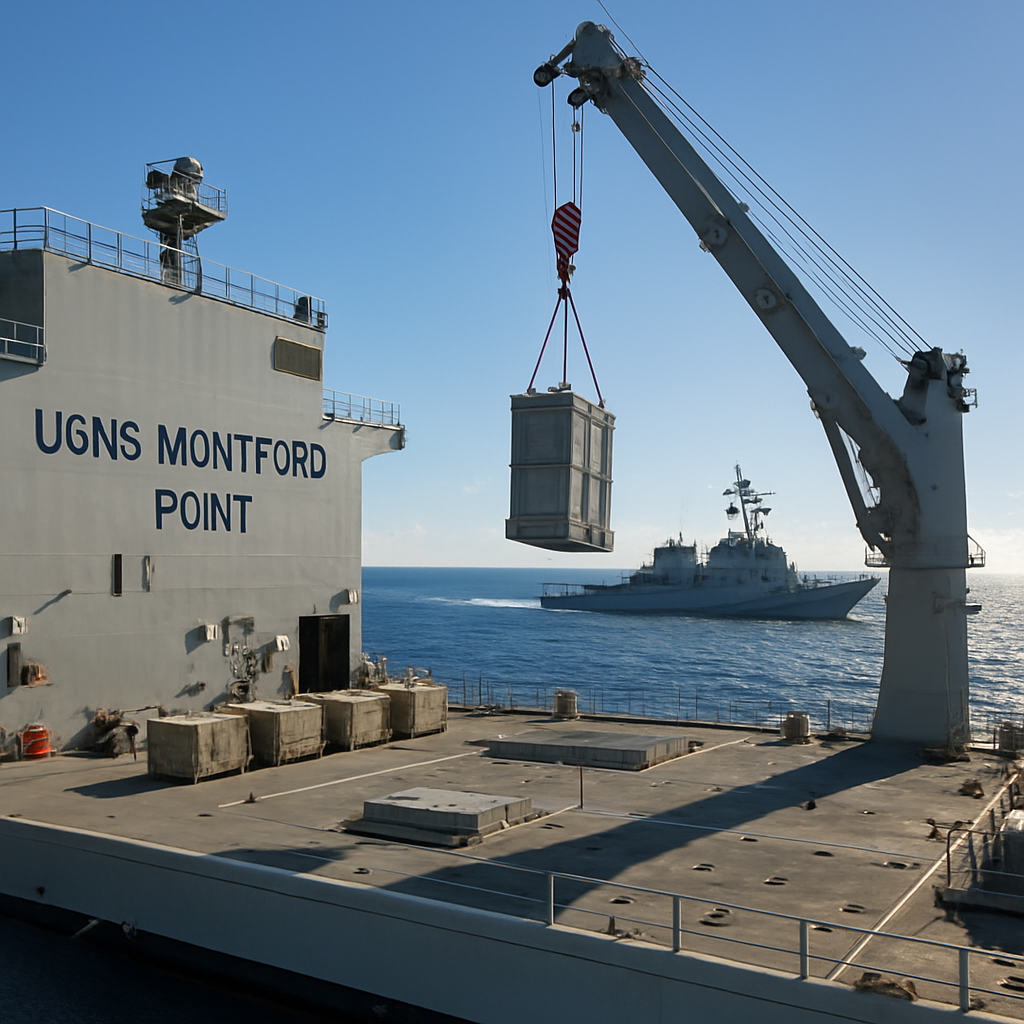
"a cost-effective Vertical Launch System (VLS) rearm at-sea solution that will be fully compatible with all CRUDES and Allied/Partner Mk41 equipped vessels," the Navy's budget documents say — and they single out the USNS Montford Point (ESD-1) as the test bed.
The FY2027 budget line: Shipboard Crane Systems/Shipboard Cargo Systems
The Navy is seeking $177.7 million in its FY2027 budget request under the line item titled "Shipboard Crane Systems/Shipboard Cargo Systems." The appropriation, rolled out last month in the service’s budget documents, would fund multiple demonstrations and investigations aimed at expanding at-sea reloading capabilities. Alongside the At‑Sea Reload of VLS (ASRV) demonstration on USNS Montford Point, the line includes work on T‑AKE expeditionary reload concepts, a "MK 41 Strike Up/Strike Down System," improvements for Naval Strike Missile and MK 48 torpedo reloading, and the initiation of a Mobile Supply Platform (MOSUP) demonstration effort.
ASRV demonstration on USNS Montford Point (ESD‑1)
The budget specifically funds initiation of "design and fabrication for At‑Sea Reload of VLS (ASRV) demonstration on ESD‑1." The documentation provides no technical details beyond positioning ASRV as a cost‑effective solution compatible with "all CRUDES and Allied/Partner Mk41 equipped vessels." The Navy’s stated plan in the documents is limited: to demonstrate the capability on Montford Point, not to declare an operational rollout or use of the class broadly.

Audit-ready is a season. It shouldn't be.
Evidence in spreadsheets, controls drifting between audits, frameworks multiplying on flat headcount. Nubivance runs continuous compliance on Rapid7 Cyber GRC - SOC 2, HIPAA, ISO 27001, PCI, CMMC.
End the scrambleWhy Montford Point and the ESD design matter
The Montford Point class was acquired between 2013 and 2014 and was the subject of an attempted inactivation four years ago that Congress blocked. With some 25,000 square feet of open main deck area and a semi‑submersible, Alaska‑tanker‑derived design, Montford Point is naturally suited to hosting outsized loads and side‑by‑side transfer operations. In their transfer dock role, the ESDs act as floating self‑propelled piers with docking lanes accommodating up to three LCACs and ramps that let amphibious vehicles drive directly into the sea. Those transfer features are what make the class attractive as a potential at‑sea reloading node: an ESD could offload munitions from a cargo ship on one side and load them into VLS cells on a destroyer or cruiser alongside on the other.
Operational gaps: limited at‑sea VLS rearm capacity and tender shortfalls
As the budget documents acknowledge, the Navy presently lacks a real capacity to conduct at‑sea rearming of VLS arrays on its surface warships. The Emory S. Land class submarine tenders are able to load missiles and torpedoes at sea, but there are only two of those tenders in the fleet. Recent Navy disclosures at the Surface Navy Association conference noted that warships supporting operations around the Red Sea had to break station and steam to friendly ports for up to two weeks to rearm — a pattern that the budget materials frame as operationally risky, especially if forward ports are unavailable in a high‑end conflict.
What this means for Lewis and Clark class, submarine tenders, and naval logisticians
- Lewis and Clark class (T‑AKE) crews and planners: The budget shows continued investment in expeditionary reload and crane/cargo system improvements for the 14 Lewis and Clark class ships, already tasked with traditional at‑sea replenishment. These ships are slated for further work on expeditionary reload methods but are described as heavily taxed and high‑priority targets in major conflict.
- Submarine tender community and AS(X) program managers: The Navy plans to order two new submarine tenders (AS(X)) in FY2027 to replace the aging Emory S. Land class. Shipbuilder General Dynamics NASSCO is promoting a companion design called AD(X) optimized for at‑sea arming of surface warships, though the Navy has not shown formal interest in AD(X) according to the reporting.
- Navy logistics planners and commanders at sea: Demonstrating ASRV on Montford Point — alongside MOSUP experiments and upgrades to crane and cargo systems — signals an attempt to diversify reload options and reduce the need for warships to withdraw to ports for rearming, while acknowledging the operational risks and increased tasking that at‑sea rearming would impose on auxiliaries.
Montford Point and its sister ship John Glenn are on reduced operating status, which lengthens the time required to prepare them for deployment. That reality, coupled with the small number of ESDs and the finite number of Lewis and Clark auxiliaries, frames the Navy’s immediate challenge: prove ASRV works on ESD‑1, then decide whether to scale the capability across existing auxiliaries, new purpose‑built ships, or some mixture of both. General Dynamics NASSCO’s AD(X) pitch and Gibbs & Cox concepts for repurposed rigs suggest industry is already proposing answers, but the Navy’s budget documents limit the service, for now, to demonstration and investigation rather than broader procurement.
Contact the author: joe@twz.com