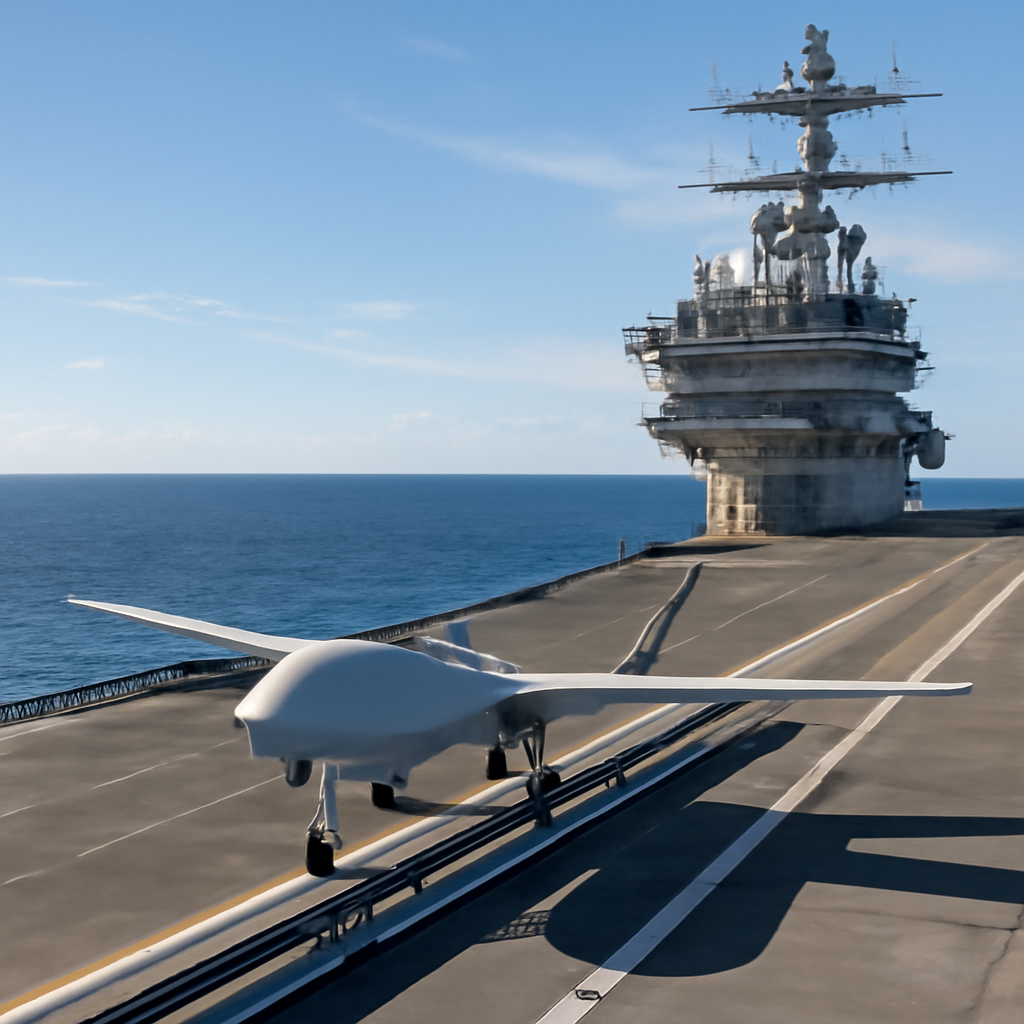
"For missions involving attacking the enemy, the system must be capable of delivering effects a minimum of 1,000 NM from the CVN without refueling," the Naval Air Systems Command stated in a recent request for information.
NAVAIR’s 1,000‑nautical‑mile combat‑radius threshold
The Navy’s recent RFI for an Air Wing of the Future (AWOTF) “family of systems,” issued by Naval Air Systems Command (NAVAIR), sets a clear baseline: carrier‑based uncrewed platforms should be able to “deliver effects” at least 1,000 nautical miles (about 1,151 statute miles or 1,900 kilometers) from the carrier without aerial refueling. The notice frames that requirement specifically around strike or attack missions and couples it with an emphasis on operating without mid‑air refueling, though it acknowledges tankers could still extend reach if available.
Eight mission sets NAVAIR wants from AWOTF platforms
The RFI asks vendors to show concepts that can perform any combination of eight mission sets: surface warfare; strike warfare; anti‑submarine warfare; air warfare; electronic warfare; intelligence, surveillance, reconnaissance, and targeting (ISR&T); mobility; and logistics. NAVAIR also seeks information on whether a proposed design would be single‑role, multi‑role, or modular/variant‑based, and on both flight autonomy (carrier pattern, taxiing) and mission autonomy (dynamic tasking/retasking, threat evasion, automated aerial refueling) maturity.

This site is the portfolio.
OSINTSights runs on Cloudflare Workers, D1, R2, and Vectorize, with an AI pipeline on Hetzner ARM. Nubivance designed, built, and operates it. We do the same for clients.
See what we buildCarrier compatibility, deck footprint and the “spot factor” constraint
The RFI requires that proposed systems be “fully compatible with both Nimitz class and Ford class CVN launch and recovery systems” and that they “demonstrate increased combat effectiveness over current 4th generation platforms at a given spot factor.” Spot factor — the physical space a platform occupies on the carrier — is a prominent constraint for any carrier‑based design. The Navy is explicit that extended range and payload must be pursued while “minimizing deck footprint and integrating with established CVN infrastructure.”
Design paths, past programs and vendors in the race
The RFI situates the 1,000‑NM ask amid existing and proposed systems. The family of AWOTF platforms already includes the MQ‑25A Stingray tanker, which the service says will retain a secondary surveillance and reconnaissance role. The RFI also references future Collaborative Combat Aircraft (CCA) that are still being defined.
Several companies are on contract to develop CCA concepts: Anduril, Boeing, General Atomics, and Northrop Grumman. The source cites past demonstrators and programs: the X‑47B drones from the earlier UCLASS effort, which were designed to carry two 2,000‑pound‑class munitions internally, and the later shift to CBARS that produced the MQ‑25. Shield AI and Kratos are also named in the RFI’s broader discussion of concepts — Shield AI’s X‑BAT aims for vertical takeoff and landing with a quoted maximum range target of 2,000 nautical miles, while Kratos’ forthcoming Valkyrie variant is noted for runway operation and rocket‑assisted takeoff options.
What this means for NAVAIR, vendors, and Carrier Strike Groups
- NAVAIR: The RFI is a formal step to refine AWOTF requirements and to "expedite transition from a 4th‑generation‑centric Carrier Air Wing (CVW) to a 5th/6th‑generation manned‑unmanned AWoTF," aligning its request with the 2025 National Security Strategy and the 2026 National Defense Strategy as well as the CNO’s Fighting Instructions.
- Vendors: Companies must balance endurance and payload while shrinking spot factor and ensuring compatibility with Nimitz and Ford class launch and recovery systems. They are also being asked to explain autonomy maturity across flight and mission domains.
- Carrier Strike Groups and planners: The Navy frames long unrefueled range as a hedge against expanding anti‑access/area denial bubbles, highlighting that unrefueled reach reduces dependence on aerial tankers — which the RFI calls a scarce and high‑value resource in contested fights.
The RFI also leaves open operational flexibility beyond pure range numbers: NAVAIR frames the requirement as the ability to “deliver effects” at range, which allows for stand‑off munitions, tertiary recovery points, ship‑to‑ship launch/recover concepts, and VTOL variants operating from destroyers and other vessels as alternatives or force multipliers. The document repeats the Navy’s longstanding view that unmanned systems are essential to “increasing Carrier Strike Group strike capacity, extending CVW operational reach, and introducing advanced methods for executing Naval Aviation missions in a Highly Contested Environment (HCE).”
The Navy is still sequencing its efforts: it says the service remains focused first on fielding the much‑delayed MQ‑25 as a pathfinder for other carrier drones, and the service is “now targeting next year to finally reach initial operational capability with the Stingray, something that was originally scheduled to happen in 2024.”
The 1,000‑nautical‑mile figure is now a clear threshold in the Navy’s planning documents. Whether future airframes meet that mark by raw unrefueled combat radius, by creative use of stand‑off effects, or by mixed launch‑and‑recover concepts will be a key dividing line as vendors respond and NAVAIR narrows requirements.