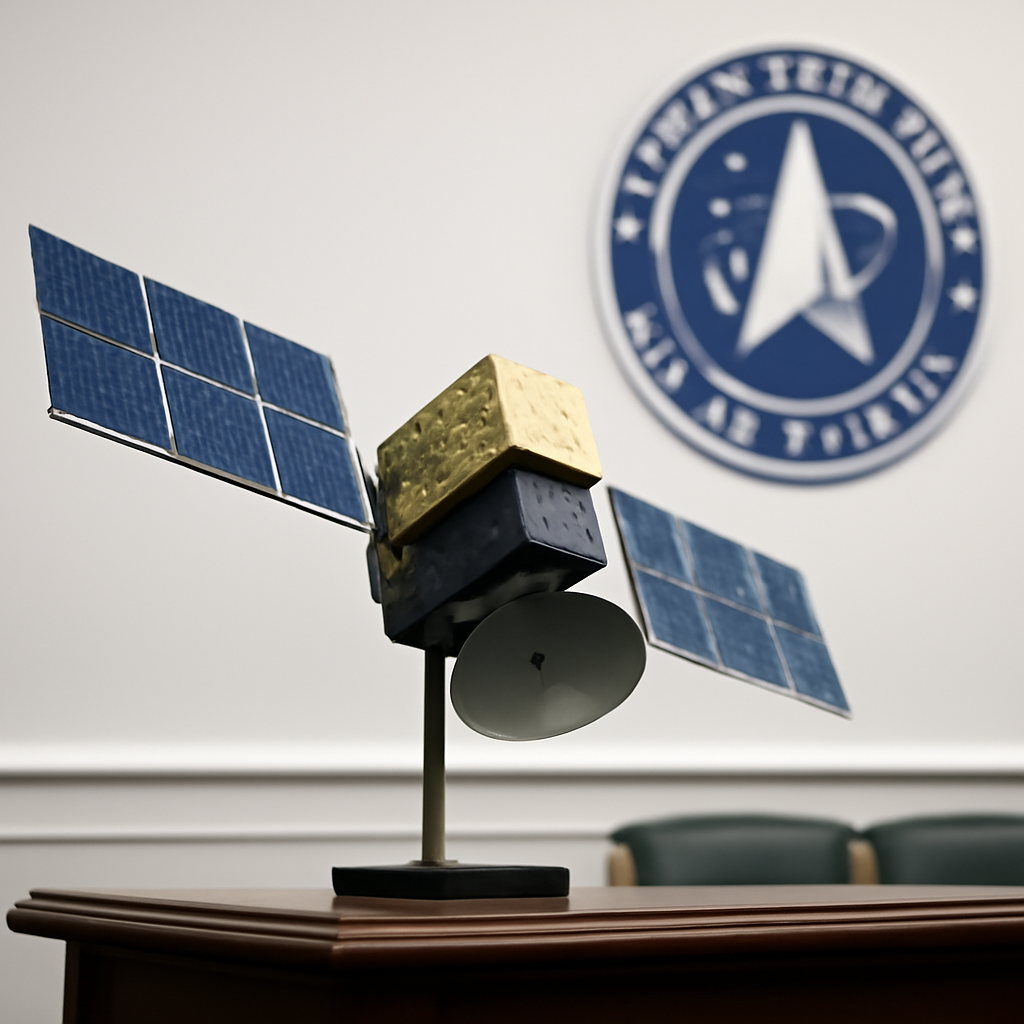
“I would say that the $71.1 billion that the president has asked for is exactly what we need,” Lt. Gen. Douglas Schiess told the Senate Armed Services Committee, framing the size and purpose of the Space Force’s budget request in a single, declarative line.
Lt. Gen. Douglas Schiess on the $71.1 billion request
Schiess, the White House nominee to lead the U.S. Space Force and currently the deputy chief of space operations for operations at the Pentagon, told senators that the administration’s $71.1 billion request “is exactly what we need.” He expanded in written testimony that the service’s budget, people, and platforms must grow to support major joint operations, and that balancing “urgent readiness for a contested space domain today with the modernization required to win tomorrow” is the service’s most significant challenge.
He noted programs the Trump administration proposed funding through reconciliation — a move House leaders said they would not fully comply with — including the Space Data Network and Golden Dome. Schiess linked the request directly to growing threats and to capabilities the joint force requires.
China and Russia: the rationale for expansion
In testimony Schiess identified China and Russia as drivers behind the expansion: “Our adversaries are fielding counterspace capabilities at a rapidly increasing pace that are designed to hold U.S. and allied satellites at risk, while also building space-enabled kill chains to threaten our Joint Force,” he wrote. He told senators the budget was “needed because of the threat from China and Russia, and the capabilities that the joint forces needs.”
The budget case was reiterated in the hearing by Chairman Roger Wicker, R-Miss., who told Schiess the service is underfunded now but would be adequately resourced if Congress passed the president’s request.

Audit-ready is a season. It shouldn't be.
Evidence in spreadsheets, controls drifting between audits, frameworks multiplying on flat headcount. Nubivance runs continuous compliance on Rapid7 Cyber GRC - SOC 2, HIPAA, ISO 27001, PCI, CMMC.
End the scrambleLaunch tempo and infrastructure: scaling to unprecedented demand
Schiess placed particular emphasis on launch infrastructure and tempo. The service has budgeted “upwards of 100 national security space launches over the next five years,” and a recent Space Force planning document cited by the nominee estimates the service’s two main launch bases could send as many as 3,000 commercial and military rockets into the skies each year by 2036.
In his written statements Schiess called “the most pressing issue” scaling to meet the “unprecedented increase in launch tempo, as well as the exponential growth in commercial missions,” and highlighted the potential role of super-heavylift rockets to “unlock new possibilities for the Space Force.” He said that, if confirmed, his first year would focus on improving combat readiness, prioritizing operational testing, building up space launch infrastructure, and expanding facilities.
Senate hearing, likely confirmation, and leadership turnover
The confirmation hearing was brief and largely uncontentious. Only six senators asked questions during the roughly 40-minute session; Sen. Angus King, I-Maine, said the small number of questioners was “an indication, I believe, of the committee's confidence in you.” Sen. Richard Blumenthal, D-Conn., added that “being non-controversial is not a bad thing.”
Schiess was tapped in April to succeed Gen. Chance Saltzman, who announced in London this week that he will retire next month. Defense One first reported the nomination. Schiess told the committee he “would have no hesitation” in providing his best military advice “even when that advice differs from the views of the Chairman, other members of the Joint Chiefs of Staff, Secretary of War, President, or other leaders.”
Outside the room, some observers have warned about the wider civil-military climate. AEI’s Kori Schake told The Atlantic that Pentagon political leaders “have created a command climate that penalizes the honest evaluations of the military about issues on which the military is expert and the civilians are not,” and called that dynamic “very dangerous.”
What this means for Congress, the Joint Force, and commercial launch providers
- Congress (House and Senate): Lawmakers will have to reconcile competing approaches to funding the Space Force — the White House’s sizable request and the House leadership decision not to fully use reconciliation to provide much of that money. The choice will determine whether programs like the Space Data Network and Golden Dome get the funding envisioned by the administration.
- The Joint Force and combat planners: Schiess tied budget growth to operational needs, including preserving satellites and defeating “space-enabled kill chains.” His stated first-year priorities — combat readiness, operational testing, and facilities — signal near-term focus on ensuring space capabilities can support joint operations cited as crucial in recent conflicts.
- Commercial launch providers and launch infrastructure managers: The Space Force’s planning assumptions — upwards of 100 national security launches in five years and a projection of as many as 3,000 commercial and military rockets per year by 2036 from two main launch bases — imply intense demand for launch capacity, range services, and ground infrastructure that commercial firms and base operators will need to meet.
Schiess’s hearing left two immediate certainties and one open question: the nominee framed the $71.1 billion request as necessary and linked it to concrete operational requirements and projected launch demand; the Senate hearing process appeared to smooth his path to confirmation; and yet funding remains uncertain because of divergent congressional choices over reconciliation. How Congress resolves that gap will determine which of the Space Force’s ambitions move from plan to program.