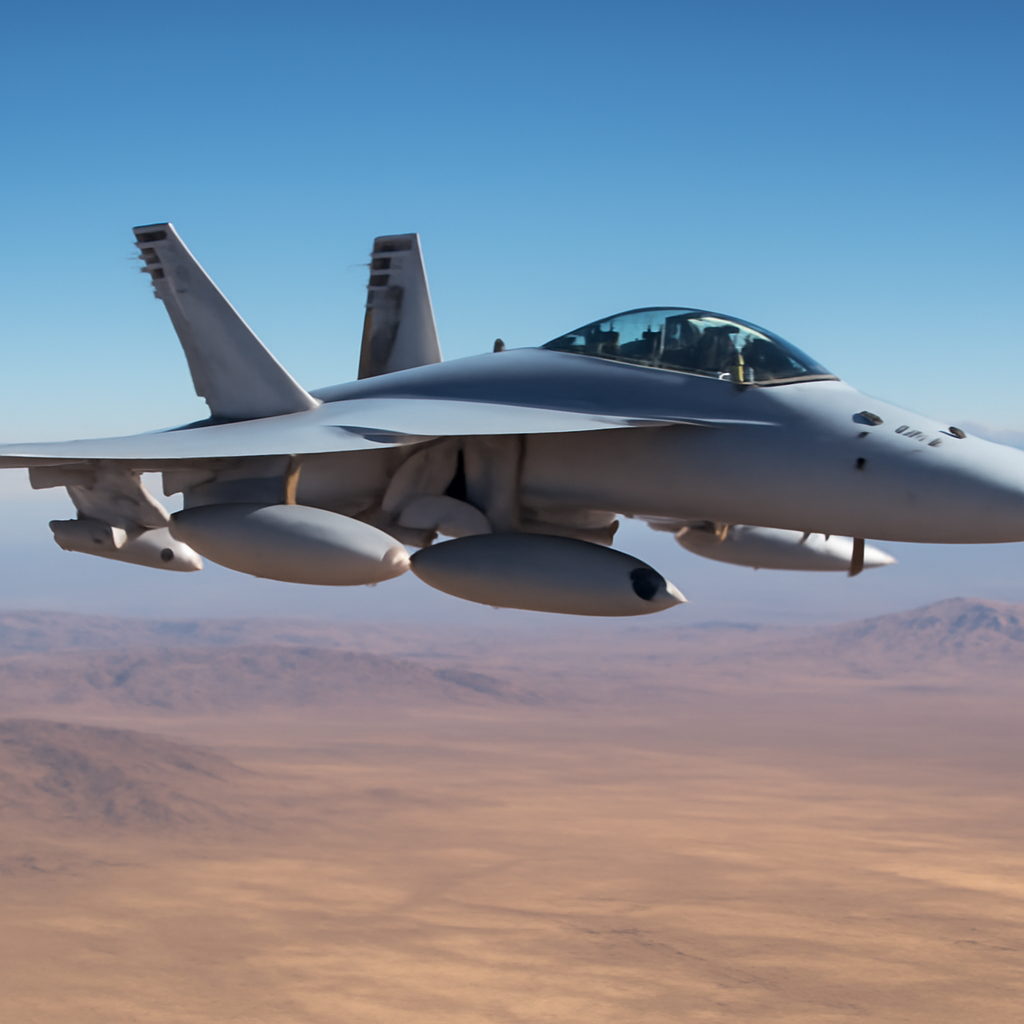
On October 14, an F/A-18F Super Hornet assigned to Air Test and Evaluation Squadron 31 (VX-31) was photographed over Ridgecrest, California carrying both an AIM-174B and an AIM-260 Joint Advanced Tactical Missile (JATM) together — the first publicly documented instance of those two long‑range air‑to‑air weapons appearing on the same aircraft. The image, taken by aviation photographer @photosxlyss2 and shared with TWZ, also showed an IRST21 infrared search‑and‑track pod on the jet’s centerline station.
AIM-174B: an SM‑6–derived extended‑range option
The AIM-174B is based on the SM-6 missile family and provides the Navy with an extended‑range air‑to‑air weapon tailored to threaten high‑value airborne assets such as aerial refueling tankers and airborne early warning and control aircraft. The missile’s size and reach make it particularly relevant against targets that sustain or enable fighter operations. Its exact range is classified, but the source describes it as “far in excess” of the AIM-120D AMRAAM and “probably in the hundreds of miles.” The AIM-174B has already appeared in major exercises including RIMPAC 2024 and Northern Edge 2025, entered Live Fire Test and Evaluation in 2025, and some examples have reached forward‑deployed Navy squadrons in Japan.
AIM-260 JATM: compact, next‑generation long range
The AIM-260 is being developed as a next‑generation beyond‑visual‑range missile intended to improve on the capabilities of the AIM-120 AMRAAM family. Its precise specifications are classified, but it is designed to deliver significantly greater range while maintaining a broadly similar form factor so it can be carried externally and internally — including on aircraft such as the F-22 Raptor and F-35. The AIM-260 was first publicly seen departing Eglin Air Force Base in Florida in May of this year on an F/A-18F from VX-31, and a similar weapon has been observed on a Royal Australian Air Force F/A-18F. Previous reporting cited in the source has indicated a target range of at least 120 miles with potential to reach considerably farther. The source notes it is unclear when the first operational AIM-260s may enter the U.S. inventory.

This site is the portfolio.
OSINTSights runs on Cloudflare Workers, D1, R2, and Vectorize, with an AI pipeline on Hetzner ARM. Nubivance designed, built, and operates it. We do the same for clients.
See what we buildIRST21 pod: passive sensing in the sensor-mix
The VX-31 jet was also carrying an IRST21 infrared search‑and‑track pod on its centerline station. IRST systems passively detect and track airborne targets without emitting radar energy, which is valuable in environments where electromagnetic emissions must be tightly managed. The source cautions that IRST does not automatically supply all the data needed for a long‑range missile engagement but can contribute to a broader sensor picture and help detect targets without immediately revealing the launching aircraft’s position. A full‑rate production contract for Block II IRST21 pods for U.S. Navy and Air National Guard fighters was awarded “this time last year,” according to the reporting.
VX-31 captive‑carry flight over Ridgecrest: what was on the jet
VX-31, based at Naval Air Weapons Station China Lake, conducts test and evaluation activities for naval aviation weapons and systems. The photographed Super Hornet carried inert missiles — denoted by blue bands — in a captive‑carry configuration, and the flight may have been part of weapons‑integration testing, handling and compatibility evaluations, or another test activity. The image provides a rare, concrete glimpse of how a Super Hornet might combine extended‑range and next‑generation missiles on a single airframe along with passive sensing in a future high‑end engagement.
What this means for the U.S. Navy, forward‑deployed squadrons in Japan, and potential adversaries
- U.S. Navy: The co‑location of AIM-174B and AIM-260 on a VX-31 Super Hornet underscores ongoing integration and testing work to expand engagement options at extended distances and against different classes of targets, including support aircraft.
- Forward‑deployed Navy squadrons in Japan: With some AIM-174B examples already reaching forward units, the photograph suggests the Navy is exploring how to field a mix of long‑range effects on carrier‑capable fighters that operate far from home bases.
- Potential adversaries (including references to China’s PL‑15 in the source): The AIM-260 is described as being developed to counter long‑range threats such as the PL-15; pairing AIM-260 with AIM-174B provides a broader set of options to challenge an opponent’s ability to operate support and surveillance aircraft at distance.
The Ridgecrest image does more than document another weapons test; it visually ties together three threads the Navy has been pursuing separately — an SM‑6‑derived extended‑range missile, a compact next‑generation JATM, and passive infrared sensing — onto a single Super Hornet. The photograph captures an intermediate step: inert missiles in captive carry. Key operational questions remain open in the public record, notably when operational AIM-260s will enter service and how the Navy will integrate these weapons — alongside newly disclosed systems such as the AIM-424 Malice, revealed in August — into carrier air wings for high‑end scenarios in the Indo‑Pacific.