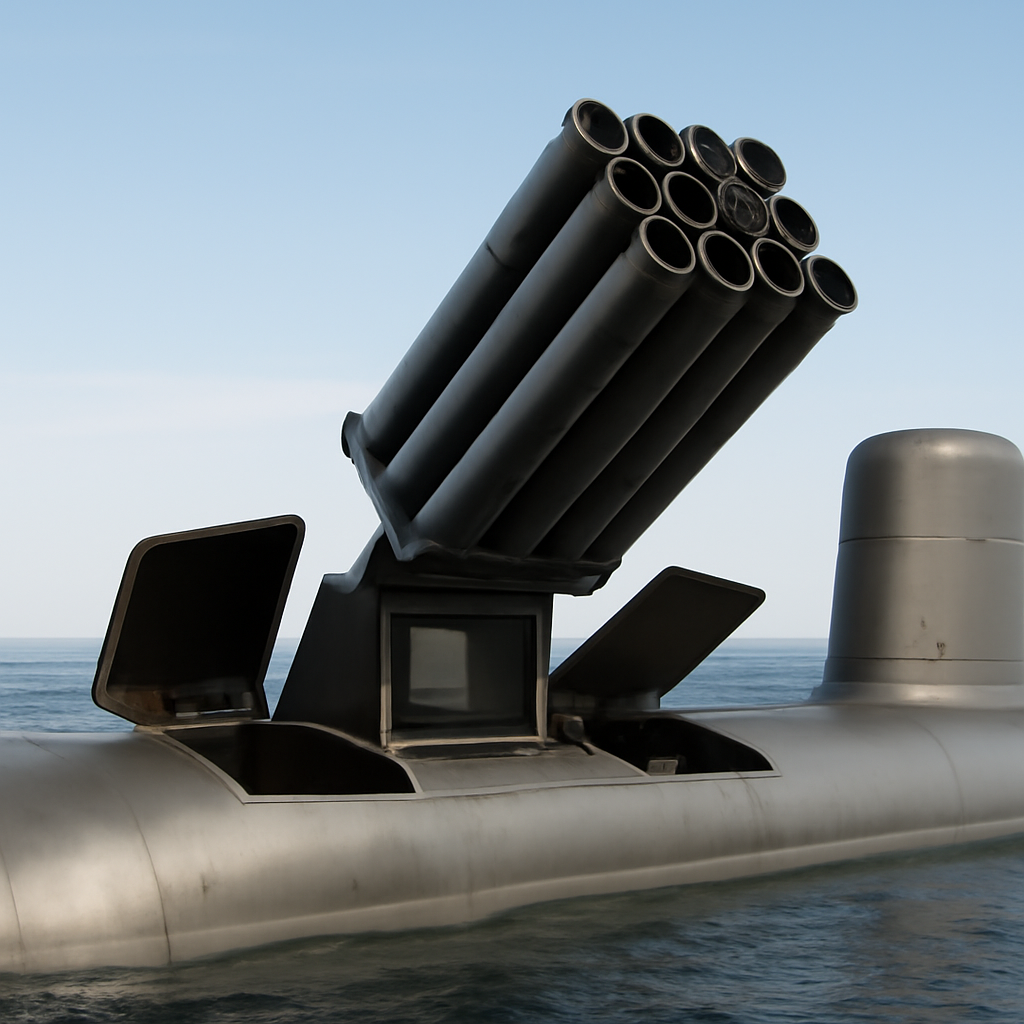
"Ghost Shark has teeth now." – @PatConroy1, Australia's Minister for Defence Industry.
Anduril's footage: a surfaced Ghost Shark opens, a 12‑tube launcher rises, a drone flies
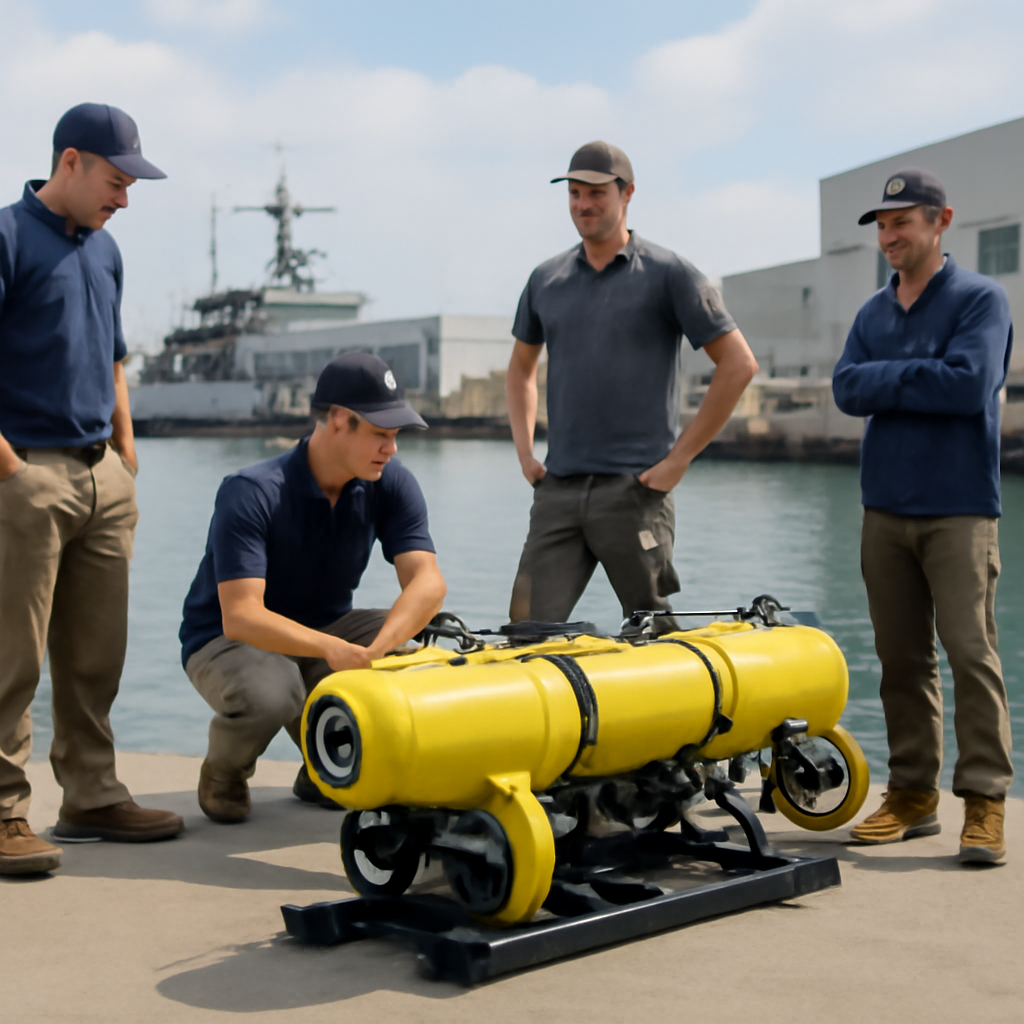
New video published by manufacturer Anduril shows an extra‑large autonomous underwater vehicle (XL‑AUV) named Ghost Shark surfacing, upper‑hull doors sliding open, and a launcher composed of 12 angled tubes emerging from an upper payload bay. The sequence cuts to an ALTIUS‑type aerial drone launched from one of the tubes while Ghost Shark remains on the surface. A second upper payload bay contains a similar launcher that is shown in the lowered position and is not raised in the footage.
ALTIUS family, launcher capacity, and endurance claims
The footage does not specify which ALTIUS variant is launched. Anduril has displayed Ghost Shark alongside derivatives of the ALTIUS‑600 family in Australia, including the ALTIUS‑600 for ISR and the ALTIUS‑600M for strike. Anduril describes the ALTIUS‑600 with a maximum range of around 275 miles and an endurance of at least four hours; some unarmed variants are "optionally expendable" and may be reused when conditions allow.
The 12‑tube arrangement visible on one upper bay — and what appears to be a matching bay opposite it — demonstrates the platform could deploy two dozen (24) aerial drones in a single sortie, enabling coordinated swarm launches far from a coastline.

Audit-ready is a season. It shouldn't be.
Evidence in spreadsheets, controls drifting between audits, frameworks multiplying on flat headcount. Nubivance runs continuous compliance on Rapid7 Cyber GRC - SOC 2, HIPAA, ISO 27001, PCI, CMMC.
End the scrambleDeployable masts, datalinks and the low‑profile design
The video reveals two deployable masts not previously shown. The larger mast lies flat along the centerline of the hull when stowed and deploys upward in an arm‑like motion, carrying an antenna; a smaller mast, located farther aft, rises vertically from its housing. The report suggests possible roles for the two masts: a tall mast for line‑of‑sight datalinks to the drones and the other as a satcom array — "such as one connected to Starlink/Starshield" — to send drone feeds to off‑surface controllers.
Anduril senior vice president Dr. Shane Arnott has emphasized the company's design choice to avoid "big masts running down the backbone of our vehicle" in favor of a flexible payload module. Ghost Shark also retains a lower‑profile swept‑back sail on its nose section, and footage of the closed payload doors with retracted masts illustrates a small surface signature while connected to drones.
Payloads confirmed by the Australian government and Navy
The Australian government and the Royal Australian Navy have confirmed Ghost Shark payload concepts that go beyond underwater surveillance: deployment of up to 12 sea mines in a mission, placement of seabed logistics caches, and air‑launched effects for ISR and strike. The combination of mine delivery, seabed cache emplacement, and aerial drone launches expands the vehicle’s mission set into broader undersea‑warfare and expeditionary support roles.
What this means for the Royal Australian Navy, technologists, and potential adversaries
- Royal Australian Navy: Ghost Shark's modular architecture allows different payload mixes — the navy can pursue mine‑delivery, logistics caches, or large drone swarms using the same hull form, and the new footage gives the navy an initial look at how aerial launches could be implemented in practice.
- Technologists and systems integrators: the 12‑tube launcher and deployable masts present integration tradeoffs between quantity and capability — the same bay could host fewer, larger drones or many smaller ones, and options such as a single larger drone carrying a satcom terminal are presented as alternate control architectures.
- Potential adversaries and operational planners: a mass drone launch from a submerged vehicle — either at standoff distances or close to shore — could be applied to broad‑area surveillance, electronic warfare against air defenses, or strike. The footage also highlights concepts for probing defenses and for clandestine delivery of seabed assets without a crewed platform.
The new footage clarifies how at least one aerial‑drone payload concept can be physically implemented on Ghost Shark, and it underscores the vessel’s modularity: the same volume that houses a 12‑tube launcher can be reconfigured for different mission packages. What remains to be seen is whether the adjacent upper bay will routinely carry a mirrored 12‑tube launcher, alternative drone types, or other mission systems in operational service — and how the Royal Australian Navy will balance margin, endurance, and control links when those choices are made.
Source: TWZ — Ghost Shark Uncrewed Submarine Shown Launching Aerial Drones For The First Time