“You just drop them into the approximate area of the channel and that’s going to be sufficient to hold up traffic,” said Bryan Clark, director of the Hudson Institute’s Center for Defense Concepts and Technology, describing why maritime mines remain so effective in narrow waterways.
Maritime mines in the Strait of Hormuz, the South China Sea, and other choke points
Clark told Breaking Defense that mines represent a persistent threat not only to military vessels but to commercial traffic in strategic trade and oil routes. He pointed to the Strait of Hormuz and the South China Sea as examples where the presence or even the threat of mines can halt shipping. Clark noted that “you’d only need the threat of a mine in order to close off access,” because vessel traffic generally pauses until the threat is verified or shipping companies accept higher insurance risk.
Low barrier to entry — Iran, Finland, and the geometry of denial
One critical factor amplifying mine danger is accessibility. Clark emphasized that mines “are so easy to obtain or build, and then deploy.” He described several real-world implications: Iran can deploy mines at standoff using rockets to place them into a strait; Finland plans to mine the Gulf of Finland in a conflict scenario to deny access to Sevastopol or St. Petersburg; and small states can field capable mine-laying forces that effectively deny transit through narrow channels. Clark argued that mines do not need sophisticated guidance to be effective — simple placement in a shipping lane is often sufficient.

Audit-ready is a season. It shouldn't be.
Evidence in spreadsheets, controls drifting between audits, frameworks multiplying on flat headcount. Nubivance runs continuous compliance on Rapid7 Cyber GRC - SOC 2, HIPAA, ISO 27001, PCI, CMMC.
End the scrambleHow the Navy is replacing manned minesweepers with robots
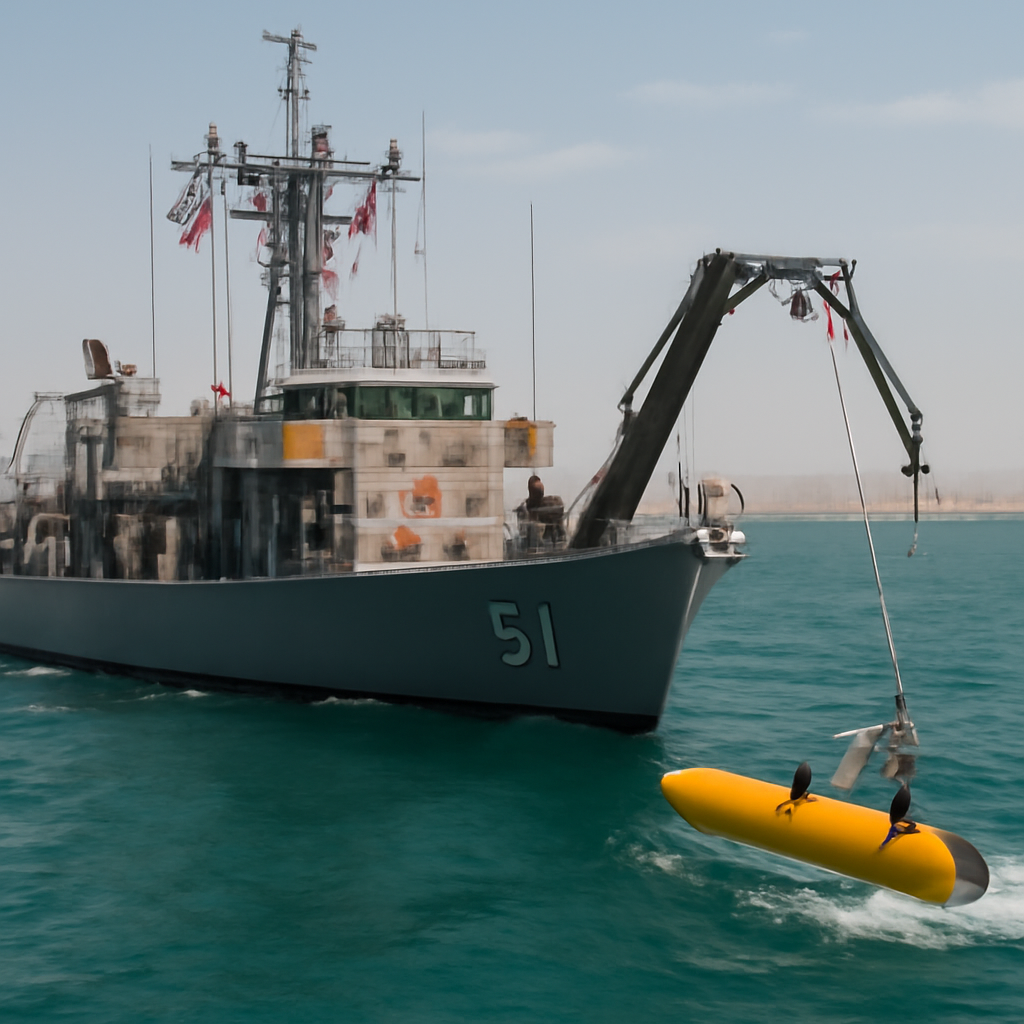
According to Clark, the Navy’s approach has shifted from wooden or fiberglass manned minesweepers toward robotic systems that keep personnel out of minefields. These unmanned vehicles carry active sonars and execute search patterns likened to a “Roomba,” scanning down from near the surface to detect objects in the top 100 to 200 feet of water when conditions permit. Data is then downloaded and processed ashore to identify candidate mine-like objects.
When objects require neutralization, Clark described the follow-on step: helicopters or small boats launch floating mine-neutralization vehicles that deploy fiber-optically guided “little torpedoes.” Operators steer the neutralizer via video feed and joystick; the device detonates on the target or punches a hole so the object sinks. Clark noted these neutralizers “have been around for 20 years or so” and that the robotic approach “does keep the people out of the minefield.”
Current operational pattern and the demand for onboard processing
Clark outlined the limits of current remote mine-hunting methods: they are typically multi-pass. Vehicles search a route, return, and offload data for analysis. Only after analysts identify likely targets are follow-on vehicles sent to investigate, and then separate platforms dispatched for neutralization. Clark argued this sequence slows operations and creates inefficiencies.
The capability he singled out as most needed going forward is onboard processing and improved communications. With processing located on the mine-hunting vehicles, Clark said they could transmit immediate reports after completing a path so commanders could “quickly decide whether to send another vehicle out there right now to investigate, or to just send the mine neutralization system out immediately.” In his vision, mature onboard processing and comms would let operators move toward “robot after robot after robot,” reducing human pauses between passes.
What this means for shipping companies, the Navy, and small militaries
- Shipping companies: Clark’s account underscores why insurers and operators react swiftly to mine warnings — traffic stops or reroutes until channels are verified clear. Even the threat of mines can force higher insurance rates or halted voyages.
- The Navy: The service benefits from robotic systems that scale more cheaply than manned minesweepers because “every minesweeper needs a crew and people are expensive.” Robots can be bought in larger numbers, stored, and deployed as needed to clear lanes with lower personnel risk.
- Small militaries and state actors (Iran, Finland): Clark’s examples show how relatively low-cost mine capabilities remain attractive tools to deny access in narrow seas — either to disrupt commerce or to inhibit an adversary’s naval movements.
Robots have moved the physical danger of mine-hunting away from sailors, and they promise a higher operational tempo if onboard processing and persistent communications arrive. Clark’s assessment leaves a pointed operational question: can the Navy and its partners field the processing and networking needed to turn today’s cautious, multi-pass routines into a continuous “robot after robot” clearance capability that neutralizes both mines and their strategic effect?