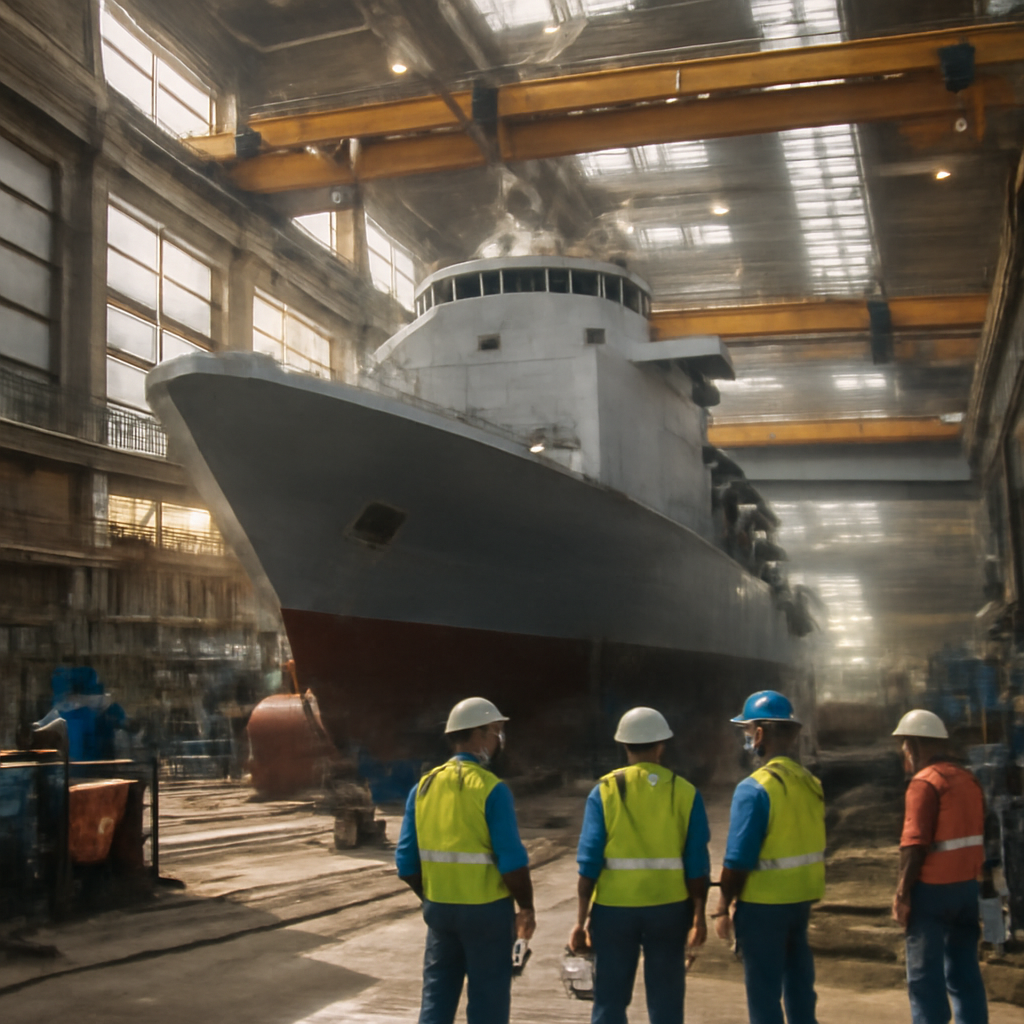
“The United States is at a strategic inflection point, and rebuilding American maritime dominance requires urgency, accountability, and sustained commitment,” Acting Secretary of the Navy Hung Cao said in a statement accompanying the Navy’s Fiscal Year 2027 Shipbuilding Plan.
Navy’s FY27 Shipbuilding Plan: a targeted request to Congress
The Navy’s newly released Fiscal Year 2027 Shipbuilding Plan asks Congress to authorize a limited expansion of ship construction overseas as a way to “supplement” — not replace — U.S. yards. Specifically, the plan requests targeted legislative changes in the FY27 National Defense Authorization Act to permit the construction of up to two auxiliary ships overseas and to allow “the flexibility for fabrication of some combatant modules overseas.” The plan frames this as a parallel track to the service’s priority of expanding domestic production.
Which ship work the Navy would move offshore — and which would remain here
Under the proposal, U.S. prime contractors would be given greater latitude to subcontract work with allied foreign partners to produce “non-sensitive modules” — examples given include hull structures — in allied overseas yards. The plan says the arrangement would preserve U.S. control over design and security by keeping “the more complex efforts like final assembly, integration of classified systems, testing and activation” in U.S. shipyards. The document describes the approach as “low-risk,” saying it “will accelerate production and preserve U.S. design sovereignty and security.”

Audit-ready is a season. It shouldn't be.
Evidence in spreadsheets, controls drifting between audits, frameworks multiplying on flat headcount. Nubivance runs continuous compliance on Rapid7 Cyber GRC - SOC 2, HIPAA, ISO 27001, PCI, CMMC.
End the scrambleContext from Sea Air Space and the administration’s shipbuilding agenda
The overseas-construction proposal follows public comments earlier this spring. Former Secretary of the Navy John Phelan told reporters at the Sea Air Space exposition in April that the Navy was eyeing foreign shipyards for work on both auxiliary and combatant ships. At the same conference, Office of Management and Budget Director Russ Vought said the U.S. would turn to alternative shipyards if the “traditional” sources could not deliver ships “on time and on budget.”
The FY27 Shipbuilding Plan also ties to the broader administration initiative identified as the Golden Fleet Initiative. The plan requests $65.8 billion for shipbuilding for FY27 — the figure the Navy included in its FY27 budget request released in April — and calls for expanding the Navy’s total inventory to 450 ships, including battle force ships, auxiliary ships, and unmanned vessels, by 2031.
Nuclear-powered Trump-class battleships and force-structure targets
The plan confirms that the Trump-class battleship will be nuclear-powered and sets out an ambitious target for battleships: an inventory of 15 by 2056, with the first delivery slated for 2036. Those details sit alongside the broader 30-year shipbuilding trajectory the plan lays out as the service pursues the Golden Fleet goals.
What this means for prime contractors, Congress, and allied shipyards
- Prime contractors: The plan would give primes “greater flexibility to subcontract” to allied yards for non-sensitive modules, potentially allowing them to tap advanced manufacturing capabilities overseas while retaining U.S. responsibility for final assembly and classified work.
- Congress: Lawmakers are the gatekeepers here — the Navy is explicitly asking Congress to authorize overseas construction in the FY27 NDAA for up to two auxiliary ships and to permit fabrication of some combatant modules overseas.
- Allied shipyards: The proposal positions allied yards to perform hull structures and other non-sensitive module fabrication, a role the plan says could accelerate production by leveraging “advanced manufacturing capabilities” abroad.
The Navy frames the overseas-construction ask as a narrowly tailored tool to speed fleet growth while keeping core, sensitive work under U.S. control. It has packaged that request inside a wider $65.8 billion FY27 shipbuilding budget and a plan that seeks 450 total ships by 2031 and 15 battleships by 2056, with the first Trump-class delivery in 2036. The immediate next step the plan identifies is congressional authorization in the FY27 NDAA for the specific authorities it requests; whether Congress will grant them is the pivotal decision ahead.