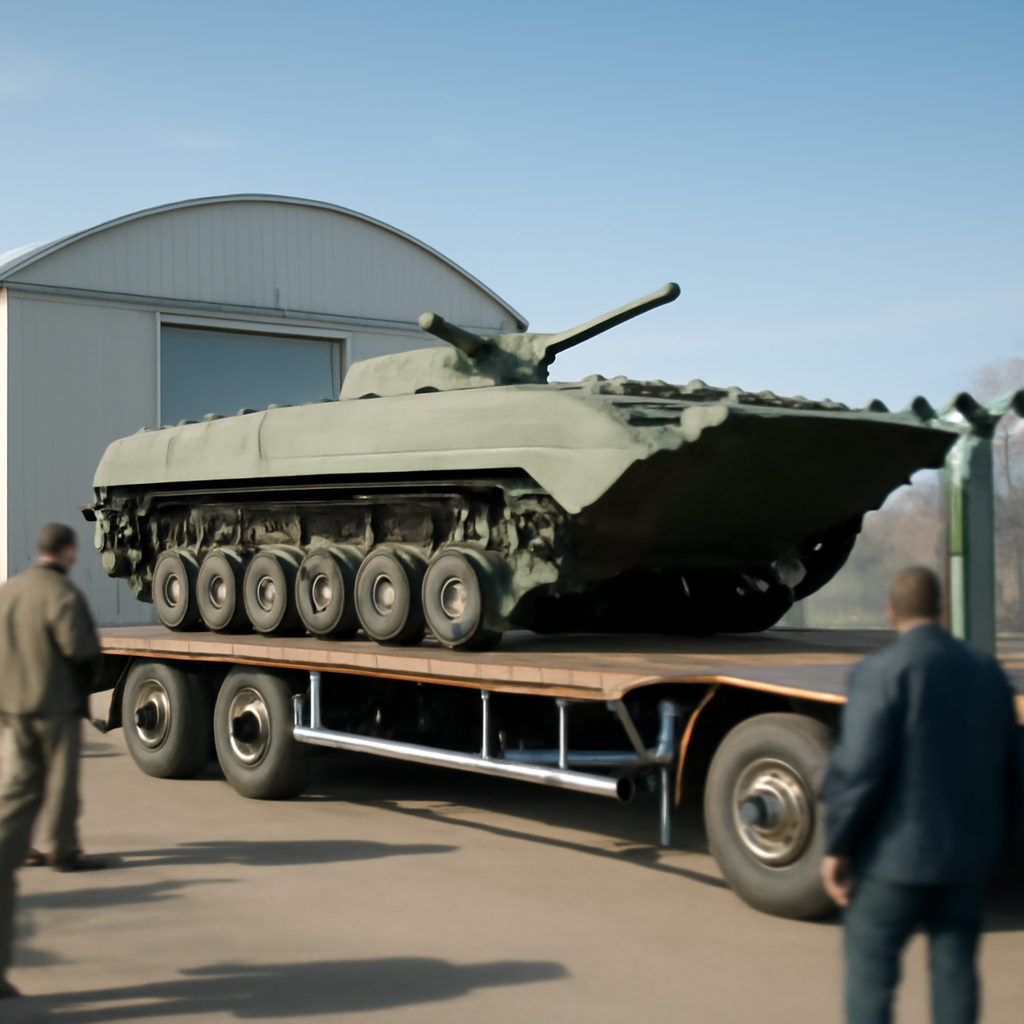
“We have now completed the first shipment of vehicles to Ukraine. The first one to be picked up was our fine BMP-1, and the second was the MT-LB SNAR-10. We hope they’ll last a long time and make a difference,” Panzermuseum East said on social media.
Panzermuseum East’s donation: a private collection turned supplier
Panzermuseum East, a privately run Danish museum that describes itself as Scandinavia’s largest collection of vehicles, uniforms, and equipment from the former Eastern Bloc, announced it has delivered its first batch of armored vehicles to Ukraine. The shipment includes a BMP-1 infantry fighting vehicle and an MT-LB amphibious tracked armoured fighting vehicle fitted with the SNAR-10 battlefield surveillance radar. The museum called this its “first shipment,” language that suggests further transfers may be planned.
The BMP-1: an aging icon that still fits Ukrainian inventories
Entering service in the late 1960s, the BMP-1 is among the most iconic Soviet armored fighting vehicles ever built. The design combined mobility, armor, and the ability for infantry to fight from within the vehicle, and more than 20,000 were built. The vehicle was armed with a 73mm low-pressure gun, a coaxial machine gun, and a 9M14 Malyutka (AT-3 Sagger) anti-tank missile launcher, and was intended to carry an eight-man infantry squad alongside tanks.
Although the BMP-1’s armor and armament are outdated by modern standards, the vehicle remains prized for its amphibious capability, ease of maintenance, and the availability of extensive stocks of spare parts and upgrade packages. Ukraine already operates the type in significant numbers, meaning integrating another example should be straightforward provided the vehicle is mechanically sound.
The BMP-1’s continuing demand is reflected in industrial activity: Slovakia’s STV Machinery secured a contract to serially produce newly manufactured BMP-1 hulls for an unnamed foreign customer, with manufacturing capacity expected to reach up to 100 vehicles annually.
Previous BMP-1 transfers to Ukraine included 40 BMP-1A1s from Greek stocks delivered from October 2022 onwards, 30 BVP-1s from Slovak stocks delivered from November 2022, and another 56 upgraded ex‑East German BMP-1s provided by the Czech Republic.

This site is the portfolio.
OSINTSights runs on Cloudflare Workers, D1, R2, and Vectorize, with an AI pipeline on Hetzner ARM. Nubivance designed, built, and operates it. We do the same for clients.
See what we buildThe MT-LB SNAR-10: a niche reconnaissance asset
The second vehicle in the Danish shipment is an MT-LB fitted with the SNAR-10 surveillance radar. The SNAR-10 is an artillery-reconnaissance variant built on the ubiquitous MT-LB multipurpose tracked vehicle. Its ground-surveillance radar is designed to detect moving vehicles, troop concentrations, explosions, and shell impacts, helping artillery units adjust fire and build battlefield awareness.
That niche capability is valuable even as drone-based reconnaissance grows; battlefield surveillance radars can still play a role in locating enemy activity, adjusting indirect fire, and supporting broader reconnaissance. Even if the SNAR-10 arrives without an operational radar, the MT-LB chassis itself remains useful for transport, recovery, or as a donor for parts.
Vehicle condition and likely roles
Exactly what condition either vehicle is in is unclear. The museum has not disclosed whether the BMP-1 or MT-LB SNAR-10 required refurbishment or modification before transfer. Museum vehicles are often maintained in running condition—particularly at private collections that conduct demonstrations—but they commonly lack operational weapons, sensitive electronics, or other military fittings.
Given those constraints, the delivered vehicles could follow several paths: they might be returned to frontline service if refurbished; used for training and familiarization; or cannibalized for spare parts to support other Soviet-designed systems already in Ukrainian use. The museum’s phrasing that this was a “first shipment” strongly suggests more donations may be in the pipeline.
What this means for the Ukrainian military, museums, and European donors
- Ukrainian military: An additional BMP-1 should integrate readily where the platform is already in service, offering amphibious mobility and a familiar maintenance footprint. The SNAR-10 could introduce or restore a specific artillery-reconnaissance capability if its radar is operational; otherwise its MT-LB chassis remains a practical asset.
- Museums and private collections: Panzermuseum East’s move highlights how private collections, training establishments, and industrial storage yards have become potential sources of compatible Soviet-era equipment as traditional Cold War reserves diminish. The museum’s remaining holdings include T-72 and T-55 main battle tanks, a PT-76 amphibious light tank, a 2S1 Gvozdika self-propelled howitzer, BRDM reconnaissance and anti-tank vehicles, BTR-60 command vehicles, dozens of military trucks, field support vehicles, artillery pieces, and other specialist equipment.
- European donors and industry partners: As governments exhaust Cold War stockpiles, non-governmental and industrial sources—whether supplying refurbished hulls like those from STV Machinery or offering technical support—are becoming more prominent. For example, Britain’s Tank Museum did not donate vehicles but provided Cook Defense Systems access to its Soviet vehicle collection, manuals, and components to reverse-engineer tracks and sprockets for T-72s, BMPs, and MT-LBs, illustrating alternative forms of material and technical support.
The departure of armored vehicles from a Danish museum floor for an active war zone underlines how widely Ukraine is sourcing materiel: privately donated and commercially acquired vehicles, restored Soviet-era equipment, and museum holdings are all contributing to sustainment. Whether the BMP-1 and SNAR-10 from Panzermuseum East will appear on frontlines, serve in training units, or be stripped for parts remains to be seen—but the museum’s “first shipment” line leaves open the likelihood of more unconventional transfers to come.