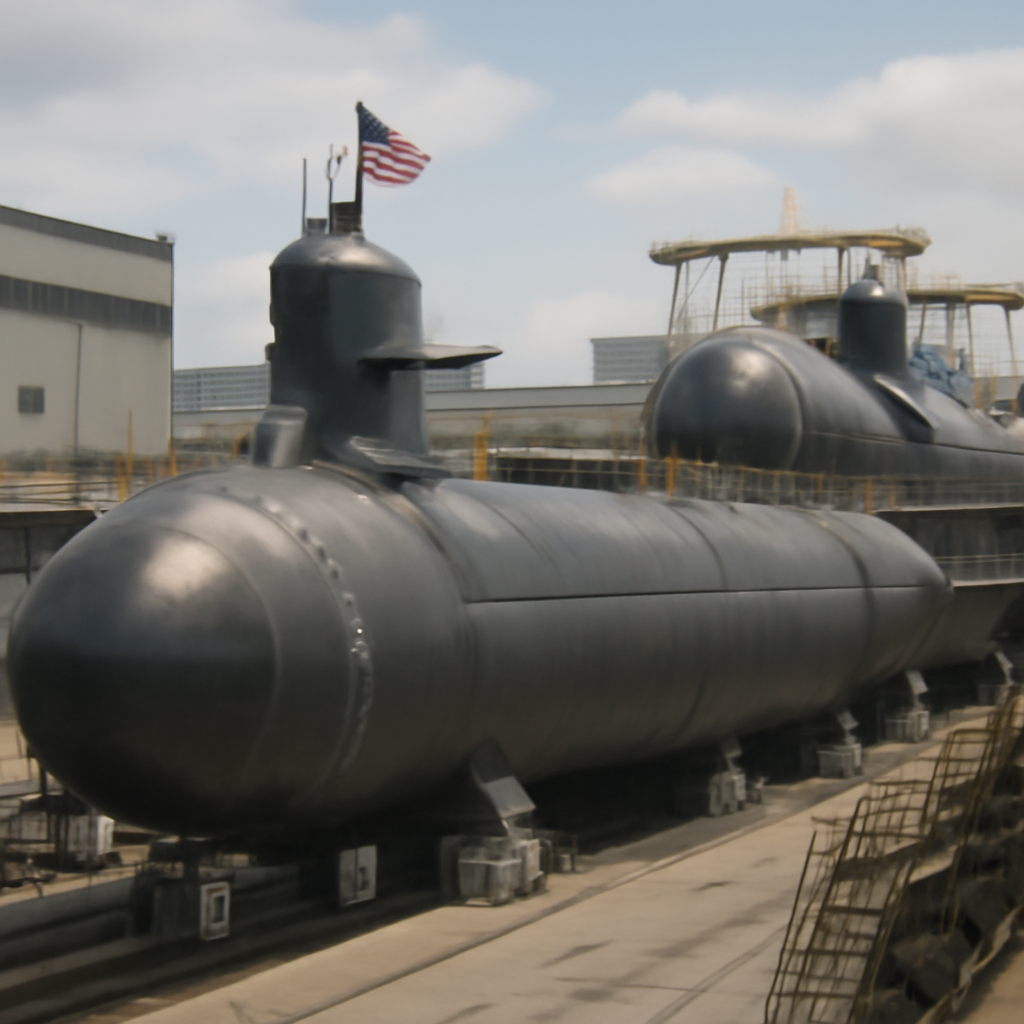
Navy reclassifies VPM-equipped Virginia class boats as SSGNs
The U.S. Navy has formally recategorized future Virginia class submarines fitted with Virginia Payload Modules (VPMs) from attack submarines (SSNs) to guided-missile submarines (SSGNs). The move accompanies the Navy’s plan to retire all four Ohio class SSGNs by the end of 2029 and follows statements from the service emphasizing the VPM’s contribution to strike capacity, operational flexibility, and deterrence. Navy Adm. Daryl Caudle, the Chief of Naval Operations, said the VPM-equipped submarines will “provide our Nation with a powerful and persistent deterrent” and expand options for combatant commanders.
The Virginia Payload Module: what it adds
The VPM is a 70-foot hull extension that contains four additional large vertical tubes. According to the Navy’s announcements, those tubes will be able to launch Tomahawk land-attack cruise missiles, Intermediate-Range Conventional Prompt Strike (IRCPS) hypersonic missiles using Advanced Payload Module (APM) inserts, and other payloads. VPM-equipped Virginias will carry 28 more Tomahawks than earlier blocks for a total load of 40. The service is also looking to acquire a surface-to-air missile designed for vertical launch from these submarines.
In addition to the VPM tubes, all Virginia class submarines retain four 21-inch torpedo tubes that can launch Tomahawks, Harpoon anti-ship cruise missiles, and can be used to launch and recover uncrewed underwater vehicles (UUVs). Some Virginias already accept Dry Deck Shelters for special operations; the Navy says those capabilities could be carried over to enlarged SSGNs and the VPMs may be capable of launching and potentially recovering additional uncrewed platforms.

This site is the portfolio.
OSINTSights runs on Cloudflare Workers, D1, R2, and Vectorize, with an AI pipeline on Hetzner ARM. Nubivance designed, built, and operates it. We do the same for clients.
See what we buildOhio SSGNs retiring, and the missile-capacity gap
The four Ohio class SSGNs are notable for very high magazine depth — able to carry up to 154 Tomahawks each and typically deploying with loads near 100. Beyond raw missile capacity, those converted Ohio boats serve multi-mission roles as motherships for special operations and uncrewed platforms, and as underwater intelligence fusion nodes and command centers. The Navy’s recategorization comes as USS Georgia, one of the four Ohio SSGNs, begins inactivation after “more than four decades of exceptional service”; Georgia returned from its final scheduled operational patrol last month and is scheduled for formal inactivation next year.
Publicly available numbers imply a significant capacity shortfall: each Ohio SSGN roughly equals four Block V/VI Virginias in missile launch capacity. Replacing the four Ohios therefore requires about 16 Virginia SSGNs; the Navy’s plan for 19 VPM-equipped Virginias would close that shortfall and add three boats of additional capacity. The Navy says it does not expect the full fleet of 19 Virginia SSGNs to be in service until Fiscal Year 2038 at the earliest — nearly a decade after the last Ohio SSGNs are expected to retire.
Production, procurement, and a numerical discrepancy
The Navy’s press release today states a plan to acquire 19 VPM-equipped Virginia class SSGNs. The future USS Arizona — the second Block V Virginia-class boat under construction — will be the first to feature a VPM, the service said; the first Block V boat, the future USS Oklahoma, will lack a VPM, while the other 10 boats in that batch are expected to have the feature. Block VI Virginias are also expected to include VPMs and other upgrades.
Complicating the accounting, the Navy last week awarded a $76.6 billion contract for nine Block VI boats and five Columbia class SSBNs. Eleven Block V boats plus nine Block VI boats would total 20 submarines, one more than the announced 19 VPM-equipped SSGNs. TWZ noted the outlier could be a planned one-of-a-kind seabed espionage subvariant shown in a 2022 General Dynamics Electric Boat graphic and said it reached out to the Navy for clarification.
There are additional production pressures: concerns about whether General Dynamics Electric Boat and Newport News Shipbuilding can keep up with demand, added strain from plans to sell some Virginias to Australia under AUKUS, and a Navy hope to push Virginia class production to two boats per year sometime in the 2030s.
What this means for fleet commanders, shipbuilders, and allied partners
- Fleet commanders: The Navy frames VPM-equipped SSGNs as a tool to “surge strike power,” provide persistent forward presence, and expand options for distributed maritime operations — but full fleet-level capacity will not arrive until FY2038.
- Shipbuilders (General Dynamics Electric Boat and Newport News): Both face increased pressure to ramp production, accommodate Block VI work, and support AUKUS transfers while meeting U.S. delivery timelines.
- Allied partners (Australia, United Kingdom): Plans to sell some Virginia class boats to Australia under AUKUS add program complexity and place additional demand on production and schedule planning.
The Navy has outlined a formal path to supplant the Ohio class SSGNs with what it now calls Virginia class SSGNs, emphasizing increased magazine depth, hypersonic-capable inserts, and broader payload flexibility. The decisive variables now are shipyard output, the resolution of the one-boat accounting discrepancy, and whether Block V and VI upgrades will reproduce the Ohio class’s multi-mission intelligence and command functions at scale before or after the last Ohio SSGNs are retired.