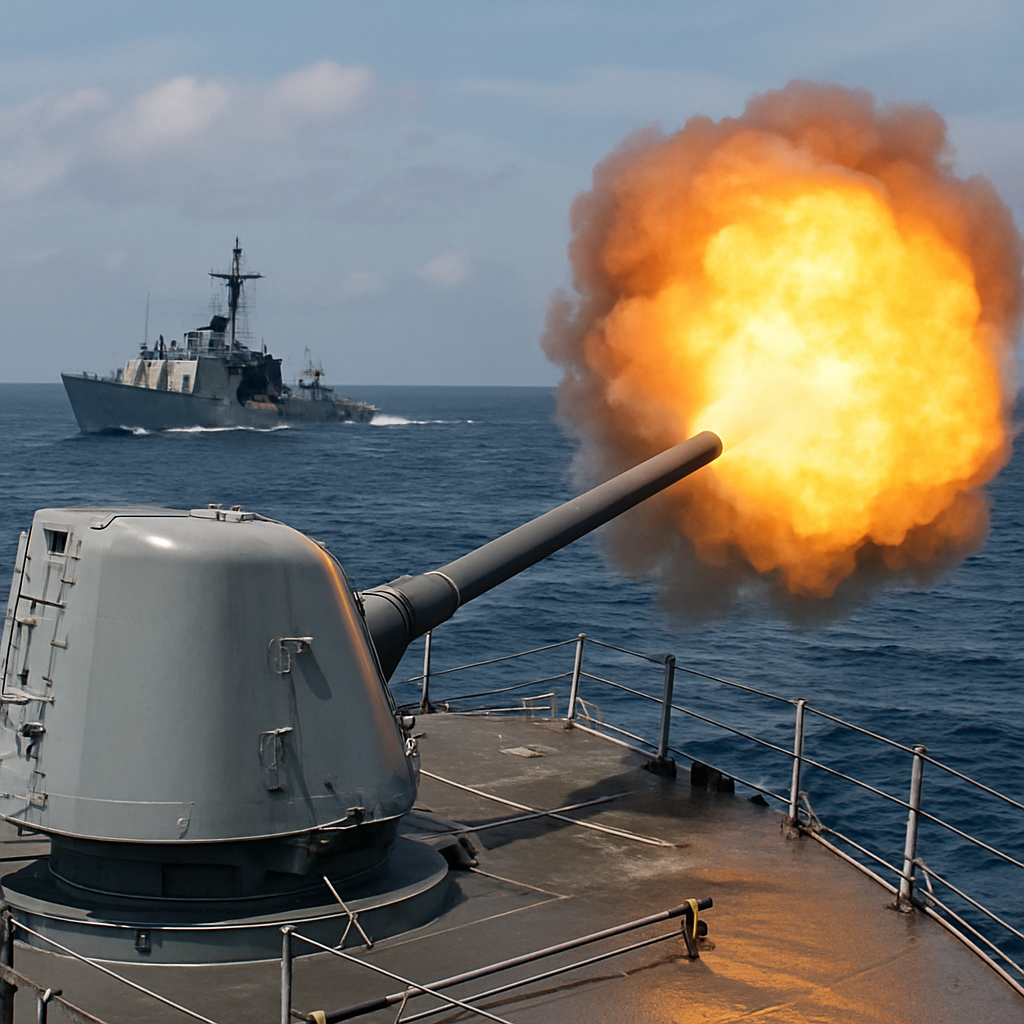
“From what we are tracking, the last known irrefutable instance of a Navy ship firing its deck gun at another ship was on April 18, 1988 during Operation Praying Mantis,” a U.S. Navy official told The War Zone — a reminder that what happened on April 19, 2026, was not routine but deeply uncommon.
Spruance and the Touska: a rare use of the 5-inch MK 45
On April 19, the Arleigh Burke–class guided missile destroyer USS Spruance fired its 5-inch MK 45 gun at the Iranian cargo ship Touska. According to reporting, the gun blast opened a hole in Touska’s engine room; the freighter did not sink and was later boarded and seized. The source describes Touska as an unarmed civilian cargo vessel that attempted to evade a U.S. blockade on Iranian ports. Video of the engagement — and of an Arleigh Burke destroyer firing its 5-inch gun in a separate clip — accompanies the reporting.
Operation Praying Mantis, April 1988: the last comparable moment
The previous clear instance of a U.S. Navy ship using its deck gun against another surface vessel occurred nearly 38 years earlier, during Operation Praying Mantis on April 18, 1988. That action grew out of Operation Ernest Will, which began in 1987 amid increased attacks on merchant shipping during the late stages of the Iran–Iraq War and a U.S. program to reflag Kuwaiti tankers for naval escort.
The immediate precipitant for Praying Mantis was the Oliver Hazard Perry–class guided missile frigate USS Samuel B. Roberts striking an Iranian mine on April 14, 1988. A Navy history described the mine’s detonation as having “blew an immense hole in the ship’s hull.” Ten sailors sustained severe injuries, four were seriously burned, and Commander Paul X. Rinn was also hurt; despite that damage, the Roberts was kept afloat through extensive damage control.
In the April 18 surface action, members of Surface Action Group (SAG) Charlie — the Belknap–class guided missile cruiser USS Wainwright, the Knox–class destroyer escort USS Bagley, and the Oliver Hazard Perry–class guided missile frigate USS Simpson — engaged the Iranian fast attack ship IRIS Joshan. The Wainwright and Bagley used 5-inch deck guns while Simpson fired its 3-inch weapon; the U.S. ships also launched SM-1 and Harpoon missiles. The Joshan, which had launched a Harpoon that narrowly missed the Wainwright, was heavily damaged by missile strikes and ultimately sunk by gunfire. In that single-day operation, the Navy destroyed two Iranian surveillance platforms, sank two Iranian ships and severely damaged another. The Navy characterized Praying Mantis as “the largest of five major U.S. Navy surface actions since World War II” and the first — and so far only — time the U.S. Navy exchanged surface-to-surface missile fire with an enemy.

Audit-ready is a season. It shouldn't be.
Evidence in spreadsheets, controls drifting between audits, frameworks multiplying on flat headcount. Nubivance runs continuous compliance on Rapid7 Cyber GRC - SOC 2, HIPAA, ISO 27001, PCI, CMMC.
End the scrambleTactical and strategic differences between 1988 and 2026
Though both episodes involved U.S. warships using guns against Iranian-linked vessels, the circumstances differ markedly. Praying Mantis was a robust, coordinated surface-and-air operation in direct retaliation for a mine strike that nearly sank a U.S. frigate; it resulted in sinking warships and destroying fixed platforms. By contrast, the Spruance’s firing at Touska struck an unarmed civilian cargo ship, left the vessel afloat, and ended with a boarding and seizure rather than destruction.
The broader naval picture has changed as well. The reporting says the vast majority of Iran’s navy was destroyed during “Epic Fury,” leaving mostly small attack craft and no large combatants like the Joshan. That alters the set of possible surface engagements and targets compared with 1988.
What this means for Iran, the U.S. Navy, and merchant shipping
- Iran: The government labeled the Touska incident “an act of piracy,” demanded the return of the ship and its crew, and threatened retaliation — though, as of the reporting, no retaliation had occurred. The source also notes that, despite diplomatic efforts, Iran has yet to signal a return to negotiations following extensions of a ceasefire deadline attributed to “Trump.”
- The U.S. Navy: The Spruance action marks the first known, irrefutable use of a main deck gun against another ship since Praying Mantis. That rarity underscores both the symbolic weight of the decision to fire and the limited role naval gunfire plays in contemporary surface warfare.
- Merchant shipping and neutral actors: The historical precedent of Operation Ernest Will — reflagging Kuwaiti tankers for U.S. escort after escalating attacks — remains a reminder that naval operations in the Gulf have long intersected with efforts to protect commerce; the Touska episode shows those tensions persist when blockades and interdictions collide with civilian traffic.
The Spruance–Touska exchange is at once a technical footnote and a diplomatic signal: a 5-inch gun punched a hole in a freighter’s engine room and revived a 38‑year‑old comparison to Praying Mantis. The immediate facts are straightforward — a damaged, seized vessel and a formal Iranian protest — but the longer-term effects, whether deterrent or escalatory, are not yet written. Iran has warned of retaliation; for now, it has not followed through. That, more than any gun blast, is the question the region will watch next.