“The security policy situation with significantly increased defence budgets in numerous countries ensures demand in the military business. The promising market situation and the persistently strong order book remain unchanged,” the company said — even as it cut an annual naval sales forecast by €300 million ($346 million) after Germany cancelled the F126 frigate programme.
Rheinmetall’s €300 million naval adjustment and 2026 outlook
Rheinmetall disclosed the €300 million reduction in its naval business sales forecast in a semi-annual financial report, translating that shortfall to roughly $346 million. The company nonetheless projected group-wide fiscal 2026 sales between €13.7 billion and €14.2 billion, significantly above its 2025 sales of €9.9 billion. The firm framed the hit as program-specific while underscoring broader demand supported by “significantly increased defence budgets in numerous countries.”
Germany’s cancellation of the F126 frigate and the move to MEKO frigates
Berlin had planned to acquire six F126 frigates originally contracted to Dutch shipbuilder Damen Schelde Naval Shipbuilding (DSNS). After issues with the project led to consideration of shifting construction to Naval Vessels Lürssen (NVL) — which Rheinmetall acquired in March — a government review found transferring the programme could cost in excess of €18 billion. In June, Germany formally scrapped the six-ship F126 project and moved immediately to a plan to acquire eight ThyssenKrupp Marine Systems (TKMS)-produced MEKO frigates to perform anti-submarine warfare and satisfy NATO requirements. That procurement remains dependent on approval by Germany’s parliamentary Budget Committee.

This site is the portfolio.
OSINTSights runs on Cloudflare Workers, D1, R2, and Vectorize, with an AI pipeline on Hetzner ARM. Nubivance designed, built, and operates it. We do the same for clients.
See what we buildNaval systems sales, ongoing shipbuilding work, and the new GMF 140
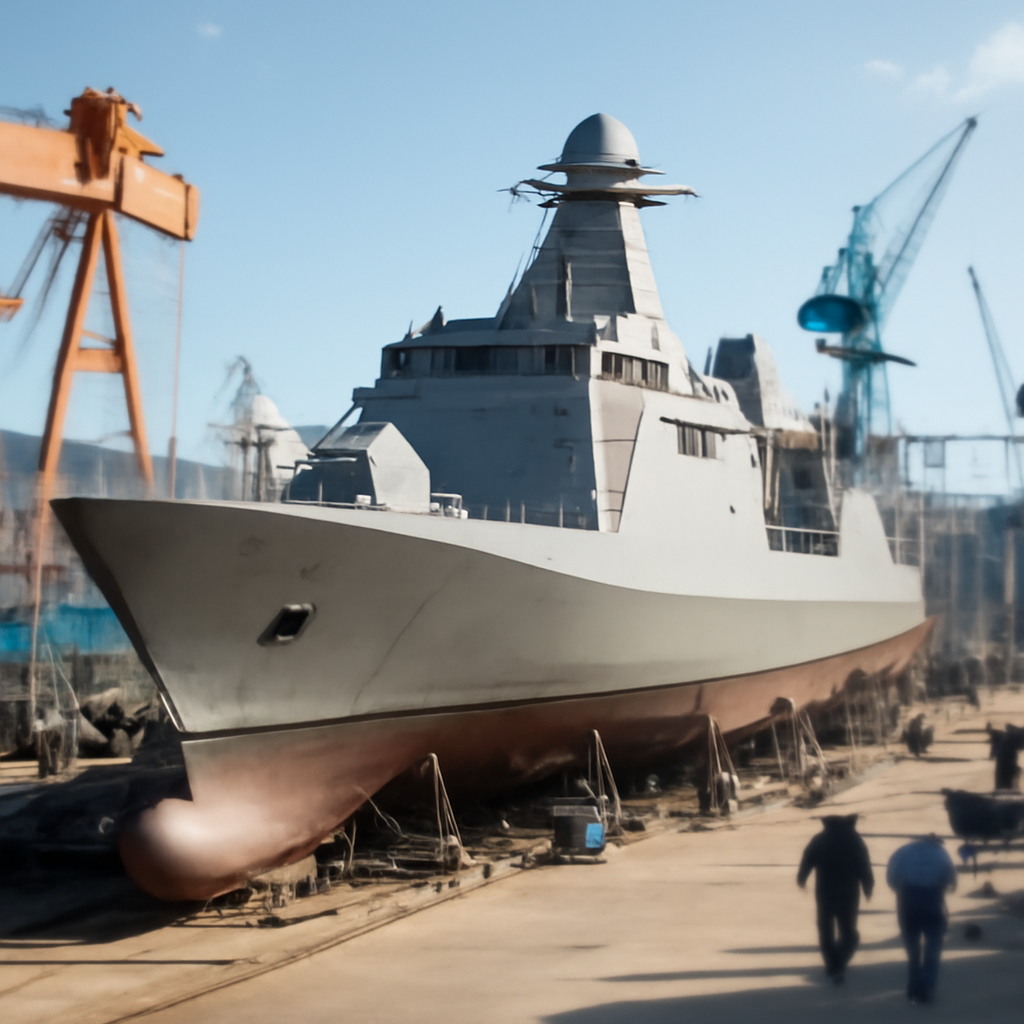
Despite the F126 cancellation, Rheinmetall’s naval systems division reported €334 million in sales over the past four months. New-build programmes were the primary contributors, including work on intelligence vessels (FDB424), Braunschweig-class corvettes (K130), replenishment oilers (MBV707) and the Bulgarian multi-purpose modular patrol vessel programme (MMPV90). In parallel with its maritime expansion plans, Rheinmetall unveiled a guided-missile frigate called the GMF 140 earlier this week; the company said the ship could be available to an unnamed North American customer and listed its mission set as including air and ballistic missile defence, anti-submarine warfare, and long-range strikes.
Vehicle, weapons and air-defence divisions driving half-year growth
Rheinmetall’s half-year results showed growth outside naval systems as well. Vehicle system sales reached €2.43 billion — a 28 percent increase compared with the first half of 2025 — which the company attributed to deliveries on German tactical vehicle programmes and wheeled armoured vehicles for Berlin and other European customers. Weapon systems, ammunition and protection systems generated €1.76 billion, up 33 percent year-on-year; Rheinmetall cited an ammunition package for Hungary and supplies of artillery and medium-caliber ammunition for Ukraine as key drivers. Air-defence sales rose 62 percent to €478 million, broadly based on production of Skynex and Skyranger systems for European buyers.
How Rheinmetall, the German government, and NATO are responding
- Rheinmetall: The company has reduced its naval-sales forecast by €300 million but reported €334 million in recent naval sales and is pressing forward with maritime product development, including the GMF 140 as a potential offering to North American customers.
- The German government: After a review that put the cost of transferring the F126 in excess of €18 billion, officials cancelled the six-ship programme in June and pivoted to an eight-ship MEKO procurement for anti-submarine warfare pending the parliamentary Budget Committee’s approval.
- NATO requirements: Germany’s immediate decision to pursue MEKO frigates was explicitly tied to meeting NATO anti-submarine warfare requirements, shaping procurement choices and timelines tied to allied capability commitments.
Rheinmetall’s headline loss from the cancelled F126 is concrete and program-specific — a €300 million reduction in naval sales — even as the company points to broader momentum across land, ammunition and air-defence lines to lift overall 2026 sales well above 2025 levels. The next concrete inflection point in this story is procedural: whether Germany’s parliamentary Budget Committee approves the planned MEKO frigate procurement, and how Rheinmetall markets the GMF 140 as naval business realigns following the F126 cancellation.