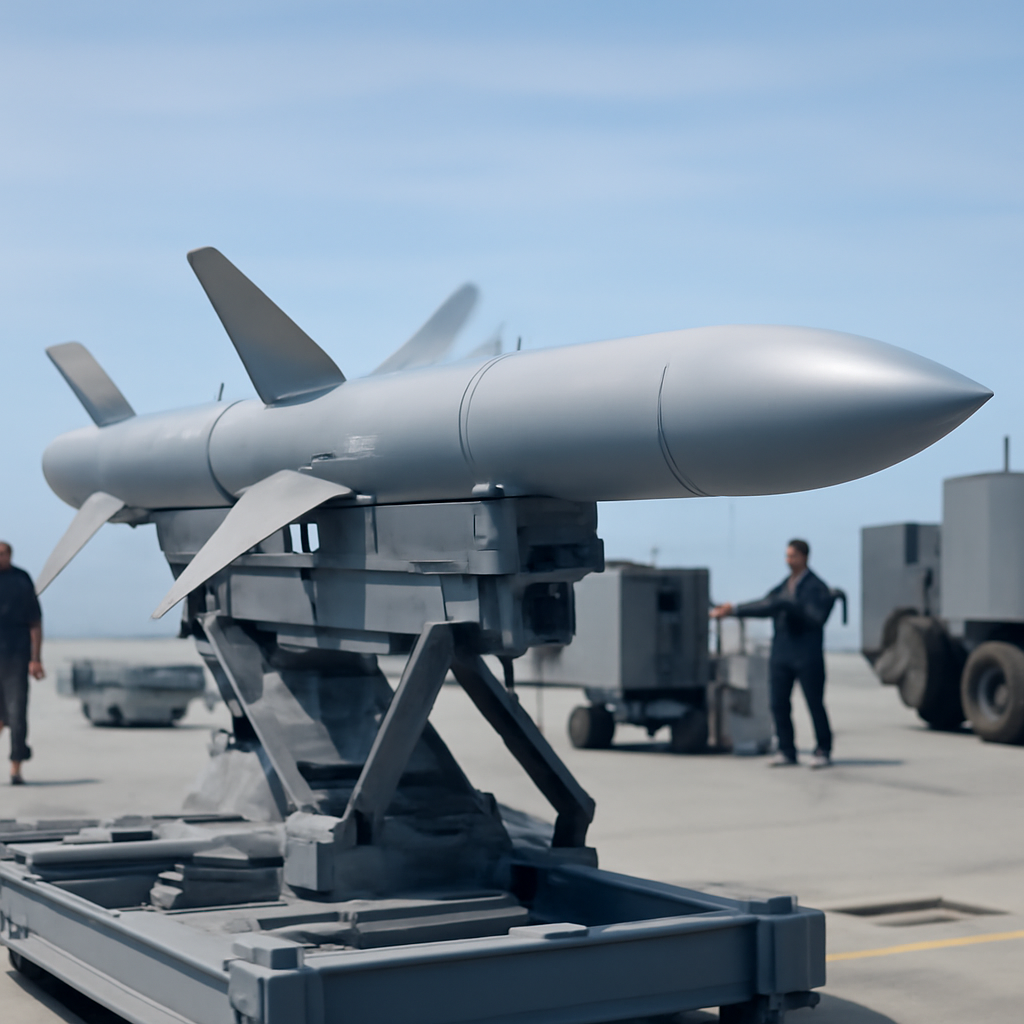
NAVAIR’s fresh AESM request for information
Naval Air Systems Command (NAVAIR) issued a new Advanced Emission Suppression Missile (AESM) request for information (RFI) yesterday, asking industry to identify candidates “capable of providing an AARGM-ER equivalent missile system.” The notice requests an All-Up-Round (AUR) missile — hardware, software, logistics elements, trainers, “AARGM-ER equivalent flyout model,” and “all system verification elements.” NAVAIR adds that the offering must be a mature design (Technology Readiness Level >6) and “compatible with existing launch platforms.”
Requirements: AESM versus the AGM-88G AARGM-ER
The RFI’s stated needs closely mirror what the Navy has said it expects of the in-development AGM-88G (AARGM-ER). AESM must have “extended range” for “significant standoff distances,” an “advanced anti-radiation seeker with broad frequency coverage,” the “ability to target modern and advanced radar systems,” and lethality sufficient to deliver a “high probability of kill against a wide range of targets.” The notice specifies suitability for internal and external carriage on at least certain F-35 variants and names F/A-18E/F Super Hornet and EA-18G Growler jets as threshold launch platforms.

Audit-ready is a season. It shouldn't be.
Evidence in spreadsheets, controls drifting between audits, frameworks multiplying on flat headcount. Nubivance runs continuous compliance on Rapid7 Cyber GRC - SOC 2, HIPAA, ISO 27001, PCI, CMMC.
End the scrambleAir-to-air capability: present in draft, absent in the reboot
The initial AESM RFI from February included a more explicit requirement for an air-to-air engagement capability — language that would have signaled a hybrid anti-air/anti-radiation role. The new, pared-back RFI omits that specific call, leaving unclear whether an air-to-air function remains a priority. TWZ notes the earlier RFI asked vendors to describe “ability to engage air-to-air and air-to-ground targets,” a capability not previously associated with the Navy’s AGM-88G program.
Program status, testing milestones, and procurement posture
The AARGM-ER itself is a direct evolution of the AGM-88E AARGM and has been pursued actively since 2018. The program has experienced technical issues and delays: an original goal of reaching initial operational capability (IOC) in 2023 was missed, and the Navy is now aiming for IOC by September of this year. The Navy’s February statement described a “strategic pause” in U.S. purchases for FY2027, with plans to resume U.S. procurements after successful completion of testing and software updates and to “ramp up production to clear a backlog of over 150 missiles,” restarting U.S. buys in FY2028. Meanwhile, FY2027 production would be allocated to Foreign Military Sales tied to five signed international cases.
Industrial base diversity, allied partners, and program derivatives
The RFI and accompanying reporting frame the AESM push not only as a capability hedge but as an industrial one. The Navy’s solicitation for “AARGM-ER equivalent” systems can be read as a search for alternate or additional suppliers to reduce reliance on single vendors and expand production capacity. The story notes that Italy is a full partner in the AARGM-ER’s development, that foreign customers remain in line for deliveries, and that the U.S. Air Force is pursuing a derivative called the Stand-in Attack Weapon (SiAW), reportedly designated AGM-88J. The piece also points to broader moves within the Pentagon to broaden the defense industrial base, a trend the source traces in part to actions “since President Donald Trump started his second term.”
What this means for the Navy, Italy, and prospective vendors
- The Navy: Will pursue parallel paths — validate AARGM-ER through testing to meet the stated IOC date while soliciting market alternatives that are “compatible with existing launch platforms” to ensure resilience and replenishability of stocks.
- Italy (and foreign customers): Remain committed partners and buyers; FY2027 production is earmarked for Foreign Military Sales tied to five signed international cases, preserving some delivery timelines despite the U.S. procurement pause.
- Prospective vendors and non‑traditional suppliers: Are being asked to demonstrate mature designs (TRL >6) and to provide complete AUR packages, opening opportunities for firms that can meet platform-compatibility and verification requirements quickly.
The Navy’s renewed outreach via the AESM RFI — coupled with a declared pause and a stated IOC target for AARGM-ER in September — leaves the service running two tracks: finish and field the upgraded AGM-88G while exploring market alternatives that could either supplement or provide a capability equivalent to the AARGM-ER. How industry responds to the TRL>6 requirement, and whether AESM reintroduces an air-to-air role, are the immediate questions now in play.