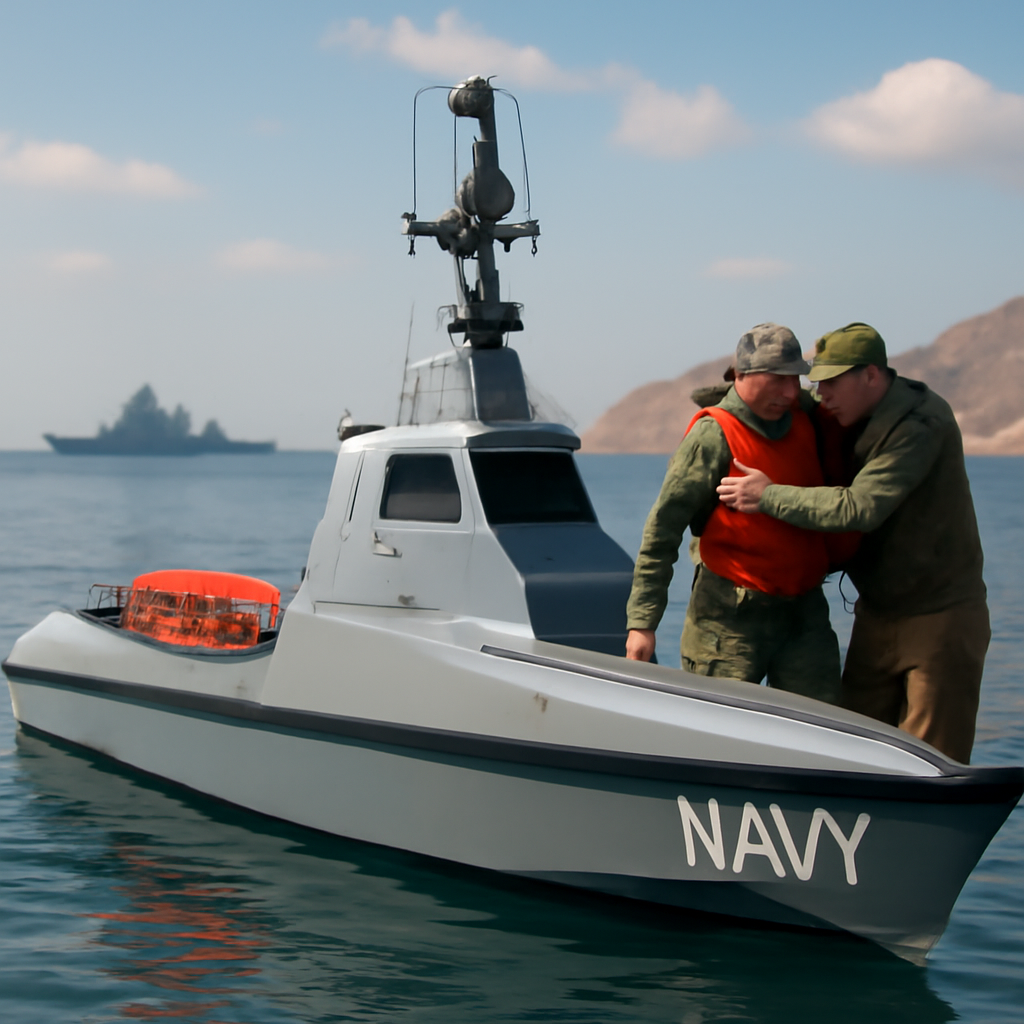
“At 7:33 p.m. ET on June 8, two crew members from a U.S. Army AH-64 Apache were rescued by American forces after their helicopter went down near the coast of Oman while patrolling regional waters,” CENTCOM said.
CENTCOM timeline and immediate findings
CENTCOM’s statement places the incident on the evening of June 8 and reports the two soldiers were “safely rescued within approximately two hours and are in stable condition.” The command also said the cause of the incident is under investigation. Navy Capt. Tim Hawkins, a CENTCOM spokesman, confirmed to TWZ that a U.S. Navy uncrewed surface vessel (USV) took part in the rescue effort.
The uncrewed surface vessel and Task Force 59
TWZ reports this as the first known instance of a drone boat executing a personnel recovery as part of a military search-and-rescue operation. Task Force 59, the Navy’s principal drone force in the Middle East, is named in CENTCOM’s statement and operates a variety of USVs, including speedboat‑type vessels. The specific model used in this rescue has not been identified publicly. TWZ describes Task Force 59 as actively experimenting with multiple uncrewed naval technologies and calls the rescue “a major win for the forward‑looking unit.”

Audit-ready is a season. It shouldn't be.
Evidence in spreadsheets, controls drifting between audits, frameworks multiplying on flat headcount. Nubivance runs continuous compliance on Rapid7 Cyber GRC - SOC 2, HIPAA, ISO 27001, PCI, CMMC.
End the scrambleWho led the recovery: U.S. Naval Forces Central Command, the 82nd Airborne Division, and Task Force 59
The rescue, CENTCOM said, was led by U.S. Naval Forces Central Command and the 82nd Airborne Division with support from U.S. Air Force and Navy units, including U.S. 5th Fleet’s Task Force 59. TWZ highlights the mix of service elements involved and notes that employing a USV in an open-water recovery presents distinctive operational advantages—particularly the ability to reach areas where crewed assets might be at risk.
Operational context: AH-64 Apaches and recent regional operations
TWZ places the downing in a broader operational context in which Army AH-64 Apaches have been used to enforce a blockade of Iran and to protect commercial shipping. The site quotes Navy Adm. Brad Cooper, head of CENTCOM, saying that Apaches and Navy MH-60 Seahawks destroyed six small Iranian boats last month after those boats were threatening commercial ships in and around the Strait of Hormuz. TWZ also reports that Apaches had been conducting missions targeting Iranian naval assets prior to the announcement of a ceasefire in April and underscores the helicopters’ role in defending against swarms of small boats.
The story further states that, since the start of the latest operations against Iran in February, the U.S. military has lost at least seven crewed fixed‑wing aircraft and helicopters, with additional aircraft damaged both in the air and on the ground, including by Iranian fire. TWZ published a visual tally of damaged and destroyed aircraft as of April 10.
What this means for commanders, Task Force 59, and policymakers
- Commanders and CSAR planners: The incident underlines search‑and‑rescue risk in maritime and contested environments and adds urgency to options that reduce risk to rescue crews—specifically pre‑positioned or forward‑deployed uncrewed assets that can perform recovery tasks without exposing additional personnel.
- Task Force 59 and naval operators: TWZ frames the event as validation of USV concepts the Task Force has been experimenting with, demonstrating a novel mission set—personnel recovery—in addition to the surveillance and strike support roles already explored.
- Policymakers and national leaders: CENTCOM’s investigation into cause remains the official line, but TWZ also reports an update in which President Donald Trump said on Truth Social that Iranian forces shot down the Apache and that “the United States must, of necessity, respond to this attack.” That statement, as reported by TWZ, raises the prospect of policy and operational responses tied to the investigation’s findings.
Whether the Apache went down because of hostile action or mechanical failure is officially unresolved; CENTCOM has begun an investigation even as the president publicly described the aircraft as shot down by Iran. What is clear from the record TWZ provides is that the rescue expanded the role of uncrewed maritime systems in live personnel recovery—an operational first that commanders and planners are likely to study closely.