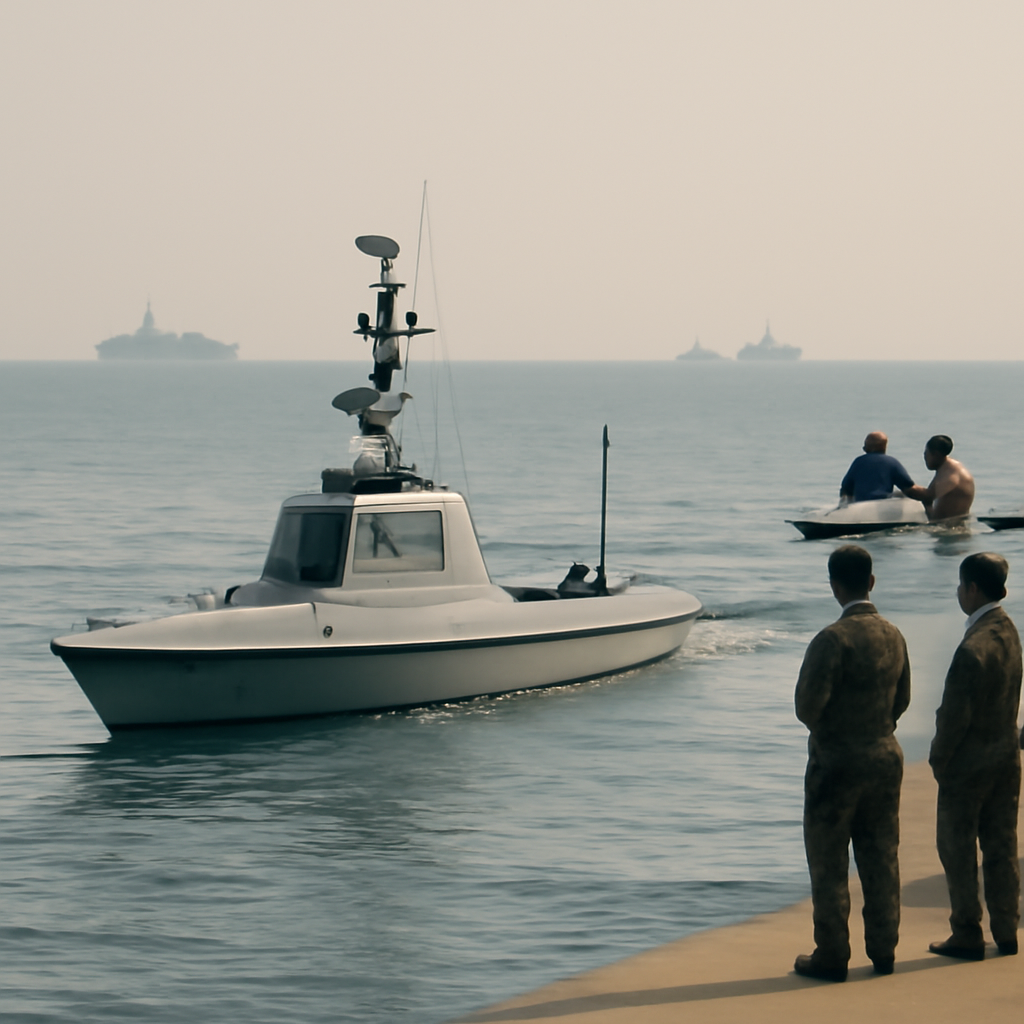
“The surface drone that assisted in last night’s rescue of the Apache crew off the coast of Oman was a U.S. Navy Corsair unmanned surface vessel operated by U.S. 5th Fleet’s Task Force 59,” U.S. Navy Capt. Tim Hawkins, a CENTCOM spokesman, told TWZ.
The Corsair: a 24‑foot drone boat now proven in rescue
The unmanned surface vessel (USV) that recovered the two U.S. Army aviators was the Saronic Corsair, a 24‑foot autonomous surface vessel the company unveiled in 2024. Saronic and official releases report a top speed of 35 knots, a maximum range of 1,000 nautical miles, and a 1,000‑pound payload capacity. The Navy signed an Other Transaction Authority (OTA) deal with Saronic last December valued at $392 million to produce Corsair USVs.
Task Force 59: fielding Corsair in theater
The Corsair used in the Gulf of Oman rescue was operated by U.S. 5th Fleet’s Task Force 59. CENTCOM confirmed Task Force 59 began fielding these drones in theater in late March. Established in 2021, Task Force 59 has the explicit charge of expanding operational use of uncrewed platforms, artificial intelligence, and machine learning across the Middle East and has operated multiple USV and uncrewed aerial system types over the years.

This site is the portfolio.
OSINTSights runs on Cloudflare Workers, D1, R2, and Vectorize, with an AI pipeline on Hetzner ARM. Nubivance designed, built, and operates it. We do the same for clients.
See what we buildHow the rescue unfolded, as reported
CENTCOM said the Corsair “picked them [the Apache crew] up and transported them to another location on the water where they were then hoisted up to a helicopter for further transport.” The two Army aviators spent approximately two hours in the water before being recovered safely. The Wall Street Journal was first to report the specific type of drone boat employed. President Donald Trump separately said Iranian forces brought down the AH‑64 Apache and promised a U.S. response. TWZ described this as the first known instance of a drone boat being used to recover personnel as part of a search‑and‑rescue mission.
Capabilities and configurations seen so far
Public imagery and company statements show Corsair fitted primarily for surveillance and reconnaissance: a camera turret mounted on a central mast‑like frame, commercial navigation radar, extra cameras for situational awareness, and various antennas. Saronic states Corsair has logged more than 100,000 nautical miles of travel, including multi‑day missions, and in 2025 reported more than 79,000 nautical miles and over 15,000 hours of operations across multiple U.S. test sites.
Saronic describes Corsair as highly autonomous — able to operate alone or in collaborative swarms with human operators “in the loop” via datalink. Company materials advertise redundant communications and passive perception capabilities, and say Corsair can autonomously identify, track, follow, and intercept targets in contested or communications‑denied environments. Saronic has also discussed integrating additional mission payloads, including launchers for loitering munitions, in the past.
What this means for Saronic, the Navy, and Army aviators
- Saronic: The public, operational use of Corsair in the Gulf of Oman is likely to bolster the platform’s profile for future sales; Corsair already has been evaluated by the Defense Innovation Unit (DIU) under the PRIME effort and was a finalist in the Army’s xTechPacific 2025 challenge. Saronic is also developing larger USVs, including the 180‑foot Marauder prototype that the company says can travel up to 4,100 nautical miles with 150 metric tons of containerized payloads.
- The Navy / Task Force 59: The incident demonstrates a practical CSAR (combat search and rescue) role for USVs and supports the Navy’s plan to prototype medium unmanned surface vessels (MUSV). The Navy is set to evaluate Marauder and designs from six other companies as part of the first round of MUSV prototyping.
- Army aviators / CSAR planners: The operation shows an option to recover personnel from high‑risk maritime environments without immediately risking additional crewed CSAR assets; the Corsair transported the downed aviators to a rendezvous where a helicopter completed the hoist.
The Corsair’s role in the Gulf of Oman rescue marks a shift in how uncrewed platforms may be used in maritime personnel recovery. The Navy has shown a route toward quicker fielding — an OTA contract and Task Force 59 deployments — while Saronic’s public mileage and operational claims point to a platform tested in long‑range, persistent missions. How many Corsairs Task Force 59 currently operates, and the exact configurations deployed in theater, remain unspecified in the reporting. Meanwhile, the service is already moving to evaluate larger USV concepts such as Marauder under MUSV prototyping.
Link to original story: https://www.twz.com/sea/this-is-the-corsair-drone-boat-that-plucked-the-downed-apache-crew-out-of-the-gulf-of-oman