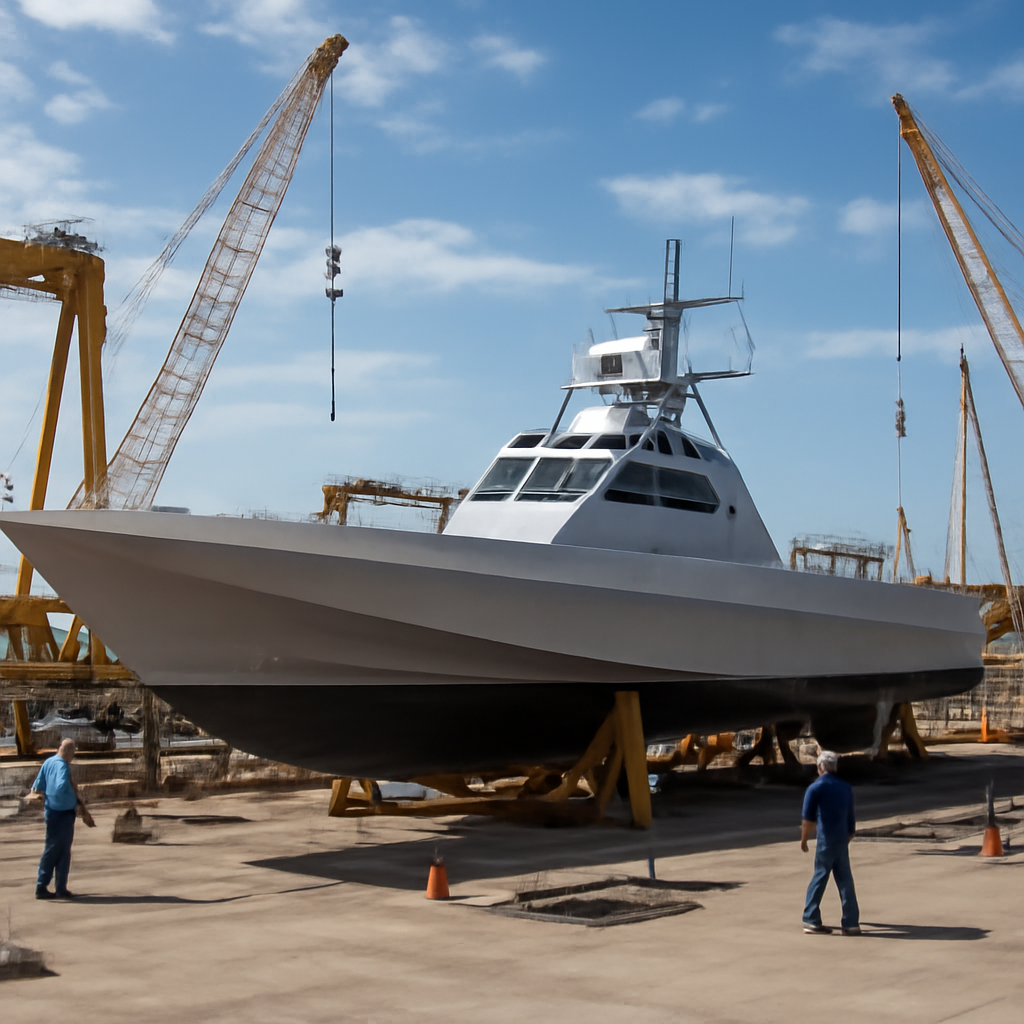
"Each agreement is for the procurement of 10 MUSV at an average procurement cost of $40 million per vessel," Acting Direct Reporting Portfolio Manager for Robotic and Autonomous Systems (DRPM RAS) Chris Miller said at a media roundtable. The Navy announced that it has awarded Other Transaction Authority (OTA) agreements to three companies to buy 30 medium uncrewed surface vessels (MUSVs) — 10 apiece — in a move the service called a significant step toward a tangible fleet capability.
Contracts, cost, and immediate production plans
The three OTA awards went to Galliano Marine Services (doing business as Edison Chouest), Huntington Ingalls Industries (HII), and Saronic Technologies. Miller said production will begin immediately at shipyards in Loreauville, Houma, and Franklin, Louisiana, with deliveries starting as early as the fourth quarter of Fiscal Year 2027. At an average unit procurement cost of $40 million, the 30-vessel package carries a notional $1.2 billion price tag. The OTAs are intended to support rapid prototyping and research-and-development work without traditional contracting timelines.
Who submitted designs and who competed in Phase I
HII submitted the Romulus design and Saronic offered the Marauder for the MUSV Phase I competition; Galliano has not publicly announced its entrant. The initial Phase I round involved seven companies in all — the three awardees plus Birdon, Leidos, PacMar Technologies, and Sea Machines — and was conducted under an earlier set of OTAs. Birdon did not complete the required testing. Under Phase I terms, Galliano, HII, and Saronic will also receive $15 million awards and be included in the Drones.mil-hosted Maritime Marketplace.

This site is the portfolio.
OSINTSights runs on Cloudflare Workers, D1, R2, and Vectorize, with an AI pipeline on Hetzner ARM. Nubivance designed, built, and operates it. We do the same for clients.
See what we buildPhase I testing: autonomy, navigation, and the 26-hour trial
The Phase I demonstrations evaluated a range of attributes. Miller said testing measured "the vessel’s ability to see and understand the surrounding maritime environment, how well the vessels navigated autonomously according to the international regulations for preventing collisions at sea, and the vessel’s ability to conduct a long-duration mission." The endurance test required platforms to "execute [over] roughly 26 hours and over 360 nautical miles with only a single input during that time from a C2 [command and control] station allowed," demonstrating continuous operation for more than 24 hours with minimal operator input.
Phase II parameters and the Maritime Marketplace
The Phase II contracting notice sets additional constraints and capabilities for future MUSV entries. Submitted designs must be no more than 295 feet (90 meters) long, displace no more than 5,000 metric tons, and be able to carry at least 2x twenty-foot equivalent units (TEU) weighing 24,000 kg each and consuming 25 kW each. Platforms must be "capable of executing multi-day unmanned operations of at least 10 days," be operable in NATO STANAG 4194 Sea State 4, and survivable in Sea State 6. The notice also states that "to be considered for this Call for Solutions, the proposed MUSV must be ready for operational demonstration at the time of solution submission" and warns that designs requiring substantial modifications from the as-demonstrated platform will not be considered.
Miller said the Phase II solicitation removes earlier speed and at-sea refueling targets after Phase I lessons, noting: "What we learned from Phase I is that as you increase the speed requirements and some of these other things, it does present certain challenges for industry." Testing evaluations for Phase II are scheduled to begin "as early as November 16th," and proposals will be assessed on a continually rolling basis over the next five years. The Drones.mil Maritime Marketplace is intended as a conduit for follow-on production agreements across authorized acquisition authorities.
What this means for Leidos, PAC MAR, Sea Machines, and the Navy’s operational aims
- Leidos, PacMar Technologies (PAC MAR), and Sea Machines: The Navy said these firms were determined to complete their prototype OTAs and will receive $15 million awards under previously established terms. Inclusion on the Maritime Marketplace makes them eligible for follow-on production agreements from authorized acquisition authorities.
- Blue Water Autonomy and Saildrone: Those companies filed suit against the Navy after being left out of Phase I; the source says the lawsuit is still ongoing and alleges the service did not follow its own selection criteria.
- The Navy’s operational posture: Miller framed MUSV as part of a broader effort to build scalable, modular systems for containerized payloads — sensors, repair equipment, and other modular packages — and signaled potential cross-service cooperation. The Navy also recently established a Robotic and Autonomous Systems Warfighting Development Center (RASWDC) to centralize development, operational integration, and employment of RAS across the maritime domain.
The awards and marketplace approach mark a decisive pivot toward fielding larger uncrewed surface platforms, but the Navy’s own comments underline remaining contingencies. Miller acknowledged budget constraints and other hurdles, saying, "I’m trying to be prepared depending on where that demand goes." The program still needs to translate prototype demonstrations and OTA procurements into sustained operational fleets — a process that will play out through Phase II demonstrations beginning November 16th, ongoing legal challenges, and the delivery timeline that currently targets Q4 FY2027.
Source: TWZ — Navy Orders 30 Drone Ships To Finally Advance Its ‘Medium’ Uncrewed Vessel Ambitions