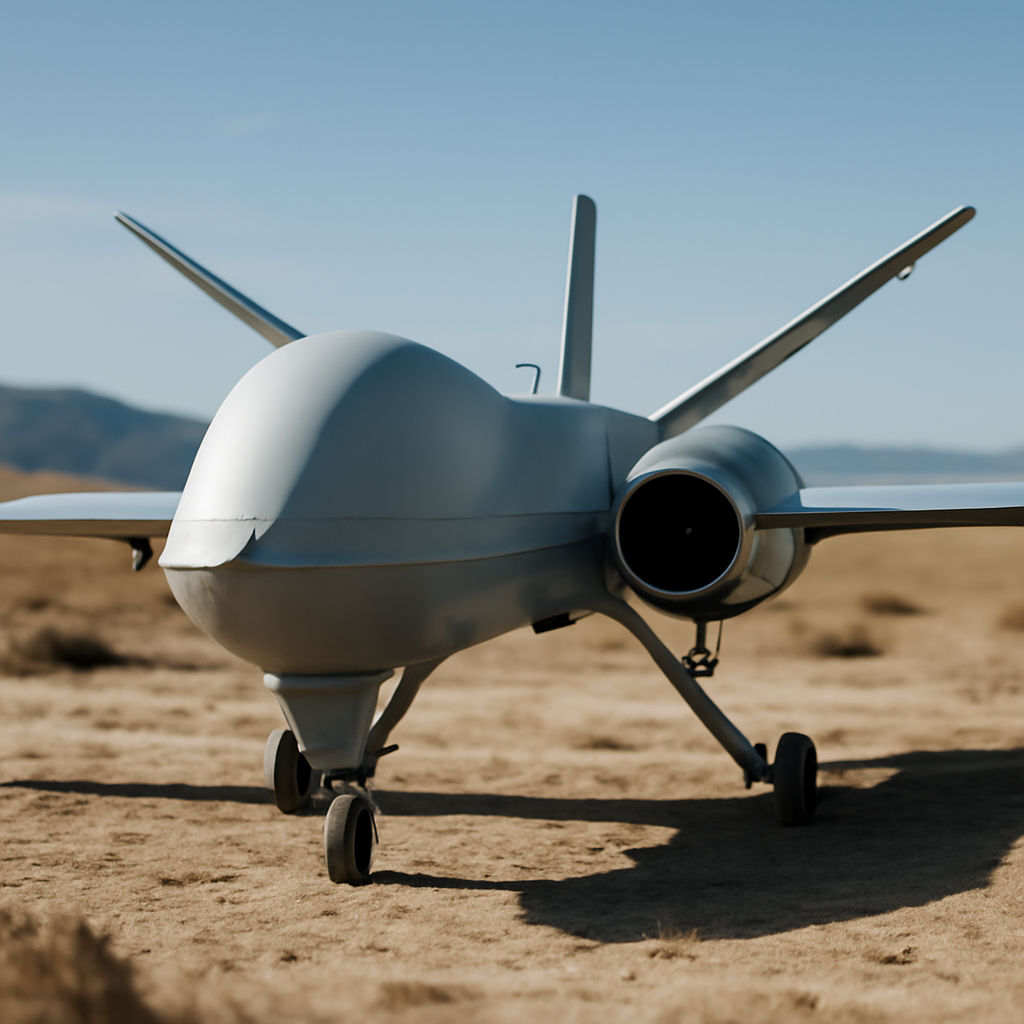
"This engine allows it to fly at speeds of up to 450 to 500 kilometers per hour over Ukrainian territory. Sometimes even faster," RFE/RL proffered.
What the Geran-4 is: a purpose-built jet Shahed
Ukraine’s Defense Intelligence Directorate (GUR) and Radio Free Europe/Radio Liberty (RFE/RL) describe the Geran-4 as a jump in capability from the earlier Geran-3/Shahed-136 derivatives. According to GUR, the Geran-4 appeared in May and uses a new airframe built for higher-speed flight because "the structural strength [of the older model] was insufficient for high-speed flights, and even less so for maneuvering under high G-loads." GUR notes a blended air intake, improved aerodynamic efficiency, reinforced structure, a turbojet engine with increased thrust, permanently integrated center wing section, and fewer fuselage hatches to reduce drag.
Range, altitude, sensors and connectivity
RFE/RL’s hands-on examination reported that the Geran-4’s turbojet allows flight to altitudes up to eight kilometers—about twice that of earlier propeller-driven models—and speeds the outlet described at roughly 450–500 km/h. The camera suite found on the recovered drone supports daylight, night-vision, and infrared modes with 10x optical and up to 32x digital zoom; that, RFE/RL said, enables operators to view terrain from altitude. The outlet also documented GSM modems and two cellular modems that can carry location data over mobile networks; a Chinese mesh modem with an advertised range up to 300 kilometers was reported to provide radio and video communications and act as a signal relay among multiple drones.

Audit-ready is a season. It shouldn't be.
Evidence in spreadsheets, controls drifting between audits, frameworks multiplying on flat headcount. Nubivance runs continuous compliance on Rapid7 Cyber GRC - SOC 2, HIPAA, ISO 27001, PCI, CMMC.
End the scrambleComponents and production: multinational parts, Russian assembly
Inspectors found foreign-made elements inside the Geran-4. RFE/RL reported the turbojet was made in China and noted cases where such engines were assembled in Russia using Chinese components. The reporting also showed circuit boards containing components from Texas Instruments. The drone that RFE/RL examined was, according to specialists, assembled at Alabuga. Ukraine’s military intelligence provided a production estimate: Russia is now producing around 3,000 Geran-4 and Geran-5 drones a month at Alabuga and other facilities.
Operational impact: scale of strikes and new damage patterns
The Geran-4 and related jet-powered Geran-5 variants have placed new strain on Ukrainian air defenses. In one overnight operation reported by the Air Force, Russia launched 165 drones, 79 of them jet-powered; air defenses downed or suppressed 112 and hits were recorded at 14 locations. Videos and social-media posts included a recent Geran strike that hit a residential building in Odesa. Polkovnyk GSh reported that Geran-5 models carry a DSMAC navigation module similar to the X-101 for image-based reference navigation, enabling independent navigation without external positioning. Presidential adviser on defense technology Serhii Beskrestnov said mesh repeaters on these weapons let the Russian military acquire real-time, high-quality battle-damage assessment of strikes.
Ukraine’s responses: fighters, new interceptors, and scaling claims
Ukraine has adapted multiple ways to blunt the jet-powered threat. The Ukrainian Air Force has used F-16 Vipers employing the M61 Vulcan cannon to shoot down jet-powered Shahed-type drones, and the Air Force posted footage of such an engagement. President Volodymyr Zelensky told the U.N. General Assembly that "our soldiers have already successfully tested four new jet-powered interceptor drones against Russian jet-powered Shaheds. So we are scaling up production," though the sources note it is unclear which interceptor types he referenced.
Private Ukrainian firms are also public about combat tests. Wild Hornets, maker of the Sting family, posted video claiming a "STING S" variant shot down a Geran-5 and said roughly a dozen Geran-4s and several Geran-5s had been shot down in recent days during combat testing with select units. Wild Hornets described the STING S as a high-speed quadcopter-type interceptor intended to be inexpensive, easy to use and scalable, and said that many engagements used "Hornet Vision Ctrl" remote-control technology for low-latency image transmission, long-range communication and resistance to electronic warfare. TWZ noted it could not independently verify Wild Hornets' claims.
What this means for technologists, policymakers, and the Ukrainian military
- Technologists and security teams: the presence of mesh modems, GSM modems, and high-zoom electro-optical sensors inside Geran-4s highlights how connectivity and C2 (command-and-control) elements are being embedded in kamikaze UAVs—tools to watch for include mesh relays and off-the-shelf telecom components used as relays or datalinks.
- Policymakers and export-control authorities: RFE/RL’s finding of Chinese-made engines and U.S.-made components on recovered drones underscores, in the outlet’s words, "gaps in global export control enforcement" that policymakers must account for when assessing sanctions and supply-chain interdiction.
- The Ukrainian military and defense industry: the combination of F-16s using cannon fire and new, higher-performance interceptor drones (including claims about the Sting S) represent parallel approaches—air-to-air and point-defense drone interception—to stretch dwindling surface-to-air missile stocks and respond to the shortened engagement windows against faster, higher targets.
The facts in the record show a rapid technical evolution: a purpose-built jet airframe, turbojet propulsion, longer range and higher altitude, embedded sensors and mesh communications, and a reported monthly production scale that together create a new challenge for Ukraine’s air defenses. At the same time, Ukraine’s flight and industry responses—fighters and bespoke interceptors—have already begun to blunt the effect. Which mix of interceptors, production capacity, and export-control measures proves decisive is the unresolved hinge in this weapons-evolution cycle.