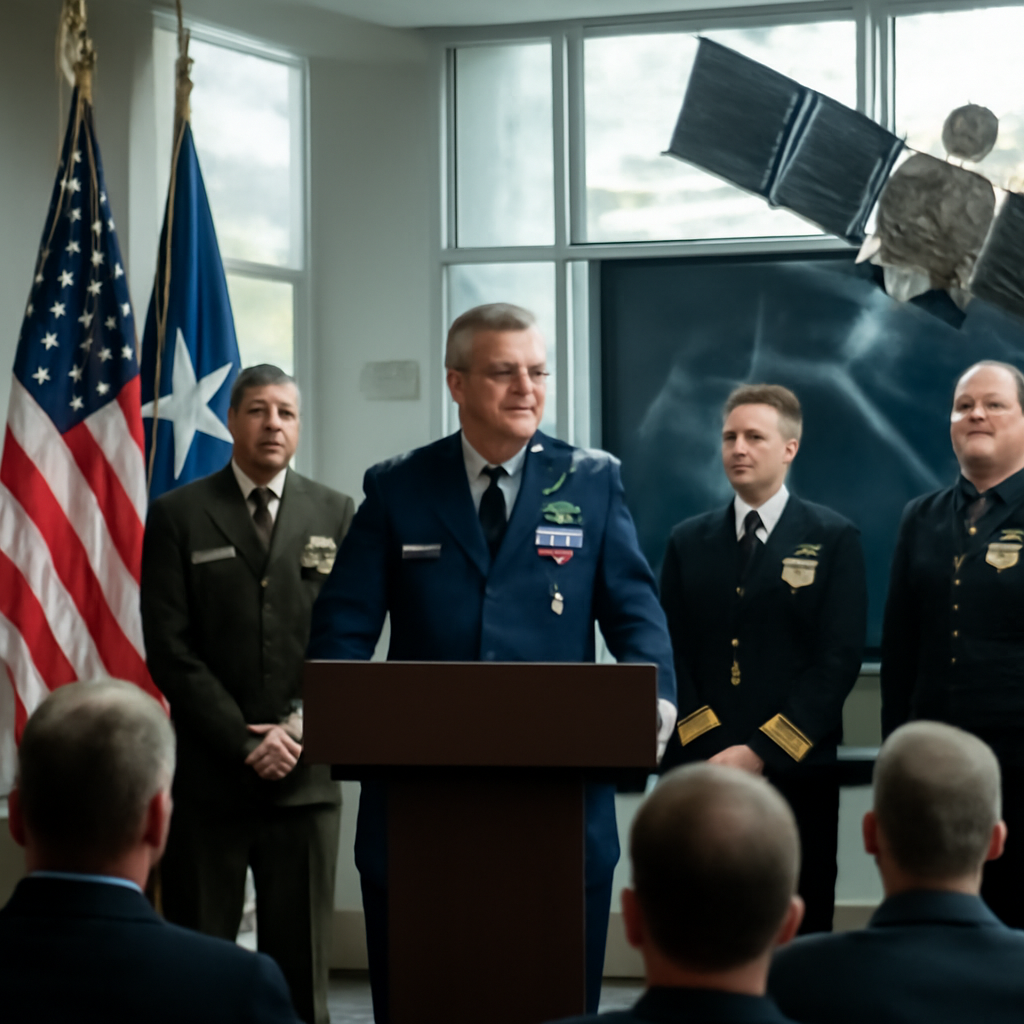
“Today, we continue to ensure we remain ready to meet the challenges of evolving threats wherever they exist,” Air Force Secretary Troy Meink said, announcing publicly that the United States now possesses space-control weapons “on orbit” capable of defending the joint force against hostile adversaries.
Troy Meink’s public admission and what he said
Meink made the statement during a Monday morning speech at the Air, Space, Cyber conference in National Harbor, Md., saying the weapons are “on orbit” and “capable of defending the joint force against hostile adversaries.” He did not provide additional technical detail about the type, number, or specific missions of those on-orbit space-control systems.
In the same speech, Meink warned against adversaries seeking to “take those away from us, to threaten those things,” and argued it is “critically important that we maintain our dominance not only in the air but in space.”
Defense and stability concerns: expert reactions
Defense experts and space-security analysts reacted strongly to the public acknowledgement. The report says “defense experts were shocked by Meink’s admission,” and several warned that the disclosure could prompt similar public acknowledgements — or overt actions — by other spacefaring states.
Victoria Samson, Secure World Foundation’s chief director of space security and stability, said: “Well, that's huge, because I don't think any US government official has ever said that before. The US also now has to accept the Chinese and Russians doing/saying the same. I don't think that this is going to be in the interest of US national security.” The article quotes experts saying the revelation may accelerate an arms race in orbit.

Audit-ready is a season. It shouldn't be.
Evidence in spreadsheets, controls drifting between audits, frameworks multiplying on flat headcount. Nubivance runs continuous compliance on Rapid7 Cyber GRC - SOC 2, HIPAA, ISO 27001, PCI, CMMC.
End the scrambleNon‑kinetic versus kinetic tools and debris concerns
Meink did not identify whether the on-orbit weapons are kinetic or non‑kinetic. The story notes longstanding official warnings against kinetic attacks — which can create long-lasting debris — and quotes Maj. Gen. Chris Povak of the National Reconnaissance Office: “Our commitment to responsible space operations is fundamental to our mission assurance and our role as stewards of the space environment.”
Samson suggested the admission likely refers to non‑kinetic capabilities: “I'm going to guess what he's talking about is not a kinetic space-control weapon due to multiple comments government officials have said about avoiding debris causing counter space,” and added, “So I'm going to go with my first guess: space-based jammers, electronic warfare.” The article includes that reasoning as a limit on plausible interpretations offered by observers.
Golden Dome, space-based interceptors, and the AMTI prototype launch
Meink also announced related space initiatives: prototypes for the space-based Airborne Moving Target Indicator (AMTI) satellite constellation are scheduled to be launched “this month,” and Meink said space-based interceptors — described as the cornerstone technology of President Donald Trump’s Golden Dome missile defense system — are now “flight ready.”
The article references Space Force Gen. Michael Guetlein, Golden Dome’s direct-reporting program manager, who said last month the missile defense project “would be in dire straits if Congress can’t prioritize additional funding for the effort.” Guetlein also told reporters that initial development on space-based interceptors is underway and that the service has executed two “phenomenally successful” tests.
How Congress, the joint force, and China and Russia may respond
- Congress: The reporting records an explicit funding risk for Golden Dome — Guetlein warned that the program could be “in dire straits” without congressional prioritization. That positions lawmakers as a near-term decision point for whether the announced capabilities move from prototype and test phases to sustained deployment.
- The joint force and NRO: Meink framed the on-orbit capability as a defensive tool “capable of defending the joint force,” while Maj. Gen. Chris Povak emphasized stewardship of the space environment. Those twin themes — mission assurance and restraint on debris-producing options — frame how U.S. services describe the role of space-control systems.
- China and Russia: The article cites analysts warning that Meink’s acknowledgment may prompt Chinese and Russian officials to make similar admissions or accelerate their own programs, increasing the risk of reciprocal revelations or operational steps in orbit.
This public acknowledgement marks a rhetorical shift: senior U.S. officials have historically been restrained in discussing on-orbit weapons, even as program development and testing proceed. The immediate facts in the reporting are narrow — Meink’s statement that the United States has “on orbit, space-control weapons,” the AMTI prototype launches slated “this month,” and the claim that space-based interceptors are “flight ready” — but they combine with expert warnings to underscore a near-term policy and procurement reckoning. Will Congress prioritize Golden Dome funding, and will rival states respond with parallel disclosures or deployments? Those are the concrete next steps the reporting leaves on the table.