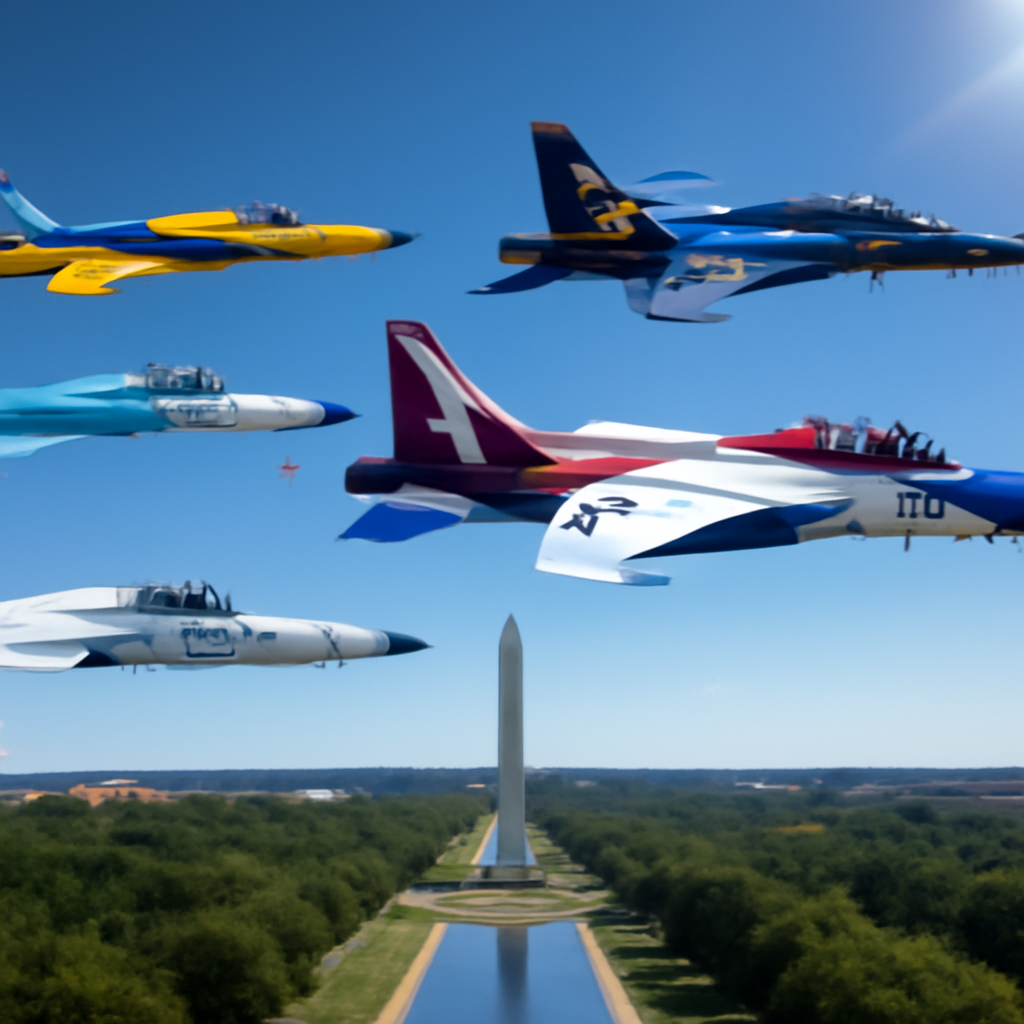
NASA-affiliated aircraft, including F-5 Tiger IIs jets, will kick off roughly seven hours of flyovers above Washington, D.C., to mark the Fourth of July.
NASA aircraft and the Freedom 250 F-5 team
NASA has publicly unveiled multiple aircraft painted in special 250th‑anniversary liveries and is slated to begin the program with a “NASA F-5 Flyover” followed immediately by a “NASA Fleet Review” at 1:14 PM ET tomorrow, per the Freedom 250 schedule. The NASA “Freedom 250” F-5 team consists of four privately owned aircraft, including one that belongs to Jared Isaacman; three of the F-5s, wearing their 250th anniversary schemes, landed at Andrews Air Force Base on June 30.
NASA also revealed an F-15D Eagle and an F/A-18B Hornet dressed in star‑spangled paint schemes; spotters in Spokane, Washington, photographed those jets on July 2. The source notes the F-15D appears to be one of two ex‑Oregon Air National Guard jets that NASA acquired in January. Johnson Space Center images show T-38, WB-57F, and Gulfstream V airframes bearing Freedom 250 emblems, but the schedule does not confirm whether those specific types will fly in the review.
U.S. military waves and scheduled highlights
The Freedom 250 schedule lays out a multi‑service procession that follows the NASA segment. U.S. Coast Guard helicopters and fixed‑wing aircraft are next, then parachute demonstration teams — the U.S. Army’s Golden Knights and the U.S. Navy’s Leap Frogs — followed by an Army helicopter review that could include AH-64 Apaches, UH-60 Black Hawks, CH-47 Chinooks and UH-72 Lakotas, along with Special Operations MH-60Ms, MH-47Gs and AH/MH-6 Little Birds.
Waves of U.S. Air Force, Marine Corps, and Navy aircraft will follow. The Air Force portion is arranged in “heavies,” Air Force Special Operations Command (AFSOC) types, and fighters. The publicly posted schedule explicitly includes a “Tri‑Bomber Formation” of a B-2, B-1 and B-52, and it names the VC-25B “Bridge” aircraft as part of the review — the same VC-25B that “made its maiden flight in the Air Force One role this week in taking President Donald Trump on a trip to North Dakota,” according to the source.
AFSOC’s roster is listed to include AC-130J Ghostrider, MC-130J Commando II, CV-22 Osprey and OA-1K Skyraider II. The fighter waves may showcase F-22s, F-35As, F-15E/ F-15EX, F-16C/D and A-10 aircraft. Demonstration teams are scheduled as well: the Navy’s Blue Angels and a Marine MV-22 demonstration team, the Navy’s F-35C demo, and the Air Force’s Thunderbirds — with a Delta Break (Delta Burst) explicitly on the program. Late‑day highlights include a “U.S. Stealth Airpower Flyover” and afterburner passes by the F-22 and later by a B-1; the program concludes with a “Twilight Jump” and a final “Night Pass” by a B-1 in afterburner at 10:36 PM ET.

Audit-ready is a season. It shouldn't be.
Evidence in spreadsheets, controls drifting between audits, frameworks multiplying on flat headcount. Nubivance runs continuous compliance on Rapid7 Cyber GRC - SOC 2, HIPAA, ISO 27001, PCI, CMMC.
End the scrambleForeign participants: Al Fursan and Patrouille de France
At least some foreign air forces will take part. The UAE’s national aerobatic team, Al Fursan, “has arrived in the United States of America to take part in the celebrations,” the UAE Ministry of Defense wrote in an official post on X, per a machine translation. The source notes Al Fursan currently flies Chinese Hongdu L-15 jet trainers, and that this “looks to be the debut appearance of any Chinese-made military aircraft in the United States.”
The French Patrouille de France — operating Dassault/Dornier Alpha Jets — has already flown over Washington, D.C., and New York City as part of a “Liberté 250” tour tied to the 250th anniversary celebrations.
Flight restrictions, exclusions, and the public experience
The source makes clear there are heavy restrictions on uncrewed aircraft in U.S. national airspace, noting that it is very unlikely drones from any of the services will be part of the procession. The scheduled timing stretches from the early afternoon into the late evening: the review begins at 1:14 PM ET, includes dusk‑time displays such as the F-22 afterburner flyby around sunset (7:53 PM ET) and runs through a final night B-1 pass at 10:36 PM ET. The coverage promises waves of fixed‑wing and rotary aircraft, signature demonstration maneuvers from the Blue Angels and Thunderbirds, and multiple “HUGE 1” formations whose exact compositions are not specified on the public schedule.
What this means for NASA, the U.S. military, and the general public
- NASA: The agency is visibly leveraging both government and privately owned aircraft — including F-15D and F/A-18B jets and a four‑ship F-5 team that includes an aircraft owned by Jared Isaacman — to anchor the opening segment of the review.
- The U.S. military: The event consolidates many service capabilities into a single publicly visible sequence — from AFSOC platforms to strategic bombers and presidential airlift — while explicitly excluding classified demonstrators such as the B-21 Raider and alleged RQ-180/NGAD demonstrators.
- The general public and spotters: Expect a long, staged show with daytime formations, signature aerobatic maneuvers, dusk and night afterburner passes, and at least some foreign teams; precise aircraft lists for several large formations remain unspecified on the Freedom 250 schedule.
This will be, by the source’s own accounting, an “unprecedented aerial extravaganza,” larger than recent military parades and past centennial events. The public schedule names dozens of types and specific moments, yet leaves the composition of several marquee formations and the final “HUGE 1” flyovers to be seen when the sky over the capital fills with jets, helicopters and noise.
Source: TWZ — This Is The Massive Aerial Armada That Is About To Fly Over The Capital