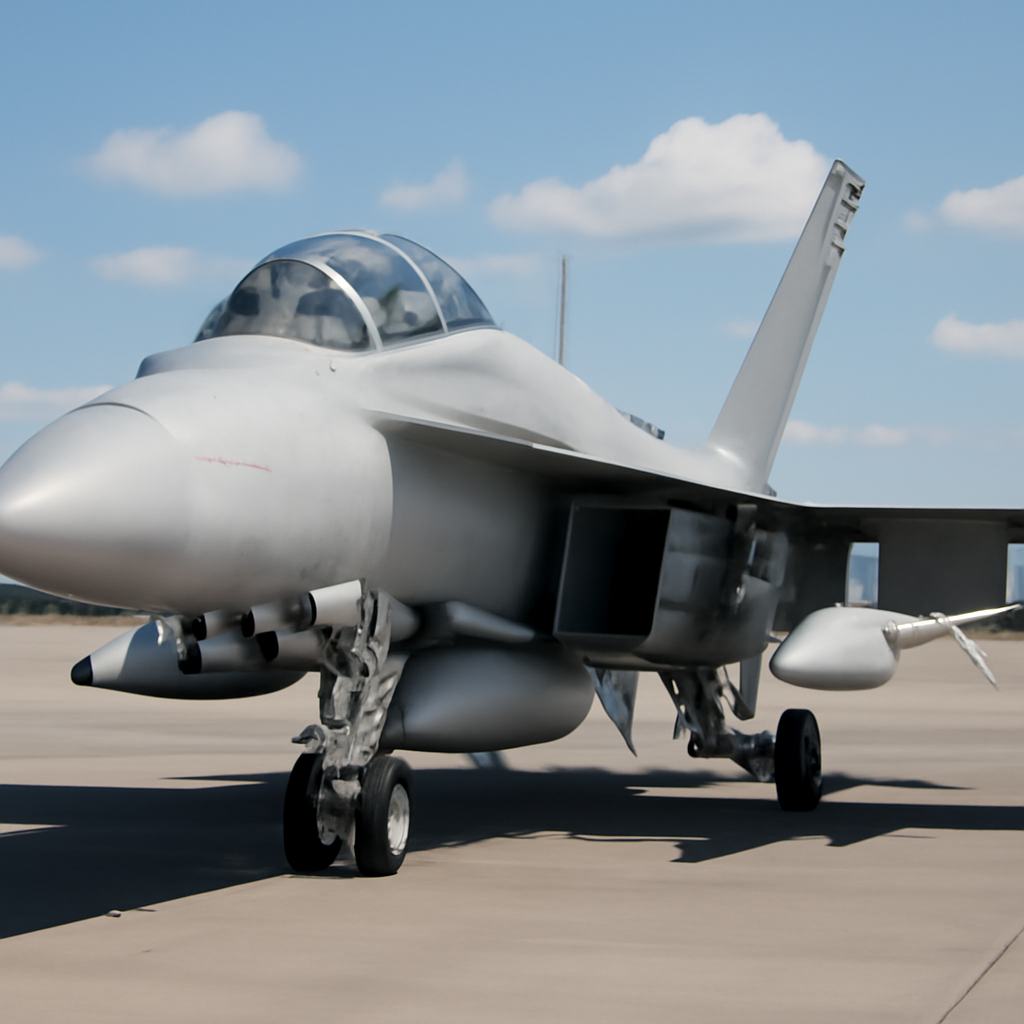
“The AIM-260 seen in Tweedy’s pictures looks entirely in line with what had previously been depicted in official renderings of the JATM,” The War Zone noted — and on May 13 a photographer put those renderings into three-dimensional reality.
AIM-260 sighted on VX-31 Super Hornet at Eglin Air Force Base
Photographer Jonathan Tweedy captured images on May 13 of several U.S. Navy test jets departing Eglin Air Force Base, including an F/A-18F Super Hornet from Air Test and Evaluation Squadron 31 (VX-31) carrying an AIM-260 Joint Advanced Tactical Missile (JATM) on the fuselage station outboard of its right engine intake. The jet also carried a modified FPU-13/A drop tank with an infrared search and track (ISRT) sensor on the centerline station and flight data pods on its wingtips. Aviationist was the first to publish Tweedy’s pictures; The War Zone subsequently published and analyzed the images.
Visual design and test markings match official renderings
Tweedy’s photographs confirm a minimalist external layout: the missile has four tail fins and lacks mid-body control surfaces or strakes. The body is predominantly white with a light-gray nose cone, square visual-tracking markings near the rear, and two black bands toward the tail. A yellow band at the front end suggests the AIM-260 in these images “looks to have a live high-explosive warhead,” The War Zone reports. Overall, the photographed missile aligns with previously released renderings from the Navy and Air Force.

The cyber insurance questionnaire just landed. Now what?
SOC 2, HIPAA, insurance renewals - someone has to own security strategy. Nubivance provides fractional CISO leadership without the full-time salary.
Get a security leadPerformance priorities reflected in form factor and configuration
The JATM program has prioritized a substantial boost in maximum range while retaining a roughly AIM-120-sized form factor to ease integration on existing platforms. Officials have cited the growing reach of Chinese air-to-air missiles — the PL-15 in particular — as a key driver behind the program. The AIM-260 is reportedly designed to hit targets out to at least 120 miles, if not further.
Propulsion, seeker, networking and integration — how TWZ has described the technical path
As The War Zone previously wrote, an advanced rocket motor with highly loaded propellant has long been seen as a likely route to give the AIM-260 significantly greater range and speed without enlarging the missile. TWZ also described dual-pulse motor design, thrust-vectoring capability, and an active electronically scanned array (AESA) seeker as likely or desirable features; the analysis noted multi-mode seeker capability (including imaging infrared and passive radiofrequency guidance) and advanced networking to allow the missile to receive third-party targeting data and to prosecute cooperative engagements. The War Zone framed much of this as likely or possible rather than confirmed.
Testing, program history, and fielding prospects
The JATM program traces back to at least 2019 and remains largely classified, but flight testing has been underway for some time and has included multiple live-fire shots. There has been “movement in recent years to get the missile into production and fielded operationally.” Navy Super Hornets and U.S. Air Force F-22 Raptors are expected to be the first aircraft to fly operationally armed with AIM-260s, and the missile is expected to be integrated on other platforms including the Air Force’s future F-47 and a Navy sixth-generation F/A-XX should that design be selected. Initial public program goals set in 2019 targeted fielding in 2022; a reported three-month delay late last year attributed to funding in a fact sheet distributed by some members of the U.S. House Committee on Armed Services was later described by the committee as incorrect. The first public sighting this week is a visible sign of new progress toward fielding, The War Zone concluded.
What this means for the U.S. Navy, the U.S. Air Force, and the U.S. House Committee on Armed Services
- U.S. Navy and U.S. Air Force: The photographs show a JATM form factor consistent with integration plans on Super Hornets and F-22s; both services will be watching how testing, seeker and propulsion choices translate into operational range and platform fit.
- U.S. House Committee on Armed Services: The program’s classified elements and prior confusion over reported delays underscore continued congressional attention to schedule, funding and the accuracy of program facts that share committee briefings.
- China and developers of long-range air-to-air missiles: Officials have explicitly cited the PL-15’s growing reach as a driver; the AIM-260’s reported range target of at least 120 miles speaks directly to that stated concern.
The public images from Eglin do more than confirm a rendering: they place a near-final-looking missile on a test jet and show the program in active flight operations. The AIM-260’s photographed form factor, markings and carriage on a VX-31 Super Hornet align with long-stated program goals, but the timeline for operational fielding remains unclear based on the record available. The next public indicators will likely be additional flight tests, formal integration announcements for specific aircraft, or production contracts — all of which would convert the AIM-260 from a visible test asset into a deployed capability.



