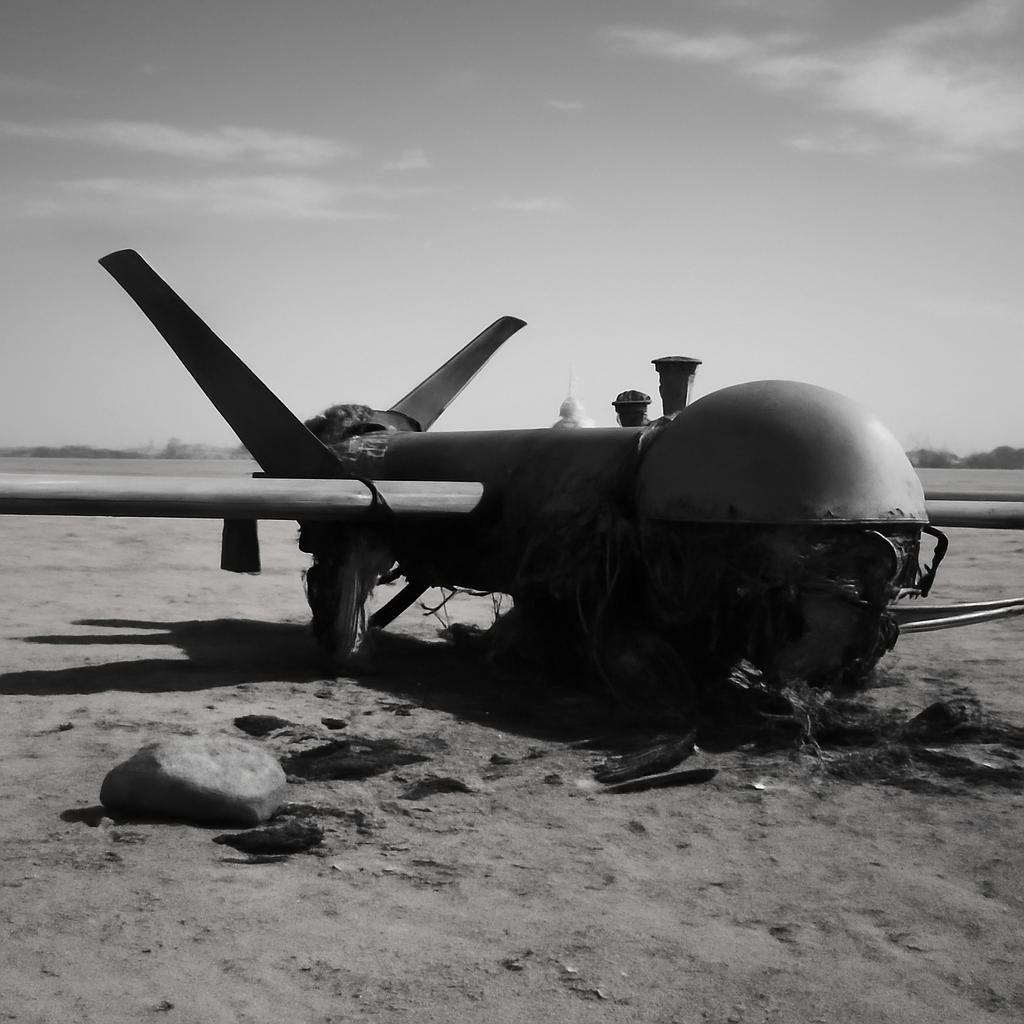
“At least 45 Reapers, approximately a quarter of the pre-war fleet, were shot down, crashed, or destroyed,” an account in August reported — a stark metric of how much the U.S. aerial inventory has bled since the Iran war began on February 28, 2026.
Drone fleet: MQ-9 losses and cascading shortfalls
The unmanned MQ-9A Reaper sustained the greatest attrition. The Pentagon’s Lead Inspector General reported “as many as 30” MQ-9A drones destroyed through June 30, while the Congressional Budget Office (CBO) counted 24 at a $30 million unit price for Foreign Military Sales valuation. Reporting compiled by TWZ and OSINT pushed the tally higher: The Washington Post cited U.S. officials saying at least 45 Reapers had been lost across the region, and TWZ’s tracking increased that number to 47 after two more shootdowns.
Replacement math varies: a CBO-style $30 million unit price yields more than $1.4 billion for 47 losses, but a fully kitted Reaper can approach $50 million depending on sensors and weapons. The Air Force’s inventory fell to 135 MQ-9s as of May, down from 165 at the start of fiscal year 2026. General Atomics sold fewer than 10 unused airframes to the service, and the Air Force is accelerating lower-cost alternatives under the Massed Modular Aircraft (MMA) concept even as new-production MQ-9B variants do not meet current requirements.
Other unmanned losses include an MQ-4C Triton that went down over the Persian Gulf in April (logged by the Navy as a Class A mishap) and an MQ-1 shot down over international waters in late May, which CENTCOM would not identify as Predator or Army Gray Eagle.
Crewed aircraft and the April CSAR’s inventory toll
Manned platforms also suffered notable hits. Aerial refueling took major damage: two KC-135 Stratotankers were destroyed and up to seven damaged, and a March 12 collision between two Stratotankers — “not due to hostile fire or friendly fire,” CENTCOM said — resulted in the loss of six airmen.
Three F-15E Strike Eagles were destroyed early in the conflict by friendly fire over Kuwait, and another was shot down over Iran on April 3, precipitating an extensive combat search-and-rescue (CSAR) between April 3 and 5. That CSAR, which included more than 150 aircraft and 92 special operators, ended without American fatalities but cost significant hardware: two MC-130J Commando IIs and four MH-6 Little Bird helicopters were deliberately destroyed to prevent capture; the CBO values the MC-130Js at $300 million and the helos at $122 million.
The E-3G Sentry serial 81-0005 was struck on a taxiway at Prince Sultan Air Base on March 27; the CBO treats it as lost with a $500 million replacement value because it can only be replaced by the E-7A Wedgetail program. Other crewed losses and damages cited in reporting include an F-35A hit by Iranian fire, a Black Hawk struck by an FPV kamikaze drone, a CH-47F image circulated by Iranian media, and an AH-64 Apache shot down near the Strait of Hormuz.

The cyber insurance questionnaire just landed. Now what?
SOC 2, HIPAA, insurance renewals - someone has to own security strategy. Nubivance provides fractional CISO leadership without the full-time salary.
Get a security leadThe CBO and IG bills: hardware, replacement choices, and totals
Through August 1, the CBO estimated hardware losses that the Pentagon “would have to change its plans to replace” at nearly $1.9 billion in 2026 dollars. If the Pentagon decided to replace every lost aircraft with a comparable platform available today, that bill rises to $3.3 billion; factoring in damage and losses after the CBO cutoff could push the figure above $4 billion. TWZ also reports the Pentagon’s operational bill for the conflict now sits conservatively at over $38 billion.
The CBO’s accounting highlights how replacement choices inflate costs: A retired A-10C’s replacement by an F-35A would add roughly $120 million per airframe; F-15E losses would require restarting production or buying F-15EX at an assessed replacement cost. The report even includes a $500 million charge for a lost THAAD AN/TPY-2 radar, one of only eight radars the Army fields for those batteries.
Missile inventories and the Pacific deterrence problem
Both the Lead IG and the CBO flagged strain on U.S. munitions. The CBO concluded the U.S. likely expended “between one-half and two-thirds” of inventories of Patriot, THAAD, SM-3, and SM-6 interceptors since June 2025, and projected rebuilding would take “at least five years, even if production was increased.” Pentagon deals with Lockheed Martin and Northrop Grumman aim to increase Patriot and THAAD production, but the CBO cautioned that boosting missile production historically requires three to five years between order placement and delivery, with several more years to fully replace expended stocks.
The CBO contrasted Iran’s missile inventory with the much larger arsenal China fields, noting China “has many more ballistic and cruise missiles than Iran had at the onset of Operation Epic Fury” and a larger economic base to produce them more rapidly. Those dynamics underline the CBO’s conclusion that “DoD now has fewer interceptors on hand to use in a potential conflict with the PRC.”
How CENTCOM, U.S. Pacific Command, and Congress are responding
- CENTCOM: Adm. Brad Cooper told 60 Minutes he was “not concerned at all” about munitions, saying “We’re well armed and ready for any contingency,” a stance the IG noted may reflect theater-level resourcing during an active war.
- U.S. Pacific Command: In an assessment cited by the Washington Post, Adm. Samuel Paparo “disagreed with the level of support he was ordered to continually provide,” warning that extended commitments to the Iran fight risk draining combat power needed in the Pacific; Paparo has long warned that interceptor use “is now eating into stocks.”
- Congress and budget watchers: The Lead IG’s quarterly report on Operation Epic Fury and the CBO’s August letter to the ranking member of the House Budget Committee together formalized inventory and cost estimates that will shape replacement decisions and funding debates.
The record compiled by the IG, the CBO, open-source analysts, and TWZ shows costly, visible attrition across unmanned and crewed fleets and a munitions drawdown that will take years to reverse. The most immediate, concrete questions are not theoretical: which platforms will be replenished now, which will be traded for newer or different capabilities, and how long U.S. missile defenses will remain thinned while production ramps up. Those answers will determine whether the lessons of this conflict alter strategy — or simply the accounting.
Source: Every American Aircraft Lost Or Damaged During The Iran War, Visualized — TWZ