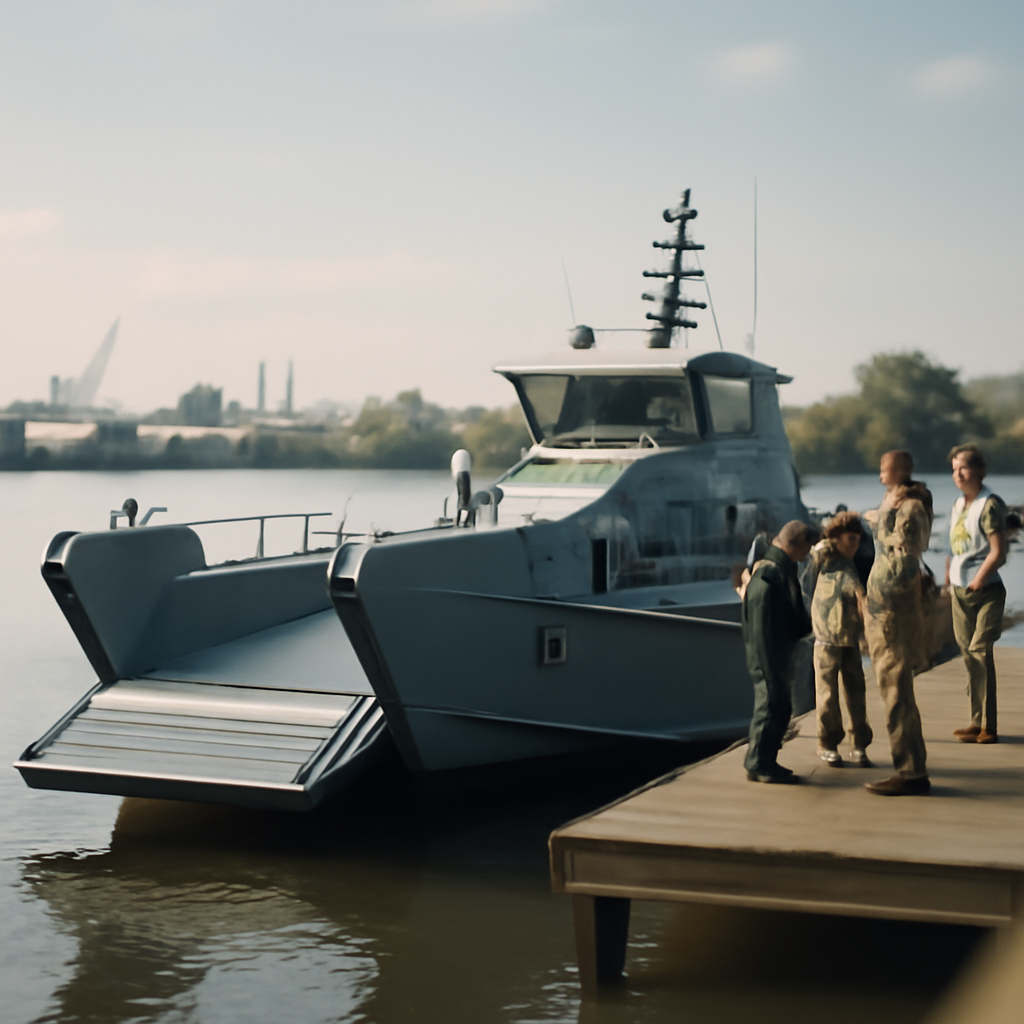
“This prototype allows MCWL to immediately execute hands-on experimentation, test tactical concepts, and put real hardware in the hands of Marines,” Col. Kenny Jones, Science and Technology Division Director at the Marine Corps Warfighting Laboratory, said in a service release after the craft’s technical acceptance.
ASC-1 surfaced at a Bayou La Batre distinguished visitor day on August 12, 2026
Photographs released by the Marine Corps Warfighting Laboratory show the first Ancillary Surface Craft, hull number ASC‑1, moored in Bayou La Batre, Alabama. Marine Corps personnel, representatives from the Australian Army, and industry attendees were present for the distinguished visitor day where the images were taken. The Marine Corps caption for one photograph said the event “provided an opportunity for senior leaders, Marines, allied partners and industry personnel to observe the ASC’s capabilities and discuss its potential to support distributed maritime operations and sustainment in contested littoral environments.”
What the vessel is — and what the renderings showed
Birdon, the Australia‑headquartered firm that announced it would provide two ASCs to the Marine Corps, has previously described the craft as 150 feet long and 30 feet across with an open main deck and a bow ramp that drops to the beach. Birdon’s 2025 press release and renderings showed the design fitted with at least two remote weapon stations armed with 30mm automatic cannons, a .50‑caliber M2 deck gun, and an angular mast. The newly released photographs of ASC‑1 show differences: no visible 30mm stations or deck‑mounted M2, a pole‑like mast with rotating maritime navigation radar and a searchlight over the pilot house, truncated catwalks, and an additional boxy structure with ventilation slats.

Audit-ready is a season. It shouldn't be.
Evidence in spreadsheets, controls drifting between audits, frameworks multiplying on flat headcount. Nubivance runs continuous compliance on Rapid7 Cyber GRC - SOC 2, HIPAA, ISO 27001, PCI, CMMC.
End the scrambleSystems, payload and the Marine Corps technical acceptance
Birdon has said the ASC can carry up to 40 troops and 54 tons of cargo in its open main deck. The Marine Corps’ MCWL technical acceptance statement added additional specifics: the ASC is “fully operational in Sea State 5 and designed to survive extreme conditions up to Sea State 7,” equipped with advanced forward‑looking sonar to navigate very shallow, uncharted littoral waters, and capable of transporting “up to 46 tons of cargo and 40 combat‑loaded Marines” while performing shore‑to‑shore maneuver and sustainment. Birdon has also described a fuel delivery and transfer system designed to allow vessel‑to‑vessel or vessel‑to‑land fuel transfer to extend operational range and flexibility.
How ASC relates to Expeditionary Advanced Base Operations and the LSM program
The Marine Corps plans to use two ASC examples to inform experimentation and refinement of Expeditionary Advanced Base Operations (EABO), a concept that emphasizes rapid positioning and repositioning of relatively small units between dispersed forward locations. MCWL said the ASC’s “very shallow draft” offers the ability to deliver logistical support to the “last tactical mile” into landing sites beyond the reach of larger vessels, enabling routes “from an intermediate staging base to the beach without dependence on a port, a pier, or a causeway.”
The report places the ASC alongside other elements intended to support EABO, including planned Medium Landing Ships (LSMs). The Navy selected Damen’s LST‑100 design in December 2025 as the basis for new LSMs, but the first LSM remains scheduled to arrive in 2029. The piece also compares the ASC’s general dimensions to other medium landing craft on the market, citing the Navy’s new LCU 1700 class as roughly 139 feet by 31 feet with a higher stated payload (350 combat‑equipped troops or 170 tons of cargo).
What this means for the Marine Corps, the Australian Army, and Birdon
- Marine Corps: The MCWL will move ASC‑1 into limited technical assessments with Birdon America craft masters and engineers partnered with Australian Army crewing support and MCWL oversight. A hybrid crewing approach—pairing Marines with contracted mariners—will be used initially to train Marines for independent operation of small surface craft.
- Australian Army: Australia is embedded in the program through industry partnership, operational support during the assessment phase, and shared planning; Birdon’s collaboration was framed as U.S.‑Australian industry cooperation to support experimentation and inform amphibious modernization.
- Birdon: The company’s ASC prototype will be tested in-service and could evolve; Birdon is also developing larger landing craft concepts (a Landing Craft Medium for Australian forces and a separately announced H260 heavy landing craft that it had offered to the Marines for testing and evaluation in 2024), any of which could inform future purchases depending on experimentation outcomes.
ASC‑1’s technical acceptance closes the first chapter of hands‑on experimentation but leaves practical questions for the next phase: how the craft will perform in extended exercises, whether additional weapon or sensor suites will be installed as the design matures, and how effectively the hybrid crewing model transitions to Marine independent operation. For now, ASC‑1 is in the water, shifting the work of refining littoral maneuver from drawings and renderings into measurable trials.