$100 billion a year is the federal government’s information technology bill — and, according to a 2025 R Street Institute report cited in the source material, as much as 80 percent of that spending is devoted to operating and maintaining existing systems.
August disruption and a string of named intrusions
In August, the Federal Bureau of Investigation announced that it detected and disrupted another Chinese state-sponsored cyberattack targeting U.S. critical infrastructure. That episode joins a succession of intrusions called out by the source material: the 2025 PlugX malware incident, the 2024 Flax Typhoon hack and the 2023 Volt Typhoon operation. The piece describes these events as part of a pattern in which America’s adversaries look for any weakness in sensitive systems to exploit, sometimes cooperating together to do so.
How federal contracting and management multiplies risk
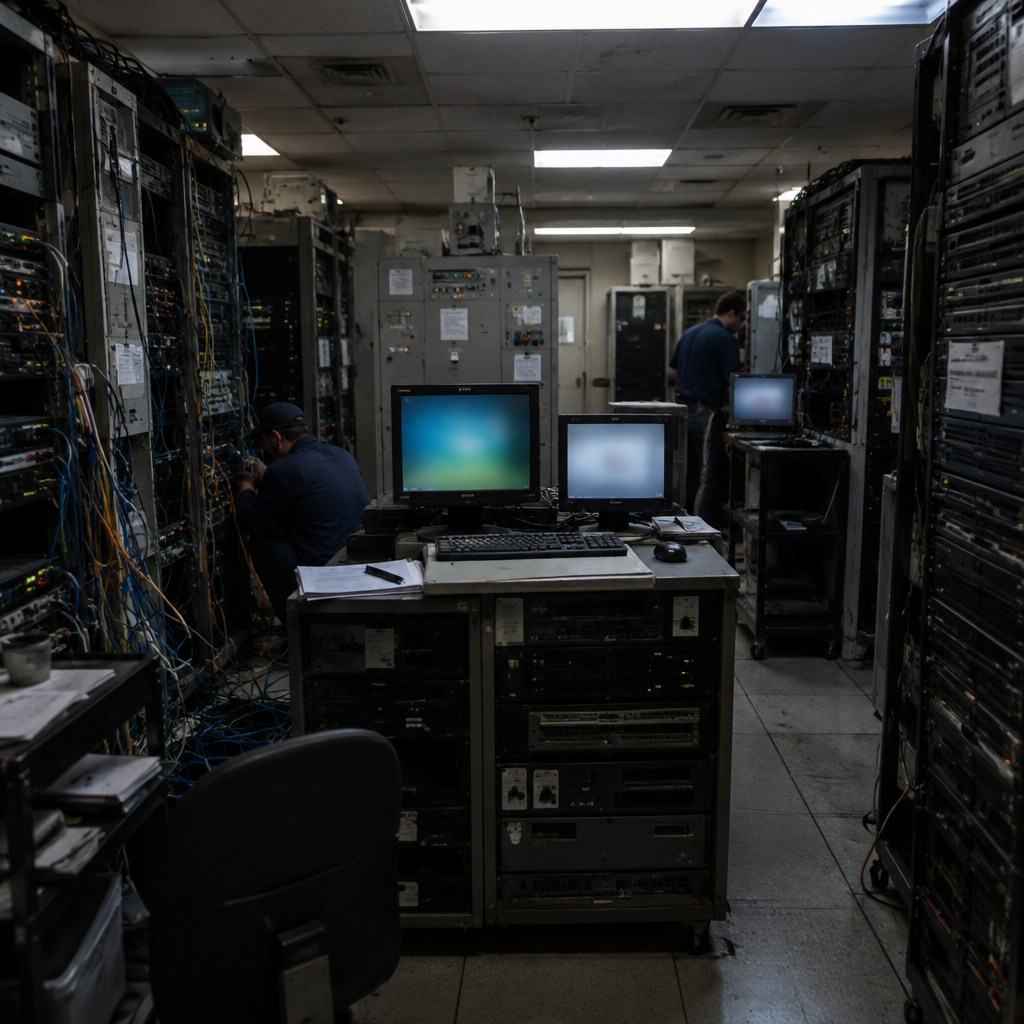
The government’s own acquisition and management practices help create the vulnerabilities attackers seek. Under the guidance of the Office of Management and Budget and the General Services Administration, agencies routinely run three or four generations of systems simultaneously — legacy databases sitting beneath cloud environments, with managed service providers and internal teams each touching different layers, often without a shared map of what connects what. Security is frequently added after missions have shifted, platforms have expanded, and new compliance requirements have emerged. That complexity, the source argues, makes solving the problem harder than spotting obvious outdated technology.

Audit-ready is a season. It shouldn't be.
Evidence in spreadsheets, controls drifting between audits, frameworks multiplying on flat headcount. Nubivance runs continuous compliance on Rapid7 Cyber GRC - SOC 2, HIPAA, ISO 27001, PCI, CMMC.
End the scrambleScale of the spend and the math of defense
Federal information technology spending exceeds $100 billion annually, and as much as 80 percent of that — roughly $80 billion a year — is spent simply to keep old systems running and secure, per the cited 2025 R Street Institute report. The source frames the problem in stark arithmetic: cyber adversaries only have to be right once; defenders must be right across every system, program and vendor. Meanwhile, adversaries are investing in new technologies and techniques that compound their advantage.
Agentic AI, supply chains and speed of exploitation
The piece warns that adversaries now have access to agentic AI systems that automate reconnaissance, accelerate exploitation of known vulnerabilities and move through supply chains before a patch cycle completes. That rapid, automated posture combines with the fragmentation of federal networks and defenses — the multiple generations of systems and dispersed contractual responsibility — to make it easier for foreign actors to penetrate systems and to threaten national network resilience in a crisis or contingency with China or Russia.
Congress, procurement pathways and the weapons-acquisition comparison
Congress is described as beginning to pay attention, but the source notes structural reasons why cyber investment often lags: cyber spend is less tangible than a new fighter jet or missile system and is spread across dozens of authorization and appropriation subcommittees in each chamber. The author argues that federal technology modernization should be treated as a security imperative with the same urgency applied to traditional Defense Department weapons acquisition. Specific prescriptions include creating procurement pathways that allow trusted security technologies to be adopted without multiyear acquisition cycles; writing vendor contracts that make accountability clear enough to identify the responsible party after a breach in hours rather than weeks; and reducing platform duplication that expands attack surface without adding operational capability.
What this means for technologists, Congress, and vendors
- Technologists and security teams: They must contend with multi-generation environments — legacy databases under cloud stacks — and fractured responsibility among managed service providers and internal teams, while adversaries use agentic AI to accelerate exploitation.
- Congress and incoming House and Senate cyber leaders: They will need to assess the strategic vulnerability created by government tech debt and consider treating federal technology modernization with similar urgency and reform standards as weapons acquisition.
- Vendors and procurement leaders: Contracts should be rewritten to define accountability clearly and to permit faster adoption of trusted security technologies without multiyear acquisition cycles; reducing unnecessary platform duplication is also highlighted as a direct way to shrink the attack surface.
Government tech debt, the source concludes, is not merely an administrative headache; it is a strategic vulnerability that adversaries are already exploiting. The recommended remedy is speed: procurement reform, clearer vendor accountability, and reduced duplication so that government systems are harder to penetrate and quicker to recover. Whether Congress and agencies will match that prescription with the structural and budgetary changes the piece calls for remains the central unanswered question.