In May 2026 the Australian National Audit Office delivered a sobering assessment after the government revealed that the Collins-class Life–of–Type Extension (LOTE) would be a refurbishment, not a modernisation, and would apply to only five of the six boats.
Why the government chose refurbishment over modernisation
Defence and Collins-class builder and maintainer ASC judged that modernisations could not be completed fast enough without disrupting operations. The assessment concluded each modernisation would need more than the two years available under the fleet’s established full‑cycle docking (FCD) cadence. The government therefore opted for a scaled‑back LOTE that keeps current capability but accepts loss of future technological competitiveness.
The Usage Upkeep Cycle and the two‑year benchmark
Since 2016 the Collins fleet has operated on a disciplined Usage Upkeep Cycle designed to keep three boats available and three in maintenance. Under that routine each submarine’s 10‑year safe‑to‑dive certification clock starts at the end of an FCD (or an LOTE). The benchmark is a two‑year interval for these major overhauls; any slippage beyond that benchmark breaks the drumbeat and reduces availability.

The cyber insurance questionnaire just landed. Now what?
SOC 2, HIPAA, insurance renewals - someone has to own security strategy. Nubivance provides fractional CISO leadership without the full-time salary.
Get a security leadDocking reality: Farncomb, Rankin, Sheehan and Collins
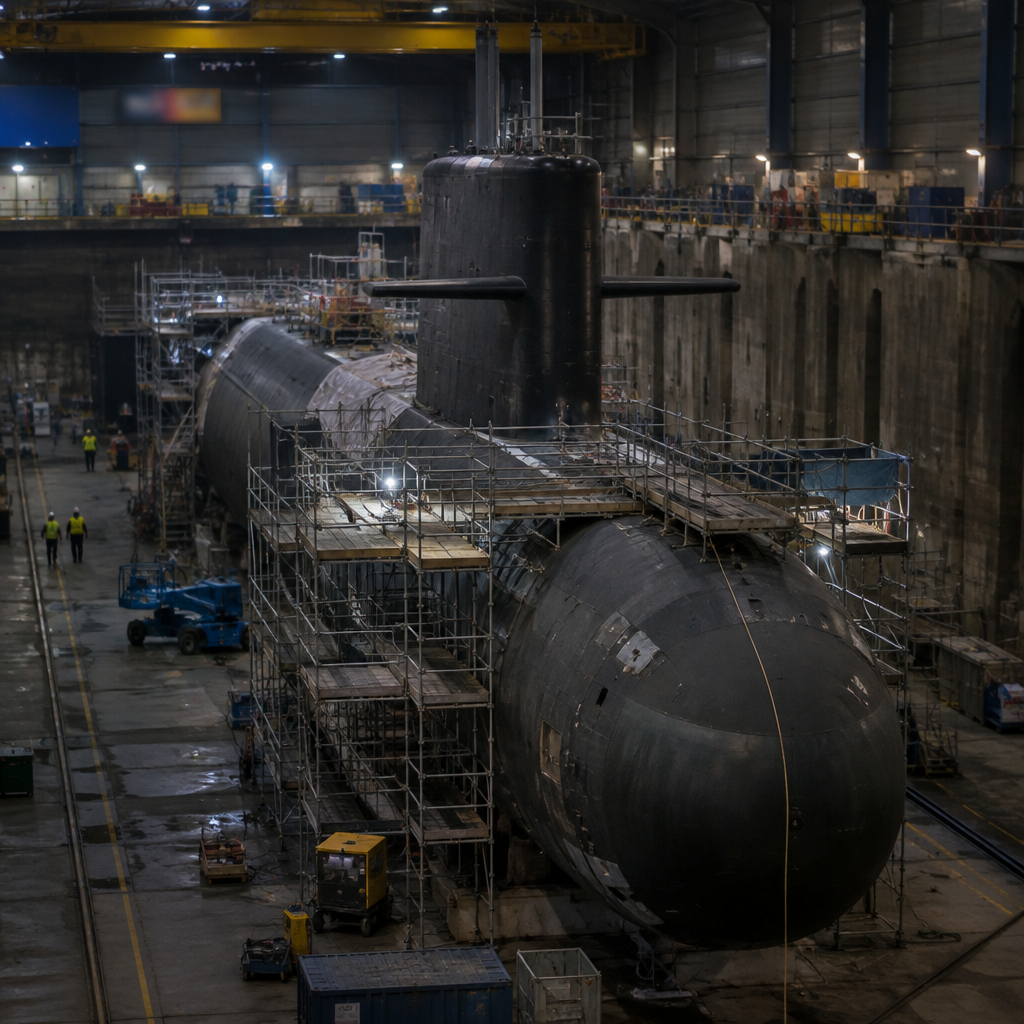
Those timing pressures are already materialising. HMAS Farncomb entered LOTE at Osborne North in mid‑2026 because her previous FCD had finished in mid‑2016. But Rankin remains in the main hall at the shipyard for her FCD, which is overrunning after unexpected problems with the previous boat, Sheehan, prolonged that earlier docking. Farncomb is being held on the external hardstand, which restricts the work that can proceed until Rankin departs. As a result, getting Farncomb back into the fleet by June 2028 looks unlikely — and that date matters because HMAS Collins needs to begin her LOTE in June 2028, after her last FCD completed in June 2018.
Osborne yards, ASC, BAE Systems and the workforce squeeze
ASC already employs more than 2,700 people across South Australia and Western Australia to sustain the Collins fleet. Next door at Osborne South, BAE Systems has more than 2,500 workers building the first Hunter‑class frigate, and that construction is ramping up. Both yards draw from the same limited pool of security‑cleared welders, pipefitters, electricians and engineers, fuelling wage pressure and disputes over pay parity.
At the same time ASC is directing hires and experienced staff into nuclear submarine sustainment efforts in Western Australia and into a joint venture with BAE Systems to build SSN‑AUKUS class submarines at Osborne by the end of the decade. The SSN‑AUKUS program will eventually need another 4,000 to 5,500 direct shipyard workers. Taken together — LOTE dockings, the Hunter build and looming SSN‑AUKUS construction — the supply of trained, cleared trades and senior supervisors in Adelaide is under severe strain.
Operational availability and the downward spiral in crewing
Even if Osborne North could handle overlapping FCDs (it currently cannot), two boats out of the water there plus the usual two in lesser maintenance at Henderson, Perth, leaves just two boats available for operations rather than the planned three. Fewer available submarines mean fewer sea days, which reduces training throughput and the number of sailors qualifying for promotion and specialist roles. That loss of training capacity accelerates departures of qualified personnel, further lowering availability in a feedback loop — a spiral that echoes the crewing crisis that prompted a 2008 review. The ANAO assessment flags this as a clear and present operational risk, including for future nuclear submarine crewing, because many sailors for the new fleet will need to be drawn from the Collins force.
What this means for Defence, ASC, and submarine crews
- Defence: faces a scheduling and certification cliff. Key benchmarks — the two‑year FCD window and the June 2028 start for Collins’s LOTE — are at risk, and Collins‑class sustainment has been on Defence’s Projects of Concern list since December 2024 and will remain there until at least October 2028.
- ASC and BAE Systems: must balance sustained Collins support, an expanding Hunter build and SSN‑AUKUS preparations while competing for cleared trades; without workforce scaling the yards risk bottlenecks and longer dock times.
- Submarine crews: will confront reduced sea days, constrained training and narrower career pipelines — pressures that may accelerate departures and shrink the pool of sailors who could transition to nuclear submarine service.
The arithmetic is stark. A decision to preserve current capability by limiting LOTE to refurbishment and to five boats may have avoided an immediate operational shock from lengthy modernisations — but it has not eliminated the scheduling, industrial and crewing risks that threaten availability. With Farncomb held on the hardstand, Rankin still in an overrunning FCD, HMAS Collins due to start LOTE in June 2028, and sustainment formally listed as a Project of Concern through at least October 2028, the coming two years will show whether the maintenance rhythm can be preserved or the capability gap widens.