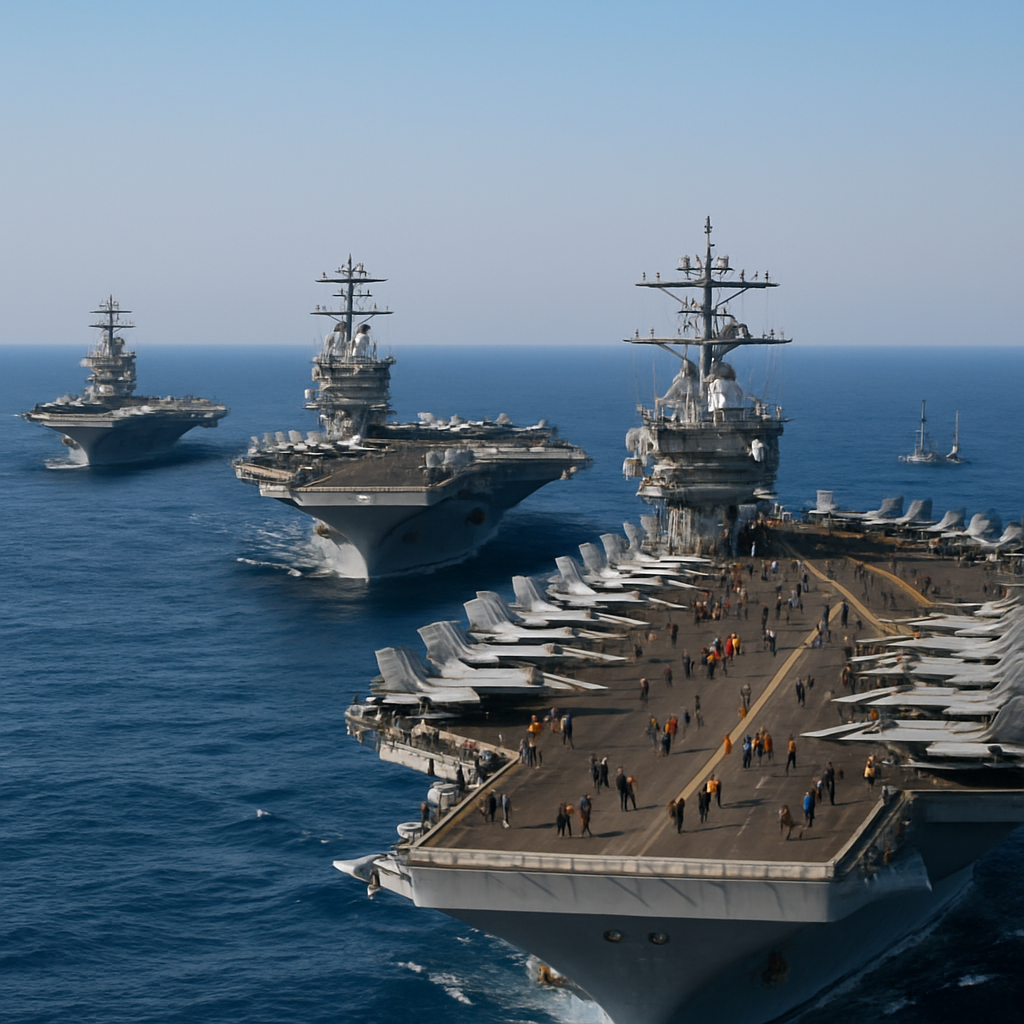
"For the first time in decades, three aircraft carriers are operating in the Middle East at the same time," CENTCOM said. The announcement marks a concentration of naval power around an ongoing campaign and a maritime posture that leaders describe as enforcement of a regional blockade.
CENTCOM announcement: which ships and how many personnel and aircraft
CENTCOM identified the three carriers as the USS Abraham Lincoln (CVN 72), USS Gerald R. Ford (CVN 78) and USS George H.W. Bush (CVN 77). Accompanied by their carrier air wings, the three carriers "include over 200 aircraft and 15,000 Sailors and Marines," CENTCOM said in a post on X. Aircraft types noted on the decks include the F-35 and F/A-18 fighter jets along with EA-18G Growlers. Combined, the strike groups include at least nine destroyers.
Deployment timelines: arrivals, departures, and unusually long patrols
The George H.W. Bush left Naval Station Norfolk in March and "arrived in the Middle East on Thursday," CENTCOM said. The Gerald R. Ford has been at sea since departing Naval Station Norfolk on June 24, 2025; CENTCOM and Navy reporting note that the Ford's time at sea has "dragged on for more than 300 days," marking "the longest deployment since the Cold War era" and approaching Vietnam-era records. Navy leaders have said the Ford "will likely remain at sea for roughly 11 months." The Abraham Lincoln left Naval Station San Diego in November; President Donald Trump announced in January that the carrier would head from the Indo‑Pacific region to the Middle East amid increased tension between the U.S. and Iran.

Audit-ready is a season. It shouldn't be.
Evidence in spreadsheets, controls drifting between audits, frameworks multiplying on flat headcount. Nubivance runs continuous compliance on Rapid7 Cyber GRC - SOC 2, HIPAA, ISO 27001, PCI, CMMC.
End the scrambleOperation Epic Fury: strikes, vessels damaged, and maritime operations
Operation Epic Fury began in February. In an update earlier this month CENTCOM said U.S. forces have conducted "more than 13,000 strikes against Iranian targets," and have damaged or destroyed "more than 155 Iranian vessels." Naval forces have conducted mine clearance missions in the Strait of Hormuz, and U.S. naval forces have been involved in enforcing "a blockade of all maritime traffic entering and exiting Iranian ports." CENTCOM qualified that transit through the strait "is not blocked for vessels traveling to and from non‑Iranian ports."
Statements from the president and the secretary of defense on rules of engagement and the blockade
President Donald Trump said Thursday that he has instructed the Navy to "shoot and kill" any Iranian vessels that may be laying mines in the waterway. Secretary of Defense Pete Hegseth described the blockade as having "proven successful so far," and said "Every ship that the US believes meets our criteria, either Iranian ships or to and from Iranian ports, has been turned around." Hegseth added that "As of this morning, 34 total non‑Iranian vessels are allowed to transit," and that "a second aircraft carrier will join the blockade in just a few days."
What this means for the Navy, non‑Iranian mariners, and U.S. political leadership
- The Navy and deployed personnel: Extended sea time is already a fact on the Ford, which has been underway more than 300 days and is expected to remain at sea for roughly 11 months; the presence of three carrier strike groups increases operational tempo and sustainment requirements for air wings, destroyer escorts, and embarked Sailors and Marines.
- Non‑Iranian commercial mariners and ship operators: The enforcement action described by CENTCOM and Secretary Hegseth includes turning around vessels that "meet our criteria" for transit to or from Iranian ports; at the time Hegseth spoke, 34 non‑Iranian vessels were allowed to transit, and mine‑clearance operations in the Strait of Hormuz are ongoing.
- The president and Defense leadership: Public instructions to "shoot and kill" suspected mine‑laying vessels and the decision to add carriers to a maritime blockade are active policy choices that shape the naval campaign and the rules of engagement at sea.
CENTCOM's declaration that three carriers are now operating in the Middle East is framed as historic; the command did not immediately respond to a request from Breaking Defense to confirm which carriers had concurrently operated together in 2003, and the Navy noted a brief overlap of three carriers in the CENTCOM region in January 2012 that did not continue. In the near term, whether the Ford completes its extended deployment on the schedule Navy leaders have outlined and how rapidly the additional carrier joins blockade operations are the concrete movements that will change the tactical and operational picture at sea.