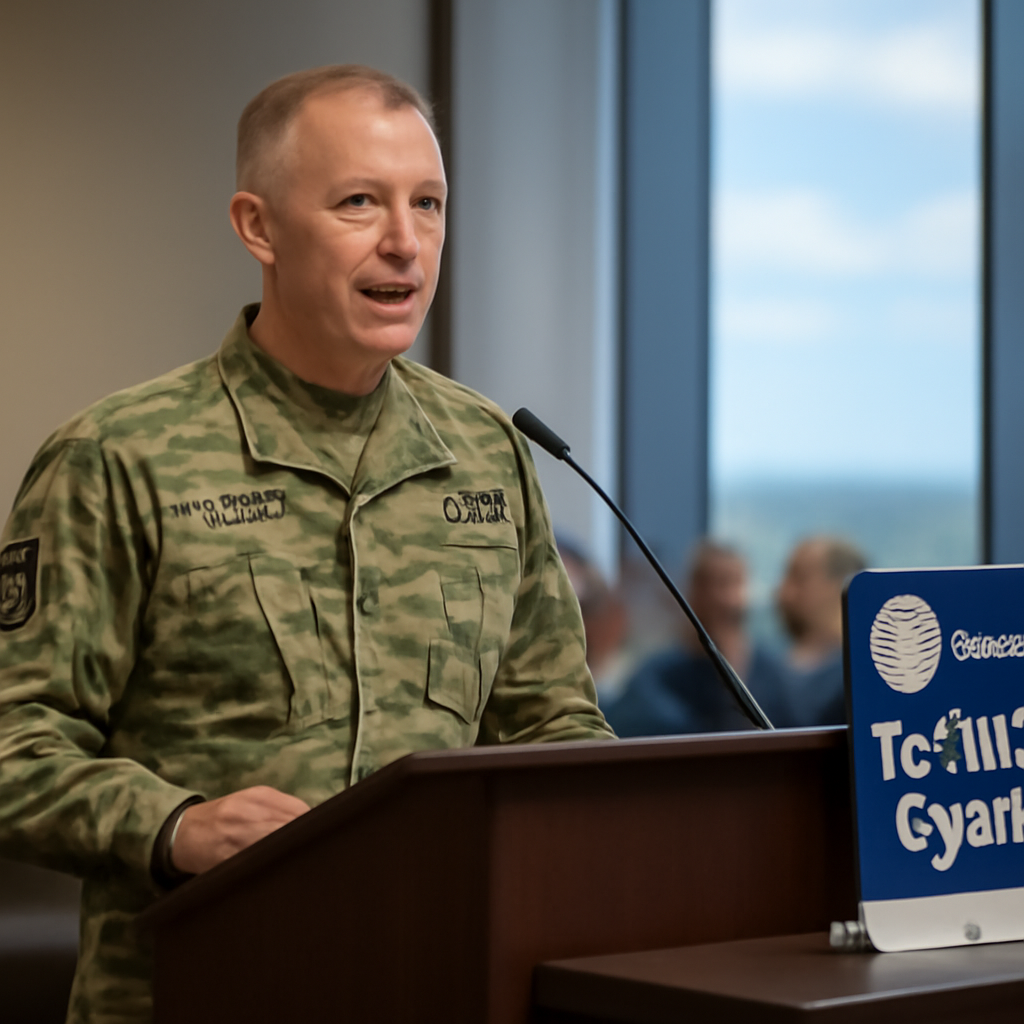
"It's going to take all of us." — Lt. Gen. Paul Stanton, Department of War Cyber Defense Command commander and DISA director.
DISA's modernization priorities set the agenda
Across AFCEA International TechNet Cyber 2026, attendees repeatedly returned to the priorities Lt. Gen. Paul Stanton outlined in his keynote. Stanton — described in conference materials as the Department of War Cyber Defense Command commander and DISA director — framed modernization as a collaborative project between government and industry: “I look forward to working with you, to being on the team alongside you, because quite frankly, our nation needs us.”
That message resonated on the show floor. Vendors and agencies focused less on isolated point products and more on platforms and architectures intended to improve interoperability and speed decision-making across enterprise mission sets. As Ben Hayth of Cloudflare observed, customers are trying to “connect the dots across a very large ecosystem of technologies, partners, and mission requirements,” a challenge that underpins many modernization debates at the event.
Artificial intelligence: deployment, governance, and defense
AI dominated conversations not as an abstract possibility but as a technology agencies are preparing to run in production. Stanton warned that “the speed, scope and scale of frontier AI models will significantly change the way that we approach delivering warfighting capabilities and securing them for our nation,” and conference participants treated that as an operational imperative: build the infrastructure to host AI securely and at scale.
Anwar Mallory of Cloudflare said AI surfaced “in conversations across nearly every mission area represented at the conference,” from cyber operations to network management and mission planning. That shift — from piloting to integrating AI into mission environments — was matched by a growing focus on securing AI systems themselves. Project Glasswing, which brings together leading AI companies, cybersecurity providers, and government partners to identify vulnerabilities in frontier AI models, was cited as an example of efforts to advance innovation alongside security and resilience.

Audit-ready is a season. It shouldn't be.
Evidence in spreadsheets, controls drifting between audits, frameworks multiplying on flat headcount. Nubivance runs continuous compliance on Rapid7 Cyber GRC - SOC 2, HIPAA, ISO 27001, PCI, CMMC.
End the scramblePost-quantum cryptography moves into the near-term playbook
Just days after President Trump signed an executive order advancing federal post-quantum cryptography (PQC) timelines, PQC emerged at TechNet Cyber as a pressing operational priority. Ben Hayth said “post-quantum cryptography was almost as hot a topic as AI,” and reported that senior leads were focused on “how they prepare for the transition and what steps they need to take now to protect data and communications.”
That urgency reflects concerns about “harvest now, decrypt later” attacks — adversaries collecting encrypted information today with the expectation of decrypting it once quantum capabilities mature — and the executive order’s role in accelerating agency timelines. Conference conversations emphasized practical migration questions and the need for concrete guidance for defense organizations seeking quantum-resistant communications.
Operational resilience: visibility, connectivity, and Zero Trust
Resilience framed much of the technical discussion: threat intelligence, internet-scale visibility, and modern connectivity were presented as complementary levers to improve mission outcomes. Mallory stressed the value of combining existing threat intelligence with broad visibility, saying, “We talked with a number of organizations about the value of combining their existing intelligence with visibility into a significant portion of global internet traffic.”
Zero Trust and network modernization reappeared as necessary elements of that resilience. Hayth said organizations are trying to “simplify and modernize their environments without sacrificing security,” while seeking architectures that support both enterprise and tactical missions. Nick Andersen, Acting Director of the Cybersecurity and Infrastructure Agency, reinforced the public-facing purpose of that work: “The American people have given special trust and confidence in us as their government to look out for their resilience.”
How government, industry, and defense organizations are responding
- Government (agencies and DISA leadership): moving from strategy to coordinated programs — prioritizing interoperable platforms, accelerated PQC timelines following the executive order, and infrastructure to host frontier AI.
- Industry (Cloudflare, AI companies, cybersecurity providers): focusing on operationalizing AI, integrating Zero Trust, and offering visibility at internet scale; companies are partnering in initiatives such as Project Glasswing to harden models.
- Defense organizations and mission teams: seeking practical guidance for PQC migration, looking to replace legacy connectivity models with agile architectures that support distributed operations and faster decision cycles.
TechNet Cyber 2026 showed a defense community shifting from concept to execution: AI and PQC are no longer distant conversations, Zero Trust and network transformation are practical requirements, and resilience is judged by visibility and adaptability rather than gates and guards alone. As Lt. Gen. Stanton put it to attendees, “readiness is the foundation.” The work now is to build that foundation in ways that keep pace with rapid policy changes, emerging threats, and the technologies they aim to enable.
Original story: The Road to Readiness: Insights from TechNet Cyber 2026